19 Nov 2007
Pascoe comes to grips with the Don
Mozart made it easy for the Philistines. They see Don Giovanni thrown into the flaming jaws of Hell and hiss: “Two thousand women seduced and abandoned! “
English Touring Opera are delighted to announce a season of lyric monodramas to tour nationally from October to December. The season features music for solo singer and piano by Argento, Britten, Tippett and Shostakovich with a bold and inventive approach to making opera during social distancing.
This tenth of ten Live from London concerts was in fact a recorded live performance from California. It was no less enjoyable for that, and it was also uplifting to learn that this wasn’t in fact the ‘last’ LfL event that we will be able to enjoy, courtesy of VOCES8 and their fellow vocal ensembles (more below …).
Ever since Wigmore Hall announced their superb series of autumn concerts, all streamed live and available free of charge, I’d been looking forward to this song recital by Ian Bostridge and Imogen Cooper.
Although Stile Antico’s programme article for their Live from London recital introduced their selection from the many treasures of the English Renaissance in the context of the theological debates and upheavals of the Tudor and Elizabethan years, their performance was more evocative of private chamber music than of public liturgy.
Evidently, face masks don’t stifle appreciative “Bravo!”s. And, reducing audience numbers doesn’t lower the volume of such acclamations. For, the audience at Wigmore Hall gave soprano Elizabeth Llewellyn and pianist Simon Lepper a greatly deserved warm reception and hearty response following this lunchtime recital of late-Romantic song.
For this week’s Live from London vocal recital we moved from the home of VOCES8, St Anne and St Agnes in the City of London, to Kings Place, where The Sixteen - who have been associate artists at the venue for some time - presented a programme of music and words bound together by the theme of ‘reflection’.
'Such is your divine Disposation that both you excellently understand, and royally entertaine the Exercise of Musicke.’
‘And there was war in heaven: Michael and his angels fought against the dragon; and the dragon fought and his angels, And prevailed not; neither was their place found any more in heaven … that old serpent … Satan, which deceiveth the whole world: he was cast out into the earth, and his angels were cast out with him.’
There was never any doubt that the fifth of the twelve Met Stars Live in Concert broadcasts was going to be a palpably intense and vivid event, as well as a musically stunning and theatrically enervating experience.
‘Love’ was the theme for this Live from London performance by Apollo5. Given the complexity and diversity of that human emotion, and Apollo5’s reputation for versatility and diverse repertoire, ranging from Renaissance choral music to jazz, from contemporary classical works to popular song, it was no surprise that their programme spanned 500 years and several musical styles.
The Academy of St Martin in the Fields have titled their autumn series of eight concerts - which are taking place at 5pm and 7.30pm on two Saturdays each month at their home venue in Trafalgar Square, and being filmed for streaming the following Thursday - ‘re:connect’.
The London Symphony Orchestra opened their Autumn 2020 season with a homage to Oliver Knussen, who died at the age of 66 in July 2018. The programme traced a national musical lineage through the twentieth century, from Britten to Knussen, on to Mark-Anthony Turnage, and entwining the LSO and Rattle too.
With the Live from London digital vocal festival entering the second half of the series, the festival’s host, VOCES8, returned to their home at St Annes and St Agnes in the City of London to present a sequence of ‘Choral Dances’ - vocal music inspired by dance, embracing diverse genres from the Renaissance madrigal to swing jazz.
Just a few unison string wriggles from the opening of Mozart’s overture to Le nozze di Figaro are enough to make any opera-lover perch on the edge of their seat, in excited anticipation of the drama in music to come, so there could be no other curtain-raiser for this Gala Concert at the Royal Opera House, the latest instalment from ‘their House’ to ‘our houses’.
"Before the ending of the day, creator of all things, we pray that, with your accustomed mercy, you may watch over us."
The doors at The Metropolitan Opera will not open to live audiences until 2021 at the earliest, and the likelihood of normal operatic life resuming in cities around the world looks but a distant dream at present. But, while we may not be invited from our homes into the opera house for some time yet, with its free daily screenings of past productions and its pay-per-view Met Stars Live in Concert series, the Met continues to bring opera into our homes.
Music-making at this year’s Grange Festival Opera may have fallen silent in June and July, but the country house and extensive grounds of The Grange provided an ideal setting for a weekend of twelve specially conceived ‘promenade’ performances encompassing music and dance.
There’s a “slide of harmony” and “all the bones leave your body at that moment and you collapse to the floor, it’s so extraordinary.”
“Music for a while, shall all your cares beguile.”
The hum of bees rising from myriad scented blooms; gentle strains of birdsong; the cheerful chatter of picnickers beside a still lake; decorous thwacks of leather on willow; song and music floating through the warm evening air.
Mozart made it easy for the Philistines. They see Don Giovanni thrown into the flaming jaws of Hell and hiss: “Two thousand women seduced and abandoned! “
He was a bad man and he got what he deserved!” But did Mozart really see it this way? Could he have written the music that he did for this man without a strong sense of identification - without a sympathy rooted in his own experience of life?
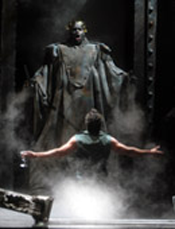
In the staging of “Don Giovanni” at the Washington National Opera this fall, John Pascoe might not answer this question, but it’s clear that he — both director and designer of the handsome production — hardly takes a Bible-belt view of the Don and his fate. But what does Pascoe do to make this an unusually absorbing staging? And does he get this all-time Casanova off the red-hot spikes on which he is impaled on stage by Satan’s minions? (Remember that in “Man and Superman” Shaw sends Giovanni to Heaven, where he is bored by all the lily-white Goodness and spends his days lounging in Hell, where life is far more interesting.)
All of us — women and men alike — want to be Giovanni or be seduced by him, Pascoe writes, outlining his approach to the opera. And in comments on the WNO production, the seeds of which were sown in a 2003 staging while the company was “in exile” in Constitution Hall during the renovation of its Kennedy Center home, Pascoe points to the distinction between the Don as seducer and the Don as a demonic individual. “He should not be a demon figure,” the director writes. “He has to be an incredibly seductive figure . . . looking like a magnificent sexually driven animal in the first act.”
But losing oneself in interpretative speculation at this point overlooks the overwhelming excellence of the performance seen on November 13. “Giovanni” is a long opera of many scenes that easily become piecemeal in lesser hands. Pascoe picks up on the dramatic drive of the score in the opening D Minor chords of the overture and sustains this throughout both acts of the opera until the tension is broken by the epilogue the follows the Don’s demise.
One sits for three hours as if facing a headwind that blows with passionate velocity from stage and orchestra pit, where WNO assistant conductor Israel Gursky made his main-stage debut as a man closely attune to Pascoe’s concept of the work. (WNO general director Placido Domingo had conducted the first six of eight “Giovanni” performances.)
Although Pascoe opts for an essentially timeless approach in sets and costumes, references to Franco’s Spain place the story in an era of turbulence and repression. And his designs bring to the Kennedy Center stage a sense of cosmic space that enhances the universality of the story. The dark clouds that gather at the end of Leporello’s “catalogue” aria — to cite one example — clearly foretell the Don’s doom.
Uruguayan bass Erwin Schrott, a leading Don of the day, was replaced in final performances of the run by Ildar Abdrazakov, who had sung Leporello to Schrott’s Don. His older brother Askar then took over the servant role. (Although Askar is the elder by seven years, the sibling collaboration recalls Peter Sellars’ 1991 casting of identical twins Herbert and Eugene Parry in these roles.)
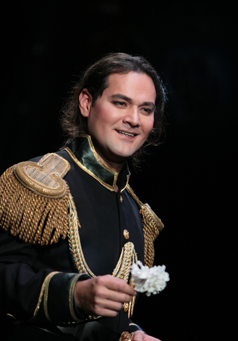 Ildar Abdrazakov (Don Giovanni)
The brothers, born in Bashkortostan, have those huge, wonderfully rich and resonant voices unique to Russian singers and are perfectly paired in these roles. Ildar has the dash and daring of an ideal Don, whom he makes a study in internal combustion set to music. Askar stresses Leporello’s awareness that he is hopelessly caught in the web of his master’s desires. (Ildar, by the way, is married to top Russian mezzo Olga Borodina.)
Although Mozart buffs have long argued whether Donna Anna or Donna Elvira is the more important woman in this drama, for Pascoe Elvira is the frontrunner, and he supports his view by bringing her on stage with a baby in arms. “I want the audience to feel as though Don Giovanni and Donna Elvira are a lion and lioness who have been apart from each other,” the director states, “and who are in love with each other in a very deep and passionate manner.” In other words, had the Don stood still long enough to realize it, Elvira was the woman who might have sated his appetite.
And German soprano Anja Kampe, WNO’s resident Sieglinde, has the strength of voice and personality to make her the equal of the Don. As an elegant Anna, on the other hand, Canada’s Erin Wall is fired by an unrelenting desire for revenge, and Pascoe’s costumes give her a feline ferocity — with claws extended. And in Canadian tenor John Tessler she has at her side an Ottavio far removed from the Milquetoast figure that her fiancé commonly is. One is grateful that both his arias are included in the staging.
Amanda Squitieriz and James Shaffran are charmingly innocent as peasants Zerlina and Masetto. And as the Commendatore Morris Robinson is a chilling basso profundo in the cemetery scene. Denmark’s pre-existentialist Søren Kierkegaard (1813-1855) was among the first to look beneath the surface of “Don Giovanni,” seeing there the parallels between the title figure and Goethe’s Faust. In “Either/Or” the “melancholy Dane,” a theologian by training, distinguishes between the “sensuous genius” of the Don and the “intellectual genius” of Goethe’s hero.
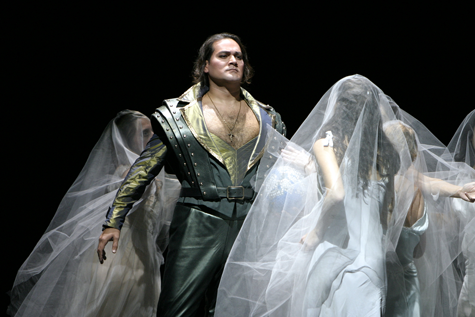 Ildar Abdrazakov (Don Giovanni)
And the suggestion is clear that while Faust’s quest is for a single incarnation of “the eternally feminine” — “das Ewig-Weibliche,” the Don seeks rather to compose a mosaic, in which an infinite number of women merge. Although Goethe (1749-1832) lived both long before and long after Mozart, they were contemporaries. Indeed, Goethe repeatedly staged “The Magic Flute” at his Weimar theater and even attempted to write a sequel to the story. And when approached by composers eager to make an opera of “Faust,” he waved them off, saying that only “the composer of ‘Don Giovanni’” would be equal to that task.
British-born Pascoe, a man with 30 years experience in opera, has brought a “Giovanni” both beautiful and musically fulfilling to Washington National Opera. And he would agree, one thinks, with Kierkegaard’s conclusion that if he were ever to understand Mozart, he would know that he is mad, for no one will ever completely understand Mozart.
Wes Blomster