11 Nov 2007
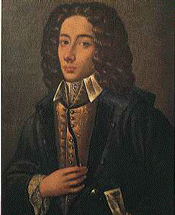
Preparing G.B. Pergolesi’s tercentenary — with a fair advance
A notice for organizers: it’s relatively easy to produce a vocal recital and sell out a large house for two nights in a row.
English Touring Opera are delighted to announce a season of lyric monodramas to tour nationally from October to December. The season features music for solo singer and piano by Argento, Britten, Tippett and Shostakovich with a bold and inventive approach to making opera during social distancing.
This tenth of ten Live from London concerts was in fact a recorded live performance from California. It was no less enjoyable for that, and it was also uplifting to learn that this wasn’t in fact the ‘last’ LfL event that we will be able to enjoy, courtesy of VOCES8 and their fellow vocal ensembles (more below …).
Ever since Wigmore Hall announced their superb series of autumn concerts, all streamed live and available free of charge, I’d been looking forward to this song recital by Ian Bostridge and Imogen Cooper.
Although Stile Antico’s programme article for their Live from London recital introduced their selection from the many treasures of the English Renaissance in the context of the theological debates and upheavals of the Tudor and Elizabethan years, their performance was more evocative of private chamber music than of public liturgy.
Evidently, face masks don’t stifle appreciative “Bravo!”s. And, reducing audience numbers doesn’t lower the volume of such acclamations. For, the audience at Wigmore Hall gave soprano Elizabeth Llewellyn and pianist Simon Lepper a greatly deserved warm reception and hearty response following this lunchtime recital of late-Romantic song.
For this week’s Live from London vocal recital we moved from the home of VOCES8, St Anne and St Agnes in the City of London, to Kings Place, where The Sixteen - who have been associate artists at the venue for some time - presented a programme of music and words bound together by the theme of ‘reflection’.
'Such is your divine Disposation that both you excellently understand, and royally entertaine the Exercise of Musicke.’
‘And there was war in heaven: Michael and his angels fought against the dragon; and the dragon fought and his angels, And prevailed not; neither was their place found any more in heaven … that old serpent … Satan, which deceiveth the whole world: he was cast out into the earth, and his angels were cast out with him.’
There was never any doubt that the fifth of the twelve Met Stars Live in Concert broadcasts was going to be a palpably intense and vivid event, as well as a musically stunning and theatrically enervating experience.
‘Love’ was the theme for this Live from London performance by Apollo5. Given the complexity and diversity of that human emotion, and Apollo5’s reputation for versatility and diverse repertoire, ranging from Renaissance choral music to jazz, from contemporary classical works to popular song, it was no surprise that their programme spanned 500 years and several musical styles.
The Academy of St Martin in the Fields have titled their autumn series of eight concerts - which are taking place at 5pm and 7.30pm on two Saturdays each month at their home venue in Trafalgar Square, and being filmed for streaming the following Thursday - ‘re:connect’.
The London Symphony Orchestra opened their Autumn 2020 season with a homage to Oliver Knussen, who died at the age of 66 in July 2018. The programme traced a national musical lineage through the twentieth century, from Britten to Knussen, on to Mark-Anthony Turnage, and entwining the LSO and Rattle too.
With the Live from London digital vocal festival entering the second half of the series, the festival’s host, VOCES8, returned to their home at St Annes and St Agnes in the City of London to present a sequence of ‘Choral Dances’ - vocal music inspired by dance, embracing diverse genres from the Renaissance madrigal to swing jazz.
Just a few unison string wriggles from the opening of Mozart’s overture to Le nozze di Figaro are enough to make any opera-lover perch on the edge of their seat, in excited anticipation of the drama in music to come, so there could be no other curtain-raiser for this Gala Concert at the Royal Opera House, the latest instalment from ‘their House’ to ‘our houses’.
"Before the ending of the day, creator of all things, we pray that, with your accustomed mercy, you may watch over us."
The doors at The Metropolitan Opera will not open to live audiences until 2021 at the earliest, and the likelihood of normal operatic life resuming in cities around the world looks but a distant dream at present. But, while we may not be invited from our homes into the opera house for some time yet, with its free daily screenings of past productions and its pay-per-view Met Stars Live in Concert series, the Met continues to bring opera into our homes.
Music-making at this year’s Grange Festival Opera may have fallen silent in June and July, but the country house and extensive grounds of The Grange provided an ideal setting for a weekend of twelve specially conceived ‘promenade’ performances encompassing music and dance.
There’s a “slide of harmony” and “all the bones leave your body at that moment and you collapse to the floor, it’s so extraordinary.”
“Music for a while, shall all your cares beguile.”
The hum of bees rising from myriad scented blooms; gentle strains of birdsong; the cheerful chatter of picnickers beside a still lake; decorous thwacks of leather on willow; song and music floating through the warm evening air.
A notice for organizers: it’s relatively easy to produce a vocal recital and sell out a large house for two nights in a row.
All you need is three (good) singers and a youth orchestra that, with a bit of a squeeze, can be fitted into an estate car. Plus, of course, a starry conductor, a living myth whose very presence on the podium is enough to make news. After several cancellations due to his state of health, old glory Claudio Abbado is back again from a convalescence of two months in sunny Sardinia, apparently in good shape and in a relaxed state of mind. On November 6-7, at Bologna’s Teatro Manzoni, he led an all-Pergolesi recital inaugurating the extended celebrations for the birth tercentenary of the ‘Neapolitan’ master, who actually saw the light of day on Jan 4, 1710, rather far from the Vesuvius: in Jesi by Ancona, then a part of the Papal States and a hot district for opera. In fact, motors of the venture are the Jesi-based ‘Fondazione Pergolesi Spontini’ (thus named for both composers, who were born only a few miles apart) and Bologna’s Orchestra Mozart, since 2004 Abbado’s pet creature.
Halfway between chamber and symphony ensemble, the Orchestra Mozart includes some forty instrumentalists aged 17-25, plus five experienced principals. A selection of 17 players — budding professionals from several countries who are still practising, with some residual degree of compromise as to strings and bows, on period instruments — tackled the Concerto in B flat for violin, strings and continuo, one among the handful of instrumental works whose Pergolesi authorship has been validated by recent research. Curiously, it’s written in a Venetian style closely resembling Vivaldi’s; so Giuliano Carmignola, the concert master who ranks as a specialist in the field, sounded quite at ease in his most familiar territory, despite a venial slip at the very start.
Until this point, Abbado kept a non-committal attitude, mostly mirroring Carmignola’s tempo choices with smiling nods and subtle gestures that seemed to highlight the structural framework just for the audience’s benefit. He definitely took the lead in the following Salve Regina, featuring soprano Julia Kleiter in the solo part. Though not an adept of flamboyant singing, Kleiter commands crystal-clear uttering, fine legato, sensitive dynamic, precise intonation even in treacherous chromatic passages (such as those found at ‘misericordes oculos’). Her weak point resides in the passage to the upper register, ending in explosive high notes after a transient black hole.
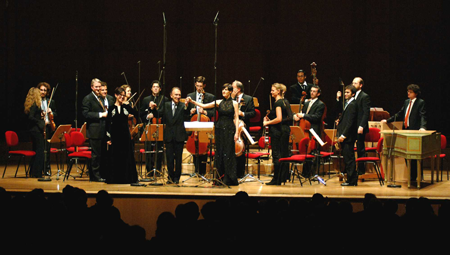
Two terrific primadonnas then stepped in for the celebrated Stabat Mater: soprano Rachel Harnisch and alto Sara Mingardo. Widely diverse in their looks, the skinny, nervous Austrian brunette and the motherly Italian newly donning henna-colored hairdoes and professoral spectacles, share panache, deep understanding of the sung text and sophisticated technical strokes. Harnisch, notable for her sustained clarion tones throughout, ignited trills and downward appoggiaturas of penetrating dramatic strength, such as in the famed ‘pertransivit gladius’. Mingardo deployed her bronze-polished centers in all their might, stretching down without apparent effort to cavernous bassoon-like notes and then soaring backward to the highest peaks. (A non-written cadenza in ‘Fac ut portem Christi mortem’ was particularly astonishing to that respect).
Without ever stealing the show, Abbado kept the primadonnas together in strict duo textures, while launching vigorous contrapuntal sections with his typical blend of passion and clarity, all in the right places. The final chord in the ‘Amen’ fugue plunged the spellbound hall into silence for a seemingly endless while. Ovations, stamping and (unfulfilled) calls for encores ensued. Yet, after a moment of such perfection, little could be added to the experience.
Carlo Vitali