11 Nov 2007
Verdiland Revisited
Since his appointment as general manager of Parma’s Teatro Regio in August 2005, Mauro Meli didn’t conceal his ambitious plans for growth.
English Touring Opera are delighted to announce a season of lyric monodramas to tour nationally from October to December. The season features music for solo singer and piano by Argento, Britten, Tippett and Shostakovich with a bold and inventive approach to making opera during social distancing.
This tenth of ten Live from London concerts was in fact a recorded live performance from California. It was no less enjoyable for that, and it was also uplifting to learn that this wasn’t in fact the ‘last’ LfL event that we will be able to enjoy, courtesy of VOCES8 and their fellow vocal ensembles (more below …).
Ever since Wigmore Hall announced their superb series of autumn concerts, all streamed live and available free of charge, I’d been looking forward to this song recital by Ian Bostridge and Imogen Cooper.
Although Stile Antico’s programme article for their Live from London recital introduced their selection from the many treasures of the English Renaissance in the context of the theological debates and upheavals of the Tudor and Elizabethan years, their performance was more evocative of private chamber music than of public liturgy.
Evidently, face masks don’t stifle appreciative “Bravo!”s. And, reducing audience numbers doesn’t lower the volume of such acclamations. For, the audience at Wigmore Hall gave soprano Elizabeth Llewellyn and pianist Simon Lepper a greatly deserved warm reception and hearty response following this lunchtime recital of late-Romantic song.
For this week’s Live from London vocal recital we moved from the home of VOCES8, St Anne and St Agnes in the City of London, to Kings Place, where The Sixteen - who have been associate artists at the venue for some time - presented a programme of music and words bound together by the theme of ‘reflection’.
'Such is your divine Disposation that both you excellently understand, and royally entertaine the Exercise of Musicke.’
‘And there was war in heaven: Michael and his angels fought against the dragon; and the dragon fought and his angels, And prevailed not; neither was their place found any more in heaven … that old serpent … Satan, which deceiveth the whole world: he was cast out into the earth, and his angels were cast out with him.’
There was never any doubt that the fifth of the twelve Met Stars Live in Concert broadcasts was going to be a palpably intense and vivid event, as well as a musically stunning and theatrically enervating experience.
‘Love’ was the theme for this Live from London performance by Apollo5. Given the complexity and diversity of that human emotion, and Apollo5’s reputation for versatility and diverse repertoire, ranging from Renaissance choral music to jazz, from contemporary classical works to popular song, it was no surprise that their programme spanned 500 years and several musical styles.
The Academy of St Martin in the Fields have titled their autumn series of eight concerts - which are taking place at 5pm and 7.30pm on two Saturdays each month at their home venue in Trafalgar Square, and being filmed for streaming the following Thursday - ‘re:connect’.
The London Symphony Orchestra opened their Autumn 2020 season with a homage to Oliver Knussen, who died at the age of 66 in July 2018. The programme traced a national musical lineage through the twentieth century, from Britten to Knussen, on to Mark-Anthony Turnage, and entwining the LSO and Rattle too.
With the Live from London digital vocal festival entering the second half of the series, the festival’s host, VOCES8, returned to their home at St Annes and St Agnes in the City of London to present a sequence of ‘Choral Dances’ - vocal music inspired by dance, embracing diverse genres from the Renaissance madrigal to swing jazz.
Just a few unison string wriggles from the opening of Mozart’s overture to Le nozze di Figaro are enough to make any opera-lover perch on the edge of their seat, in excited anticipation of the drama in music to come, so there could be no other curtain-raiser for this Gala Concert at the Royal Opera House, the latest instalment from ‘their House’ to ‘our houses’.
"Before the ending of the day, creator of all things, we pray that, with your accustomed mercy, you may watch over us."
The doors at The Metropolitan Opera will not open to live audiences until 2021 at the earliest, and the likelihood of normal operatic life resuming in cities around the world looks but a distant dream at present. But, while we may not be invited from our homes into the opera house for some time yet, with its free daily screenings of past productions and its pay-per-view Met Stars Live in Concert series, the Met continues to bring opera into our homes.
Music-making at this year’s Grange Festival Opera may have fallen silent in June and July, but the country house and extensive grounds of The Grange provided an ideal setting for a weekend of twelve specially conceived ‘promenade’ performances encompassing music and dance.
There’s a “slide of harmony” and “all the bones leave your body at that moment and you collapse to the floor, it’s so extraordinary.”
“Music for a while, shall all your cares beguile.”
The hum of bees rising from myriad scented blooms; gentle strains of birdsong; the cheerful chatter of picnickers beside a still lake; decorous thwacks of leather on willow; song and music floating through the warm evening air.
Since his appointment as general manager of Parma’s Teatro Regio in August 2005, Mauro Meli didn’t conceal his ambitious plans for growth.
‘My presence here — he declared on entering office — is linked to Parma’s ongoing process of internationalization [as official seat of the European Union’s Food Authority]. It’s high time that Parma, by merging its many resources, does for Verdi what Salzburg did for Mozart or Bayreuth for Wagner. The Regio will spearhead the building of a cultural district of international appeal’. Besides the regular Winter season, since 1913 a highlight in the billboard is the Festival Verdi, named for Parma’s illustrious son and usually running in late Spring. For organizational reasons, this year it was postponed by a few months, thus allowing to center its timeline around the Maestro’s birthday anniversary (October 10), and to recruit into the project such neighboring towns as Modena, Reggio Emilia and Busseto under the logo ‘Le terre di Verdi’ [Verdi’s lands]. Number of events and attendance both profited from the innovation; as to artistic quality, new entries like Riccardo Muti, Yuri Temirkanov, Denis Krief, witness enough to the festival’s productive effort.
In the same vein of Salzburg and Bayreuth, the Parma series embraced the philosophy of completism, aligning established masterpieces alongside rarely performed works. Is the young Verdi underrated? Even among the composer’s staunchest fans there is a feeling that some apology needs to be made for such early operas as Alzira, Stiffelio or Giovanna d’Arco. However, this is hardly the case for Oberto, conte di San Bonifacio, the 1839 opera marking Verdi’s debut at La Scala. It lacks neither memorable tunes, nor a surprising instinct for drama, nor the depiction of strongly individualized characters. Also a towering father’s figure — a feature due to acquire so much momentum in Verdi’s later dramaturgy — is already there. Sure, the dark color of cloak-and-dagger drama is a bit conventional and less psychologically nuanced than — say — in Simon Boccanegra or Don Carlo; yet, compared to the average output of Mercadante or Donizetti in the same genre and at approximately the same time, Oberto can stand up to the benchmark — maybe a few inches above it.
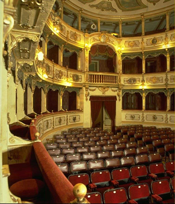
Anyway, offering a run of seven nights for Oberto (nowadays mostly a fare for CD collectors) sounded all too confident, particularly considering the venue: the cosy Teatro Verdi in Busseto, a small town some 40 kms northwest of Parma, roughly midway between the roadside inn at Roncole, where Giuseppe saw the light of day, and Sant’Agata, the country estate he built out of his musical industry. In the event, all of the house’s 307 seats were regularly sold out, with standing rooms impartially used to accommodate those local socialites, globalized opera tramps and critics from far-away places who had failed to make timely reservations.
The Florentine director Pier’Alli, also in charge of sets, costumes and lighting, is reputed as the ultimate Oberto specialist worldwide. His new production, adapted to fit the small stage, stems from those already seen at Macerata in July 1999 and at Genua in October 2002, whose basic concept may be summarized as ‘moderate disbelief’. The characters’ geometric and emphatic gesticulations, not unlike a Greek tragedy staged at Epidaurum by some Balinese coreographer who earned his master from the Comédie Française, are less and less impressive as time goes by, since he tends to peruse them in any possible context. However, his sets are both simple and effective: a semicircle of rotating panels showing in turns tainted mirrors, walls, gilded hyper-baroque friezes, castle gates and more. As to the costumes, their dominant note points towards the 1830-40s, which could possibly amount to a (once more) ‘moderate’ updating from the original 13th century to the score’s time of composition. We have already seen such and worse applications of the time-machine gimmick — once in a while not without arguably good grounds. A judicious use of extras, as well as the choir’s partial displacement in a number of front boxes and in various locations within the hall so to provide stereo effects, were also to be counted as added value.
Despite the house’s crisp acoustics (highly defined, with a fast decay not giving approximation the slightest chance) the said choir and the forty-odd Regio instrumentalists squeezed into the pit delivered a flawless performance under the lively and finely-tuned tempo choices of Antonello Allemandi. He and the Bulgarian mezzo Mariana Pentcheva, impersonating Cuniza, reaped salvos of applause from an enthusiatic audience. Having not heard Pentcheva for quite some time, I was apprehensive about how she might curb her powerful and owerflowing (once Soviet-style) organ in such belcanto highlights as the Rossini-like cabaletta ‘Più che i vezzi e lo splendore’ at the beginning of Act II. Well, I gladly avow that I was wrong. Without losing anything of her usual firm intonation, polished dark color and authoritative acting, she seems to have now acquired a more mature style awareness and all the desirable fineries in utterance.
The same is unfortunately not true for Fabio Sartori as the treacherous (but in the end repentant) count Riccardo, although his beefy tenor and sustained clarion notes provided elementary excitement. He might well aspire to heavier roles, provided he refines his dynamics — and loses some weight. Soprano Irene Cerboncini’s undeniable acting sophistication doesn’t match her poor breath control, sometimes leading her astray in phrase endings. Her Leonora featured an irritating mixture of natural talent, good looks and imperfect pitch in the lower range. With imposing physical vigor and uncommon accuracy in arioso and recitative passages, Paolo Battaglia (Oberto) made up a noble loser; a defiant old gentleman-cum-bass partly in the mould of Mozart’s Commendatore. But the company’s strong point was indeed in their ensemble numbers: the finale of Act I, starting in a menacefully subdued tone and developing in continuous crescendo through multiple twist and turns, ended in a stormy stretta of wild energetic impact, arguably beyond the composer’s intention, yet much appreciated by the audience.
Carlo Vitali