Recently in Performances
English Touring Opera are delighted to announce a season of lyric monodramas to tour nationally from October to December. The season features music for solo singer and piano by Argento, Britten, Tippett and Shostakovich with a bold and inventive approach to making opera during social distancing.
This tenth of ten Live from London concerts was in fact a recorded live performance from California. It was no less enjoyable for that, and it was also uplifting to learn that this wasn’t in fact the ‘last’ LfL event that we will be able to enjoy, courtesy of VOCES8 and their fellow vocal ensembles (more below …).
Ever since Wigmore Hall announced their superb series of autumn concerts, all streamed live and available free of charge, I’d been looking forward to this song recital by Ian Bostridge and Imogen Cooper.
Although Stile Antico’s programme article for their Live from London recital introduced their selection from the many treasures of the English Renaissance in the context of the theological debates and upheavals of the Tudor and Elizabethan years, their performance was more evocative of private chamber music than of public liturgy.
Evidently, face masks don’t stifle appreciative “Bravo!”s. And, reducing audience numbers doesn’t lower the volume of such acclamations. For, the audience at Wigmore Hall gave soprano Elizabeth Llewellyn and pianist Simon Lepper a greatly deserved warm reception and hearty response following this lunchtime recital of late-Romantic song.
For this week’s Live from London vocal recital we moved from the home of VOCES8, St Anne and St Agnes in the City of London, to Kings Place, where The Sixteen - who have been associate artists at the venue for some time - presented a programme of music and words bound together by the theme of ‘reflection’.
'Such is your divine Disposation that both you excellently understand, and royally entertaine the Exercise of Musicke.’
‘And there was war in heaven: Michael and his angels fought against the dragon; and the dragon fought and his angels, And prevailed not; neither was their place found any more in heaven … that old serpent … Satan, which deceiveth the whole world: he was cast out into the earth, and his angels were cast out with him.’
There was never any doubt that the fifth of the twelve Met Stars Live in Concert broadcasts was going to be a palpably intense and vivid event, as well as a musically stunning and theatrically enervating experience.
‘Love’ was the theme for this Live from London performance by Apollo5. Given the complexity and diversity of that human emotion, and Apollo5’s reputation for versatility and diverse repertoire, ranging from Renaissance choral music to jazz, from contemporary classical works to popular song, it was no surprise that their programme spanned 500 years and several musical styles.
The Academy of St Martin in the Fields have titled their autumn series of eight concerts - which are taking place at 5pm and 7.30pm on two Saturdays each month at their home venue in Trafalgar Square, and being filmed for streaming the following Thursday - ‘re:connect’.
The London Symphony Orchestra opened their Autumn 2020 season with a homage to Oliver Knussen, who died at the age of 66 in July 2018. The programme traced a national musical lineage through the twentieth century, from Britten to Knussen, on to Mark-Anthony Turnage, and entwining the LSO and Rattle too.
With the Live from London digital vocal festival entering the second half of the series, the festival’s host, VOCES8, returned to their home at St Annes and St Agnes in the City of London to present a sequence of ‘Choral Dances’ - vocal music inspired by dance, embracing diverse genres from the Renaissance madrigal to swing jazz.
Just a few unison string wriggles from the opening of Mozart’s overture to Le nozze di Figaro are enough to make any opera-lover perch on the edge of their seat, in excited anticipation of the drama in music to come, so there could be no other curtain-raiser for this Gala Concert at the Royal Opera House, the latest instalment from ‘their House’ to ‘our houses’.
"Before the ending of the day, creator of all things, we pray that, with your accustomed mercy, you may watch over us."
The doors at The Metropolitan Opera will not open to live audiences until 2021 at the earliest, and the likelihood of normal operatic life resuming in cities around the world looks but a distant dream at present. But, while we may not be invited from our homes into the opera house for some time yet, with its free daily screenings of past productions and its pay-per-view Met Stars Live in Concert series, the Met continues to bring opera into our homes.
Music-making at this year’s Grange Festival Opera may have fallen silent in June and July, but the country house and extensive grounds of The Grange provided an ideal setting for a weekend of twelve specially conceived ‘promenade’ performances encompassing music and dance.
There’s a “slide of harmony” and “all the bones leave your body at that moment and you collapse to the floor, it’s so extraordinary.”
“Music for a while, shall all your cares beguile.”
The hum of bees rising from myriad scented blooms; gentle strains of birdsong; the cheerful chatter of picnickers beside a still lake; decorous thwacks of leather on willow; song and music floating through the warm evening air.
Performances
18 Dec 2007
Belfast welcomes a first-rate Messiah
If Belfast in Northern Ireland isn’t a city that immediately springs to mind as a centre of musical excellence then it’s not for want of talent, initiative and professionalism within its cultural community.
It is also a
city busy re-inventing itself after decades of internecine strife and is now
buzzing with the optimism and investment that is part of the “peace
dividend”. At a time of year when many cities in the UK and USA are
churning out moderate and sometimes frankly embarrassing renditions of
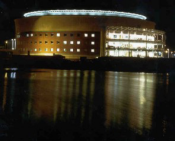
Handel’s great work it was a delight to see last Saturday night that the
Ulster Orchestra, under the forward-thinking guidance of Chief Executive
David Byers, had invited a top flight international conductor with excellent
baroque credentials to meld the undoubted talents of its musicians and chorus
with some world class soloists.
Martin Haselböck holds the titles of Vienna Court Organist (shades of
Hapsburg splendour there) and Professor of Organ at the University of Vienna,
but it is his work throughout Europe and the USA (he’s recently been
appointed Music Director of the baroque “Musica Angelica” in Los Angeles)
as a conductor of baroque opera and orchestras that he is best known perhaps.
With just a couple of days of rehearsal with a slimmed-down Ulster Orchestra
and Belfast Philharmonic Choir under Christopher Bell, he obviously gelled
most satisfactorily with both, as on both nights before full houses there was
evidence of like minds working together to produce a nimble, but supremely
eloquent rendition of this iconic work. The modern instrument orchestra
played with great Handelian style and flourish without ever over-doing the
baroque gesture, whilst the choir was almost immaculate in both intonation
and ensemble, with special mention going to the alto section for a
particularly creamy tone. No fuzzy diction in the faster passages, crisp
enunciation throughout, and a sense of true pleasure in singing came though
loud and clear. Messiah is a wonderful platform for solo excellence, but it
stands or falls by the quality of its less starry musicians, and Ulster has
every reason to be proud of its achievements here – they stand comparison
with many higher-profile European ensembles.
With this sort of solid musicianship behind them, it was inevitable that
the soloists would have to shine and really live up to their individual
billings and we were not disappointed, although on the second night there was
perhaps a slightly less ebullient start to proceedings.
Young British tenor Benjamin Hulett is, like his colleagues Deborah York
and David DQ Lee, now based in Germany and his warm, agile voice has been
noticed there in a range of baroque and classical repertoire. At the
Waterfront Hall last night his ease of production was particularly noticeable
in the Part Two recitatives and arias such as “Behold and see if there be
any sorrow” with some lovely unforced high notes being balanced by darker
lower tones.
The one singer in the group who might be termed non-specialist in the
baroque was the American baritone Randall Scarlata. However, he had no
trouble in fitting into this sound world and indeed demonstrated a similar
degree of agility in the coloratura as his colleagues, plus showing some
impressive colouring and expression in the more passionate arias, “Why do
the nations so furiously rage together” being a prime example.
With the first alto aria “But who may abide” the Belfast crowd got
their first taste of the highly promising young countertenor David DQ Lee,
who made such an impression this year in the BBC’s Cardiff Singer of the
World competition. Just a couple of weeks previously they had enjoyed the
more mature talents of Germany’s Andreas Scholl, and in the young
Canadian-Korean’s voice local informed opinion found a fascinating
comparison to enjoy. Lee’s instrument is more in the modern American
tradition of countertenor vocal production, with a warmer, more full-blooded
sound than the English/Germanic one, and his operatic experience to date
appears to colour his interpretations of these classic alto/mezzo arias,
although always with good taste and refinement of line and ornament. Some
elegant phrasing and soft, exquisitely-held cadential notes in “He was
despised” were particularly impressive.
Deborah York’s Handelian credentials are well known and respected
worldwide and if we have heard her less frequently in the UK recently, it is
more due to her present residence in Berlin than any lack of demand within in
these shores. Her bell-like, almost vibrato-free, soprano is not particularly
large, but it has the ability to ping to the farthest corners of a big house,
and the 1800 seats of the Waterfront held no terrors for her. She sang “I
know that my redeemer liveth” with a particularly glistening tone and was
an intriguing contrast to Lee’s more vibrant one in the duet “He shall
feed his flock”.
With music and singing of this standard, Belfast and the Ulster Orchestra
are up there with the best in Europe and America and Handel was well-served
indeed.
Sue Loder © December 2007