Although clearly
an indispensable presence both in concert hall and opera house, one pauses
only rarely to consider the truly monumental dimensions of Strauss’
achievement. And thus one is doubly grateful to the Lyric for the impressive
“Frau” directed by Scotland’s brilliantly perceptive Paul Curran. Its
excellence both musically and scenically call for reassessment of the debt
that owed this composer.
Part of the problem with Strauss — if a problem it is — is that,
although he was actively alive during half of the 20th century, he is
unthinkingly relegated to the century before, labeled somewhat too easily of
“the last Romantic.” It is wiser perhaps to think of Strauss not as
“the” end of an age, but rather “an” end of an era still unashamed to
sing the “unending melodies” of Wagner. As Edward Said, writing about the
1993 Strauss festival at Bard College observed: “Few composers other than
Strauss have lived so undistractedly through so many conflicting upheavals in
musical style and conception and at the same time remained so ostensibly
unaffected by them.” Indeed, Strauss in his fidelity to the tonal tradition
is sometimes compared with his close contemporary Jean Sibelius as a man
oblivious to the eruptions on the musical landscape caused by Schoenberg and
Stravinsky. The parallels, however, are severely limited in scope. Sibelius
worked in a remote corner of Europe, celebrated for his national idiom by a
people still waiting political recognition of their identity. Strauss, on the
other hand, spent his career deeply involved in the musical life of Munich,
Vienna and Dresden and Berlin, each in its way a frontrunner in the musical
grandeur of Europe until darkness descended upon the continent with the
advent of National Socialism.
It is, however, surprising to read in the largely positive commentary on
the Lyric’s production that “Frau” is the “best,” the “major”
or the “greatest” product of Strauss’ lengthy collaboration with writer
Hugo von Hofmannsthal, for although it can be seen every few years in this
country, it lies far behind “Elektra,” “Rosenkavalier” and
“Ariadne” in the number of performances on American stages. “Frau” is
a formidable work, and the infrequency of productions is due in large part to
the Wagnerian demands of the work. Thus the degree, to which the Lyric met
them, makes the staging, designed by Kevin Knight and lighted by David
Jacques all the more praiseworthy. The five major roles in the opera call for
voices that can sing out over an orchestra of 100 players and have the
endurance for a performance that runs — with two intermissions — over
four hours.
Although the “Frau” of the title is the Empress, the fairy-tale
creature from another realm, it is clearly the wife of dyer Barak who is the
central figure of the opera. And in her debut in the role Christine Brewer,
heard on December 20 in the Lyric Opera House, was a triumph of legendary
level. Brewer, who long ago made Ariadne a signature role, is now a major
Wagnerian. Her Isolde has been praised on disc and on stage, and she recently
sang her first Bru”nnhilde in a London concert performance of
“Go”tterda”mmerung.” She is a fascinating singer, for although she
has the voice of neither Flagstad nor Nilsson, she brings a humane warmth to
her work that causes listeners to identify with the characters she portrays.
Although she in no way overlooked the shrew that the Wife is in her scorn for
her husband in the first half of “Frau,” even there she evoked sympathy
for a very modern woman in an unhappy marriage. And when at her most vehement
she sang [italics]; she never shouted or barked. Her suffering was palpable,
and when change came, the heart of the audience was torn with her own in her
pain-wrought confession to Barak.
And the Lyric could not have cast her next to a better Empress than
Deborah Voigt, a veteran in the role. Friendly rivals perhaps as Ariadne, the
voices of the two sopranos blended beautifully in this staging — despite
the feeling that Voigt no longer sings with quite the radiant ease that made
her famous. She understands the Empress fully and gave full vent to the
despair that she feels when told that unless she finds a shadow — i.e.
becomes a mother to one of the ensemble of children crying for incarnation
— her husband will turn to stone. Her opposition to the Nurse’s designs,
her confrontation of her father Keikobad and finally her refusal to acquire a
shadow at the expense of the Dyer’s Wife were played with genuine
feeling.
Inspired perhaps by Brewer, Franz Hawlata, the only non-American among the
five leads, sang a singularly sympathetic Barak, a role strictly secondary in
most productions. There was nothing one dimensional about Hawlata’s often
too self-effacing dyer, and his love for his wife came across as genuinely
enduring — despite her treatment of him. He renewed his pledge to her,
recalling: “She was placed in my care for me to cherish, to protect in my
hands, to look after her and respect her for the sake of her young heart.”
He made clear that the words had meaning for him — and for those who heard
them. And his three handicapped brothers, usually caricatures of offish
bearing, were winningly played by Daniel Sutin, Andrew Funk and John
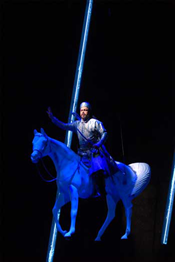
Easterlin. Tenor Robert Dean Smith, a current Bayreuth Tristan, was a
strong-voiced and attractive Emperor, especially when he swept down from
above on a white stallion. As the Nurse mezzo Jean Grove almost stole the
show with her portrayal of a woman essentially in alliance with the “bad
guys” of the story. In a comment in the Lyric’s program Grove described
the Nurse as “a Type A personality from Hell,” but cautioned: “If she
were singing ugly all the time, no one would pay any attention to her.”
Lamentation over the complex and convoluted plot of “Frau” is
commonplace, but here the leading roles were all sung with such insight that
they became credible women and men in a story in no way beyond everyday
imagination. It is much to Curran’s credit that he brought “Frau” down
to earth, stressing that despite their roots in fantasy Strauss has made
flesh-and-blood humans of Hofmannsthal’s somewhat fantastic figures. Adding
to the unforced fluency of the production was the skilled hand of conductor
Sir Andrew Davis, the Lyric’s music director, in whom Strauss has a firm
friend and ally. Davis stressed not only the drama of “Frau,” but also
the melting beauty of a score that almost a century after its 1919 Vienna
premiere stands as the valedictory outpouring of the supreme talent of the
last great Romantic. In those magic moments when Strauss reduced the
orchestra to chamber-music transparency Davis brought true enchantment to the
production. Indeed, the playing that Davis evoked from the Lyric’s
orchestra gave meaning to Glenn Gould’s designation of Strauss’ product
as “ecstatic music.”
Finally, in a personal perspective on the opening remarks on the degree to
which Strauss is taken for granted without adequate appreciation of his
achievement. The opulence of Chicago’s “Frau” returned me to the Vienna
of 1951, where it was my great good fortune to be a student. I saw my first
“Rosenkavalier” in the historic 900-seat Theater an der Wien, the home of
the Vienna State Opera while the company awaited reconstruction of its
war-devastated house on the Ringstrasse.
I thought often of that distant day after the Chicago “Frau,” for
Strauss had then been dead for only two years. My first Marschallin was
Viorica Ursuleac who had sung the first Arabella in Dresden in 1933. And on
the podium — as he had been in Dresden — was her husband Clemens Krauss,
closely associated with Strauss not only as a conductor, but further as the
librettist for “Capriccio.” I must have seen Ursuleac in the role four
times during that year — with little sense of the music history that played
before my eyes. Perhaps it is this early experience that accounts for the
enduring role that Strauss has played in over half a century of opera, and
validates the gratitude that I feel for this production.
Wes Blomster
Click here for another view of Chicago’s Frau.