04 Dec 2007
Die Frau ohne Schatten in Chicago
Die Frau ohne Schatten is the story of a being of purely sensual spirit who defies the temptation to do evil, thereby demonstrating a moral soul and achieving humanity.
English Touring Opera are delighted to announce a season of lyric monodramas to tour nationally from October to December. The season features music for solo singer and piano by Argento, Britten, Tippett and Shostakovich with a bold and inventive approach to making opera during social distancing.
This tenth of ten Live from London concerts was in fact a recorded live performance from California. It was no less enjoyable for that, and it was also uplifting to learn that this wasn’t in fact the ‘last’ LfL event that we will be able to enjoy, courtesy of VOCES8 and their fellow vocal ensembles (more below …).
Ever since Wigmore Hall announced their superb series of autumn concerts, all streamed live and available free of charge, I’d been looking forward to this song recital by Ian Bostridge and Imogen Cooper.
Although Stile Antico’s programme article for their Live from London recital introduced their selection from the many treasures of the English Renaissance in the context of the theological debates and upheavals of the Tudor and Elizabethan years, their performance was more evocative of private chamber music than of public liturgy.
Evidently, face masks don’t stifle appreciative “Bravo!”s. And, reducing audience numbers doesn’t lower the volume of such acclamations. For, the audience at Wigmore Hall gave soprano Elizabeth Llewellyn and pianist Simon Lepper a greatly deserved warm reception and hearty response following this lunchtime recital of late-Romantic song.
For this week’s Live from London vocal recital we moved from the home of VOCES8, St Anne and St Agnes in the City of London, to Kings Place, where The Sixteen - who have been associate artists at the venue for some time - presented a programme of music and words bound together by the theme of ‘reflection’.
'Such is your divine Disposation that both you excellently understand, and royally entertaine the Exercise of Musicke.’
‘And there was war in heaven: Michael and his angels fought against the dragon; and the dragon fought and his angels, And prevailed not; neither was their place found any more in heaven … that old serpent … Satan, which deceiveth the whole world: he was cast out into the earth, and his angels were cast out with him.’
There was never any doubt that the fifth of the twelve Met Stars Live in Concert broadcasts was going to be a palpably intense and vivid event, as well as a musically stunning and theatrically enervating experience.
‘Love’ was the theme for this Live from London performance by Apollo5. Given the complexity and diversity of that human emotion, and Apollo5’s reputation for versatility and diverse repertoire, ranging from Renaissance choral music to jazz, from contemporary classical works to popular song, it was no surprise that their programme spanned 500 years and several musical styles.
The Academy of St Martin in the Fields have titled their autumn series of eight concerts - which are taking place at 5pm and 7.30pm on two Saturdays each month at their home venue in Trafalgar Square, and being filmed for streaming the following Thursday - ‘re:connect’.
The London Symphony Orchestra opened their Autumn 2020 season with a homage to Oliver Knussen, who died at the age of 66 in July 2018. The programme traced a national musical lineage through the twentieth century, from Britten to Knussen, on to Mark-Anthony Turnage, and entwining the LSO and Rattle too.
With the Live from London digital vocal festival entering the second half of the series, the festival’s host, VOCES8, returned to their home at St Annes and St Agnes in the City of London to present a sequence of ‘Choral Dances’ - vocal music inspired by dance, embracing diverse genres from the Renaissance madrigal to swing jazz.
Just a few unison string wriggles from the opening of Mozart’s overture to Le nozze di Figaro are enough to make any opera-lover perch on the edge of their seat, in excited anticipation of the drama in music to come, so there could be no other curtain-raiser for this Gala Concert at the Royal Opera House, the latest instalment from ‘their House’ to ‘our houses’.
"Before the ending of the day, creator of all things, we pray that, with your accustomed mercy, you may watch over us."
The doors at The Metropolitan Opera will not open to live audiences until 2021 at the earliest, and the likelihood of normal operatic life resuming in cities around the world looks but a distant dream at present. But, while we may not be invited from our homes into the opera house for some time yet, with its free daily screenings of past productions and its pay-per-view Met Stars Live in Concert series, the Met continues to bring opera into our homes.
Music-making at this year’s Grange Festival Opera may have fallen silent in June and July, but the country house and extensive grounds of The Grange provided an ideal setting for a weekend of twelve specially conceived ‘promenade’ performances encompassing music and dance.
There’s a “slide of harmony” and “all the bones leave your body at that moment and you collapse to the floor, it’s so extraordinary.”
“Music for a while, shall all your cares beguile.”
The hum of bees rising from myriad scented blooms; gentle strains of birdsong; the cheerful chatter of picnickers beside a still lake; decorous thwacks of leather on willow; song and music floating through the warm evening air.
Die Frau ohne Schatten is the story of a being of purely sensual spirit who defies the temptation to do evil, thereby demonstrating a moral soul and achieving humanity.
Set in some hazy fin-de-siècle fairy tale Orient, the tale is ageless, its symbolic structure based on many an ancient trope and theme, especially beloved in such near-contemporary versions as Andersen’s “Little Mermaid,” Pinocchio and Die Walküre — but Frau could never have been created for the stage before the era of electric stage lighting. There is the matter of the Empress’s shadow (which must not exist until the penultimate scene, when it should be apparent and obvious), but the many other spectral intruders and the pauseless flow of scene to scene and world to world would have defied the pre-electronic stage. Hofmannsthal and Strauss deserve credit for rooting their homegrown myth so securely in a mystic fabulous while making full use of the latest (1919) technology to bring it to life. Companies that venture to stage Frau must gather the finest vocal and instrumental forces, needless to say, or risk falling on their faces — but they also risk disaster if they simplify excessively, if they do not go for broke in the visual line.
All of this was clear to the Lyric Opera of Chicago when they put a new production of the opera (the second in their history) together this fall. The stage is agog with smoke and mirrors, turntables within turntables so that characters and set elements drift apart and off the stage, ominous ramparts and portals whose openings and closings must be calculated to a hair, scrims and smoke machines, cages and lightning bolts of neon tubing, whirling dancers almost invisible in the darkness and startlingly visible (nearly nude) hung from the ceiling or rising from a well mid-stage, singers obliged to perform while on horseback in mid-air, or from a rickety bridge across mid-stage, or behind a distorted eye or confined to a spotlight by fluttering hands, barely seen. The gimcrackery is choice, the stage pictures and the vision of three separate worlds (spirit, earthy, and the imperial middle realm) rather more coherent as well as handsome than in, for example, Herbert Wernicke’s recent Met production.
Another word about the dancers, who deserve it: dance is most often used in opera either as divertissement or sideshow, in any case as a separate thing where one relaxes the ear and lets the eye take over, welcome or unwelcome as that may be. The LOC Frau is a rare and impressive example of using dance as part of the action, enhancing the magic, motile scenery. The dancers never call attention to themselves (as they so often do when choreographers take up direction); they are part of the stage magic here, creating the dungeons in Act III simply as hands fluttering in the faces of those imprisoned, swaying about the Amme in Act I to suggest the world of dark spirits she inhabits, becoming the hands and heads of the unborn children and the flood that sweeps the scene away in Act II.
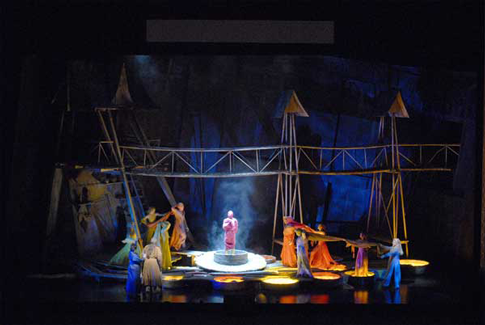 A scene from Act I of the Paul Curran-directed new production of Die Frau ohne Schatten, part of Lyric Opera of Chicago's 2007-08 season. Photo by Robert Kusel/Lyric Opera of Chicago.
The singing is sumptuous, especially from the ladies. Christine Brewer is today’s great Wagnerian heroine, her voice room-filling and rock-solid but never cold; rather, warm, deeply moving, an earth-mother Dyer’s Wife. Deborah Voigt’s Empress is a shooting star spewing Ds and C-sharps into the heavens of Act III and Jill Grove, in a breakout performance, was in complete command as the wicked Amme, one of the toughest roles in the repertory. Robert Dean Smith is evidently immune to acrophobia — and I refer to the Emperor’s tessitura as well as the flying horse. There were a few rocky phrases from Franz Hawlata, generally a sturdy and sympathetic Barak, the figure whose baritone must be the center of this morally centered tale. The twenty small roles were well-handled, in part by having some of them acted (the Falcon, the Apparition) by dancers while the singers stood discretely behind them, garbed in black. Sir Andrew Davis drew all the complexities together to tell this complicated story clearly and mellifluously. The usual cuts were, alas, observed — the show nonetheless ran to four and a half hours with intermissions.
One comes away from such a performance feeling, in the first place, the awe any first-rate presentation of this complicated opera must produce — who was keeping track of which doors should rise and which fall while tableaux and performers floated in and out of them, often in pitch dark? Rare is the military operation that boasts such precision. Paul Curran’s production, Kevin Knight’s designs and David Jacques’ lighting were constantly inventive and astonishing — though I did think the mystic Empress should be dreaming in something classier than a big brass bed, and the upturned umbrella used as a boat in Act III seemed to have strayed in from some other production entirely. These two props screamed “Fix me!” in tones as loud as any brass in Strauss’s orchestra.
I did have one misgiving about the direction: In their efforts to “humanize” a story full of tropes and archetypes, the producers and the actors (one must discuss them here in their non-singing aspects) have given the characters behavior and expression that suggest unnecessary and inexplicable subtexts to the action. We are in a fairy tale world here, where “spirit” beings aspire to human-hood, fish dinners sing, and apparitions seduce. This can be staged “realistically” — as at the Wiener Staatsoper, where the Empress is a modern Viennese lady on a couch talking her way through psychoanalysis — but having chosen, as Chicago has, to give us a fairy tale with all the trimmings, it is unwise to give the characters unnecessary layers: good should be good here, and wicked, wicked. Fairy tale, like our unconscious, knows no half measures.
Awkwardness is most clearly apparent with Deborah Voigt’s Empress, the titular lady without a shadow. Having played the role “archetypically” in half a dozen other stagings, the newly svelte and agile Miss Voigt has decided to get into the swim of things. Instead of sitting in the shadows observing the Nurse’s devious plots and the pain they inflict on Barak and his Wife, developing a moral conscience and, thus, a soul, this Empress is actively complicit with the wickedness, crowning the Dyer’s Wife, flirting with the Dyer, observing the temptations with a cynical smirk. It makes her transformation — the central moments of the drama — more difficult to accept. Grove’s Amme, too, tended at times to convey comic fluster rather than malice in her gestures, which contradicts the assurance of her stated utterances.
But these are minor points in a thoroughly winning evening of opera at its grandest.
John Yohalem
Click here for audio and video courtesy of Lyric Opera of Chicago.