![Nazan Fikret (Flora) [© Neil Libbert]](http://www.operatoday.com/ENO_TOTS1.png)
11 Dec 2007
The Turn of the Screw at ENO
Not long ago, English National Opera declared an intention to capitalise on its name and history by placing greater emphasis on English works.
English Touring Opera are delighted to announce a season of lyric monodramas to tour nationally from October to December. The season features music for solo singer and piano by Argento, Britten, Tippett and Shostakovich with a bold and inventive approach to making opera during social distancing.
This tenth of ten Live from London concerts was in fact a recorded live performance from California. It was no less enjoyable for that, and it was also uplifting to learn that this wasn’t in fact the ‘last’ LfL event that we will be able to enjoy, courtesy of VOCES8 and their fellow vocal ensembles (more below …).
Ever since Wigmore Hall announced their superb series of autumn concerts, all streamed live and available free of charge, I’d been looking forward to this song recital by Ian Bostridge and Imogen Cooper.
Although Stile Antico’s programme article for their Live from London recital introduced their selection from the many treasures of the English Renaissance in the context of the theological debates and upheavals of the Tudor and Elizabethan years, their performance was more evocative of private chamber music than of public liturgy.
Evidently, face masks don’t stifle appreciative “Bravo!”s. And, reducing audience numbers doesn’t lower the volume of such acclamations. For, the audience at Wigmore Hall gave soprano Elizabeth Llewellyn and pianist Simon Lepper a greatly deserved warm reception and hearty response following this lunchtime recital of late-Romantic song.
For this week’s Live from London vocal recital we moved from the home of VOCES8, St Anne and St Agnes in the City of London, to Kings Place, where The Sixteen - who have been associate artists at the venue for some time - presented a programme of music and words bound together by the theme of ‘reflection’.
'Such is your divine Disposation that both you excellently understand, and royally entertaine the Exercise of Musicke.’
‘And there was war in heaven: Michael and his angels fought against the dragon; and the dragon fought and his angels, And prevailed not; neither was their place found any more in heaven … that old serpent … Satan, which deceiveth the whole world: he was cast out into the earth, and his angels were cast out with him.’
There was never any doubt that the fifth of the twelve Met Stars Live in Concert broadcasts was going to be a palpably intense and vivid event, as well as a musically stunning and theatrically enervating experience.
‘Love’ was the theme for this Live from London performance by Apollo5. Given the complexity and diversity of that human emotion, and Apollo5’s reputation for versatility and diverse repertoire, ranging from Renaissance choral music to jazz, from contemporary classical works to popular song, it was no surprise that their programme spanned 500 years and several musical styles.
The Academy of St Martin in the Fields have titled their autumn series of eight concerts - which are taking place at 5pm and 7.30pm on two Saturdays each month at their home venue in Trafalgar Square, and being filmed for streaming the following Thursday - ‘re:connect’.
The London Symphony Orchestra opened their Autumn 2020 season with a homage to Oliver Knussen, who died at the age of 66 in July 2018. The programme traced a national musical lineage through the twentieth century, from Britten to Knussen, on to Mark-Anthony Turnage, and entwining the LSO and Rattle too.
With the Live from London digital vocal festival entering the second half of the series, the festival’s host, VOCES8, returned to their home at St Annes and St Agnes in the City of London to present a sequence of ‘Choral Dances’ - vocal music inspired by dance, embracing diverse genres from the Renaissance madrigal to swing jazz.
Just a few unison string wriggles from the opening of Mozart’s overture to Le nozze di Figaro are enough to make any opera-lover perch on the edge of their seat, in excited anticipation of the drama in music to come, so there could be no other curtain-raiser for this Gala Concert at the Royal Opera House, the latest instalment from ‘their House’ to ‘our houses’.
"Before the ending of the day, creator of all things, we pray that, with your accustomed mercy, you may watch over us."
The doors at The Metropolitan Opera will not open to live audiences until 2021 at the earliest, and the likelihood of normal operatic life resuming in cities around the world looks but a distant dream at present. But, while we may not be invited from our homes into the opera house for some time yet, with its free daily screenings of past productions and its pay-per-view Met Stars Live in Concert series, the Met continues to bring opera into our homes.
Music-making at this year’s Grange Festival Opera may have fallen silent in June and July, but the country house and extensive grounds of The Grange provided an ideal setting for a weekend of twelve specially conceived ‘promenade’ performances encompassing music and dance.
There’s a “slide of harmony” and “all the bones leave your body at that moment and you collapse to the floor, it’s so extraordinary.”
“Music for a while, shall all your cares beguile.”
The hum of bees rising from myriad scented blooms; gentle strains of birdsong; the cheerful chatter of picnickers beside a still lake; decorous thwacks of leather on willow; song and music floating through the warm evening air.
Not long ago, English National Opera declared an intention to capitalise on its name and history by placing greater emphasis on English works.
We have already seen Purcell's 'King Arthur' and Vaughan Williams's 'Sir John in Love' (with the same composer's 'Riders to the Sea' to follow next season) but the composer playing the largest part in this revival of the English operatic repertoire is Benjamin Britten. The operas covered so far – 'Billy Budd' and 'Death in Venice' – have proved some of ENO's greatest successes of the last two seasons, and this latest co-production of 'The Turn of the Screw' with the Mariinsky Theatre, St Petersburg (where it premiered in 2006), is no exception.
Director David McVicar, always good at exploring themes of corrupted innocence, views the story's central ambiguities from an unusual angle by attributing the evil forces to the children rather than the ghosts. Rather than being innocents possessed by an evil force, or blank slates ripe for the overworkings of the Governess's imagination, these two children were quite clearly the principal malevolent influence in this drama, and the source of the ghosts' powers from the start. In front of Mrs Grose they were little angels, but whenever her back was turned they were engaging in subversive rites: turning Flora's doll into a pig, digging a grave for the same doll while singing their cherubic Benedicite, and – in Miles's case – making sexual advances towards the Governess.
And yet McVicar still threw in a note of doubt; for example, the schoolroom scene between the Governess and Miss Jessel was not a dialogue, as it is often played, but two independent monologues, suggesting that neither woman has a greater foothold in reality than the other. Chillingly, despite the obviously menacing character of the children, the audience was still seduced into siding with them. The characters' relationships with one another and with the audience are carefully and intricately designed, but somehow the audience never feels overtly manipulated – just disturbed.
The silent cast of walk-on servants, fast becoming one of McVicar's production trademarks, were ever-present as scene-shifters, and went some way towards addressing the issue of creating a suitably intimate, claustrophobic atmosphere in a theatre the size of the Coliseum. When the giant sliding windows of the set shifted, the creakiness – which was, I suspect, unintentional – served only to crank up the atmosphere, to which Garry Walker's taut conducting was an ideal musical counterpart.
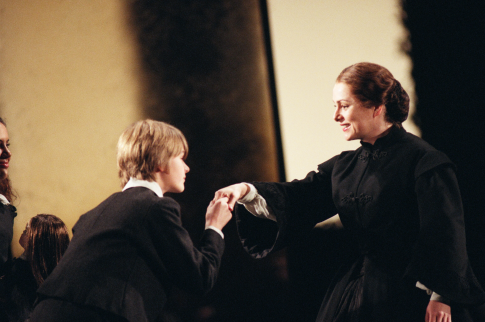 George Longworth (Miles (press night performance)) / Rebecca Evans (Governess)
Rebecca Evans sang beautifully as the Governess, though her diction was far from clear; the honeyed sweetness of her voice and liveliness of her demeanour made for a particularly unsettling contrast with the children's poised coldness and the monochrome darkness of the set and costumes. Timothy Robinson's Quint, was lean, hungry, feeding off Miles's energy; Cheryl Barker's Miss Jessel used the intensity of her presence to suck the warmth out of the atmosphere whenever she was on stage. Singing her first Mrs Grose, Ann Murray's characterisation and diction were excellent even if her mezzo really is very shrill on top these days. The two children – the excellent second-cast Miles, 12-year-old Jacob Moriarty, and Guildhall undergraduate Nazan Fikret as a Flora in fairly advanced adolescence – were really first-class.
The result was an evening which left a chill in the air and, for the right reasons, a nasty taste in the mouth.
Ruth Elleson © 2007