Recently in Performances
English Touring Opera are delighted to announce a season of lyric monodramas to tour nationally from October to December. The season features music for solo singer and piano by Argento, Britten, Tippett and Shostakovich with a bold and inventive approach to making opera during social distancing.
This tenth of ten Live from London concerts was in fact a recorded live performance from California. It was no less enjoyable for that, and it was also uplifting to learn that this wasn’t in fact the ‘last’ LfL event that we will be able to enjoy, courtesy of VOCES8 and their fellow vocal ensembles (more below …).
Ever since Wigmore Hall announced their superb series of autumn concerts, all streamed live and available free of charge, I’d been looking forward to this song recital by Ian Bostridge and Imogen Cooper.
Although Stile Antico’s programme article for their Live from London recital introduced their selection from the many treasures of the English Renaissance in the context of the theological debates and upheavals of the Tudor and Elizabethan years, their performance was more evocative of private chamber music than of public liturgy.
Evidently, face masks don’t stifle appreciative “Bravo!”s. And, reducing audience numbers doesn’t lower the volume of such acclamations. For, the audience at Wigmore Hall gave soprano Elizabeth Llewellyn and pianist Simon Lepper a greatly deserved warm reception and hearty response following this lunchtime recital of late-Romantic song.
For this week’s Live from London vocal recital we moved from the home of VOCES8, St Anne and St Agnes in the City of London, to Kings Place, where The Sixteen - who have been associate artists at the venue for some time - presented a programme of music and words bound together by the theme of ‘reflection’.
'Such is your divine Disposation that both you excellently understand, and royally entertaine the Exercise of Musicke.’
‘And there was war in heaven: Michael and his angels fought against the dragon; and the dragon fought and his angels, And prevailed not; neither was their place found any more in heaven … that old serpent … Satan, which deceiveth the whole world: he was cast out into the earth, and his angels were cast out with him.’
There was never any doubt that the fifth of the twelve Met Stars Live in Concert broadcasts was going to be a palpably intense and vivid event, as well as a musically stunning and theatrically enervating experience.
‘Love’ was the theme for this Live from London performance by Apollo5. Given the complexity and diversity of that human emotion, and Apollo5’s reputation for versatility and diverse repertoire, ranging from Renaissance choral music to jazz, from contemporary classical works to popular song, it was no surprise that their programme spanned 500 years and several musical styles.
The Academy of St Martin in the Fields have titled their autumn series of eight concerts - which are taking place at 5pm and 7.30pm on two Saturdays each month at their home venue in Trafalgar Square, and being filmed for streaming the following Thursday - ‘re:connect’.
The London Symphony Orchestra opened their Autumn 2020 season with a homage to Oliver Knussen, who died at the age of 66 in July 2018. The programme traced a national musical lineage through the twentieth century, from Britten to Knussen, on to Mark-Anthony Turnage, and entwining the LSO and Rattle too.
With the Live from London digital vocal festival entering the second half of the series, the festival’s host, VOCES8, returned to their home at St Annes and St Agnes in the City of London to present a sequence of ‘Choral Dances’ - vocal music inspired by dance, embracing diverse genres from the Renaissance madrigal to swing jazz.
Just a few unison string wriggles from the opening of Mozart’s overture to Le nozze di Figaro are enough to make any opera-lover perch on the edge of their seat, in excited anticipation of the drama in music to come, so there could be no other curtain-raiser for this Gala Concert at the Royal Opera House, the latest instalment from ‘their House’ to ‘our houses’.
"Before the ending of the day, creator of all things, we pray that, with your accustomed mercy, you may watch over us."
The doors at The Metropolitan Opera will not open to live audiences until 2021 at the earliest, and the likelihood of normal operatic life resuming in cities around the world looks but a distant dream at present. But, while we may not be invited from our homes into the opera house for some time yet, with its free daily screenings of past productions and its pay-per-view Met Stars Live in Concert series, the Met continues to bring opera into our homes.
Music-making at this year’s Grange Festival Opera may have fallen silent in June and July, but the country house and extensive grounds of The Grange provided an ideal setting for a weekend of twelve specially conceived ‘promenade’ performances encompassing music and dance.
There’s a “slide of harmony” and “all the bones leave your body at that moment and you collapse to the floor, it’s so extraordinary.”
“Music for a while, shall all your cares beguile.”
The hum of bees rising from myriad scented blooms; gentle strains of birdsong; the cheerful chatter of picnickers beside a still lake; decorous thwacks of leather on willow; song and music floating through the warm evening air.
Performances
![Hansel (Alice Coote) and Gretel (Christine Schaefer) [Photo by Ken Howard courtesy of The Metropolitan Opera]](http://www.operatoday.com/Hansel_Gretel_Met.png)
16 Jan 2008
A New Hansel und Gretel at the Met
Wagner’s all-conquering chic made apocalyptic music-dramas drawn from folklore the ideal of the nationalistic era; every serious opera composer of the time felt obliged to attempt something in that line.
Ironically, the only
one of these faux-Wagnerian epics that became (and remained) a popular hit
was Humperdinck’s 1893 setting of a Grimm fairy tale, which achieved the
perfect union of tunes kids could appreciate (and even sing themselves — he
wrote them for his sister’s children) and orchestral method that savors of
Meistersinger. Hansel und Gretel makes use of Wagnerian
counterpoint without all those embarrassing Wagnerian emotions, both immoral
and illegal — Hansel and Gretel do not go running joyously into an amorous
night.
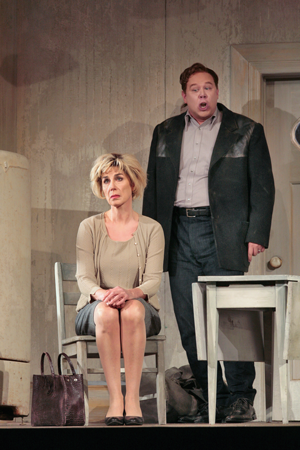 Gertrude (Rosalind Plowright) and Peter (Alan Held)
In the present era, when children imagine themselves too sophisticated for
fairy-tale kitsch (though they still love it in the right circumstances, and
the old Met production was perfect of its kind), when they are raised on
sarcastic cartoon banter and an After-School Special level of squalor, it
seems that the presentation of Hansel und Gretel must modernize too.
Hence the new Met staging, borrowed from the Welsh National Opera with a
number of Brit trappings, such as a Witch in drag out of panto. The titular
children, when we meet them, resemble shell-shocked raggedy dolls, listless
and starving on oversized chairs in a low-rent kitchen. Later they fall
asleep in a forest that resembles a very large dining room (terrific
scary-forest wallpaper out of a Maurice Sendak tale and nightmarish waiters
with branches for heads), dreaming not of angels but of Pillsbury doughboy
chefs. The Witch lives in an industrial kitchen suitable to a summer camp and
appears (in Adam Klein’s delicious performance) to be doing Julia Child and
Dame Edna in tandem. Papa probably drinks and Mama is haggard from overwork
(we are plainly dealing with latchkey kids here), and the dreams are not of
Godly salvation but of gaudy desserts.
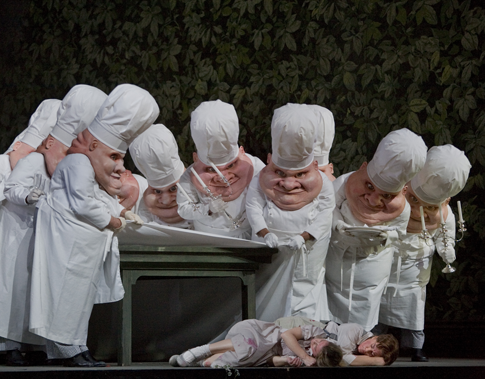 Hansel (Alice Coote), Gretel (Christine Schaefer) and Chefs/Angels
There’s a lot of good fun on the stage — what kid won’t snicker at a
grown man in drag? — but will this do for holiday resurrection year upon
year, as the fairy tale staging did? Or will once or twice do it? And will
the kids have nightmares from those tree-waiters? I did. A friend of mine
encountered a subway car full of kids after one of the special matinees of
this production, and much as they’d loved the witch, the enormous
machine-propelled Mouth that invites our heroes into her house was not their
idea of fun.
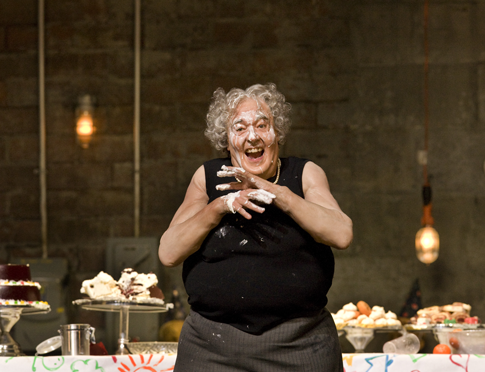 The Witch (Adam Klein)
There is a lot of good Wagnerian melody coming from the orchestra under
Vladimir Jurowski and a lot of good singing from the soloists, and the
staging ideas, if they don’t all make sense, pass the time entertainingly.
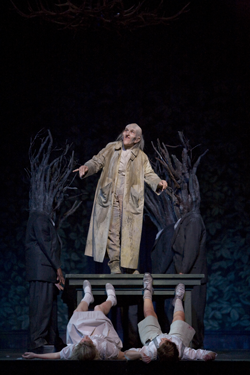 The Sandman (Sasha Cooke), Hansel (Alice Coote) and Gretel (Christine Schaefer)
The piece is performed in an updated translation that sometimes fights with
the old-fashioned music, and Christine Schaeffer as Gretel, the only singer
in the cast who was not a native English-speaker, had some problems getting
her words across — but that’s what subtitles are for. She and Alice Coote
(a fine Sesto and Octavian — will I ever see the charming Ms. Coote in a
girl’s role?) produce clear, reliably sexless vocal lines — these two
proto-Wagnerian characters must carry over a Wagnerian orchestra with
apparent childish ease — and they had fun mingling the demands of the
libretto with moves borrowed from modern video. Rosalind Plowright looked
like a harried denizen of Coronation Street, but the mother’s role is by no
means a simple one, and she sang it effectively. Alan Held filled the theater
with impressive vigor as the father — it was no surprise after this
performance to learn he is preparing Wotan for the D.C.
Ring.
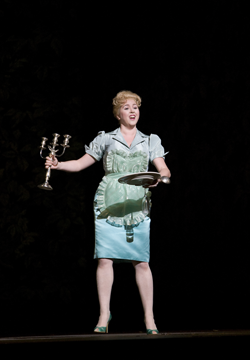 The Dew Fairy (Lisette Oropesa)
Lisette Oropesa sang the Dew Fairy sweetly in hotel chambermaid drag. In
short, the piece came off, the Witch got her madcap laughs (we all liked the
paper sleeves she placed on Hansel’s wrists and ankles before baking), and
there was joy to share. What more does one ask of this opera? Magic?
Of genuine magic there was only one moment all night: the aria of the
Sandman, as sung by Sasha Cooke of the Met’s Lindemann Young Artists
Program: a light, clear voice, seemingly tiny but produced so that it easily
filled the house and fell on each ear like fairy dust, a subtle staging that
was, for once, not an intrusion but a rare visit from the atmosphere of Grimm
to a corrupted world.
John Yohalem