Subscribe to
Opera Today

Receive articles and news via RSS feeds or email subscription.


twitter_logo[1].gif


UCP_9780226043425.gif

Recently in Performances

Domingo Conducts Holdridge’s New Opera Dulce Rosa

Dulce Rosa, a brand new opera, had its world premiere Friday night, May 17, 2013 at the Broad Stage in Santa Monica, California. It was produced by Los Angeles Opera, but staged in the smaller theater.

Verdi’s Falstaff at Glyndebourne

Richard Jones’ 2009 production of Verdi’s Falstaff translates the action from the first Elizabethan age to the start of the second.

Gareth John, Wigmore Hall

Baritone Gareth John is rapidly accumulating a war-chest of honours. Winner of the 2013 Kathleen Ferrier Award, he recently won the Royal Academy of Music Patrons’ Award and was presented the Silver Medal by the Worshipful Company of Musicians.

La bohème at ENO

This second revival of Jonathan Miller’s La bohème was the first time I had caught the production.

Rolando Villazón: Verdi (International Opera Stars Series 2013)

It’s Verdi’s bicentenary year and Rolando Villazón has two new CDs to plug — titled somewhat confusingly, ‘Villazón: Verdi’ and ‘Villazón’s Verdi’, the latter a ‘personal selection’ of favourite numbers performed by stars of the past and present.

Brahms Third in San Francisco

Nicola Luisotti and the San Francisco Opera Orchestra climbed out of the War Memorial pit, braved the wind whipped bay and held spellbound an audience at Cal Performances’ Zellerbach Auditorium at UC Berkeley.

Glyndebourne: Ariadne auf Naxos

Utterly mad but absolutely right — Richard Strauss’s Ariadne auf Naxos started the Glyndebourne 2013 season with an explosion. Strauss could hardly have made his intentions more clear. Ariadne auf Naxos is not “about” Greek myth so much as a satire on art and the way art is made.

Wozzeck at ENO

“Man is an abyss. It makes one dizzy to look into it.” So utters Georg Büchner’s Woyzeck, repeating what was also a recurring motif in the playwright’s own letters.

Mulhouse: Rare Britten Well Done

National Opera Company of the Rhine has marked this year’s Benjamin Britten celebration with a remarkably compelling, often gripping new production of the seldom-seen Owen Wingrave.

Frankfurt's Intriguing Idomeneo

Once upon a time, Frankfurt Opera had the baddest ass reputation in Germany as “the” cutting edge producer of must-see opera.

Rigoletto at Lyric Opera of Chicago

Productions of Giuseppe Verdi’s Rigoletto can serve as a vehicle for individual singers to make a strong impression and become afterward associated with specific roles in the opera.

Britten Sinfonia with Ian Bostridge

Just in case we were not aware that the evening’s programme was ‘themed’, the Britten Sinfonia designed a visual accompaniment to their musical exploration of night, sleep and dreams.

Aida, Manitoba Opera

Poor Aida! She never seems to have anything go her way.

Superlative singing: Don Carlo, Royal Opera House

Is it possible to upstage Jonas Kaufmann? Kaufmann was brilliant in this Verdi Don Carlo at the Royal Opera House, London, but the rest of the cast was so good that he was but first among equals. Don Carlo is a vehicle for stars, but this time the stars were everyone on stage and in the pit. Even the solo arias, glorious as they are, grow organically out of perfect ensemble. This was a performance that brought out the true beauty of Verdi's music.

Sarah Connolly: French Song at Wigmore Hall

The big names were absent: Duparc, D’Indy, Debussy, Ravel … and while Fauré, Chausson, Roussel and several members of Les Six put in an appearance, in less than familiar guises, this survey of French song of the early 20th century and interwar years deliberately took us on a journey through infrequently travelled terrain.

Rare restoration: Handel’s Esther 1720

Composed between 1718 and 1720, Handel’s Esther is sometimes described as the ‘first English Oratorio’, but is in fact a hybrid form, mixing elements of oratorio, masque, pastoral and opera.

The Damnation of Faust, London

Hector Berlioz's légende dramatique, La Damnation de Faust, exists somewhere between cantata and opera. Berlioz's flexible attitude to dramatic form made the piece unworkable on the stages of early 19th century Paris and his music is so vivid that you wonder whether the piece needs staging at all.

Elizabeth Connell Memorial Concert, St John's Smith Square

St. John’s Smith Square was the site of Elizabeth Connell’s final London concert, intended as a farewell to London on her moving to Australia. It was rendered ultimately final by her unexpected death.

Aida with all the Trimmings, Even a Blue Silk Elephant!

With the building of the Suez Canal, Egypt became more interesting to Western Europeans. Khedive Ismail Pasha wanted a hymn by Verdi for the opening of a new opera house in Cairo, but the composer said he did not write occasional pieces.

Die Zauberflöte, Royal Opera

Back for its fourth revival, David McVicar’s 2003 production of Mozart’s Die Zauberflöte has much charm, beauty and artistry.

OPERA TODAY ARCHIVES »

Performances

Deborah Voigt
20 Jan 2008

Deborah Voigt in Concert with the San Francisco Symphony

With her performance of the “Four Last Songs,” ably partnered by Michael Tilson Thomas and his San Francisco Symphony, Deborah Voigt emphatically confirmed her place as one of the glories of the current roster of Strauss interpreters.

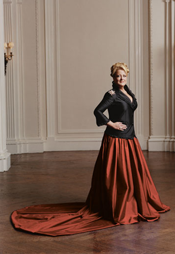
Above: Deborah Voigt (Columbia Artists Management | 21C Media Group)


We are perhaps familiar with a more usual “Liederabend” approach as furthered by other celebrated sopranos -- you know, the often mewing, cooing, hushed treatment of every fragile syllable as-if-they-might-break-if-sung-too-operatically? Such studied wispiness was little in evidence in Ms. Voigt’s renditions on January 10th. No wilting violet she, Diva Debbie just flat out really sang ‘em all instead of over-“interpreting” them. And oh, how she sang! With steady tone of great presence in all registers and at all gradations of volume; with generous, soaring, high-flying phrases; with delicate nuance and telling detail; all of which was characterized by excellent diction and complete stylistic understanding.

Up against her seasoned Straussian standard then, the SFO was highly competent if not quite equally successful in essaying this richly detailed score. Oft times on past occasions I have wished this fine group of musicians would coalesce into a single-minded band of thrilling music-makers, and often as not I have found them a bit wanting in artistic vision and ensemble, no more so than now as they confronted these lush, complex orchestral songs. If history is a teacher, my past SFO experiences had perhaps taught me that Maestro Thomas (or “MTT” as he is marketed locally) seems to draw inspiration from superb soloists more than he appears to impart it routinely to his players. That was certainly true of such past luminaries as Lang Lang and Helene Grimaud, with whom he became a true collaborator, and with whom the orchestra excelled. Here, MTT inexplicably seemed content to allow the orchestra to be a somewhat aloof accompanist.

That said, there were some very fine orchestral moments to be sure, not least of which was a peerless violin solo in “Beim Schlafengehen,” matched by an equally superb horn solo in “Im Abendrot.” (Indeed, the horns were remarkably wonderful throughout the evening.) Having heard the Vienna Philharmonic take on this score, the bar was set very high for me, since those guys absolutely inhabit this music as a seamless ensemble. That SFO would not be so seamlessly involved was foretold by the concert opener, Knussen’s Third Symphony. It was dispatched with cool skill, but little overt joy or passion, the very talented individual musicians shining if somewhat independent. The Strauss merely continued that semi-detached, sit-back-and-play-the-notes pattern.

And then something happened. Barber’s seldom heard “Andromache’s Farewell” knocked us right between the eyes with a well-judged and committed dramatic reading from our soprano, matched thrill for thrill by expansive, virtuosic orchestral playing elicited by MTT’s fiery conducting. (What, did this guy knock back a couple of Red Bull’s at intermission?)

The wonderful, under-valued soprano Martina Arroyo premiered the piece in 1963 to open the new Avery Fisher Hall at Lincoln Center. How enjoyable to already encounter the vibrant palette of orchestral sounds and effects (especially the exciting brass fanfares) that the composer would further refine and put to good use a bit later in his “Antony and Cleopatra” which opened the new Metropolitan Opera House.

“Andromache’s” dynamic score certainly deserves to be heard more often. That is, if a dramatic soprano of Ms. Voigt’s bountiful gifts can be found. It is an interesting and varied scena with well-calculated dramatic tension; featuring a pleasing balance of signature Barber melodiousness and parlando passages; and with some sure-fire, slam-bang, full-Geschrei money notes that stir the soul and tickle the eardrums. And man, does our Diva ever have those money notes! Million Dollar Baby, baby! It was a singular treat to hear such a wholly realized, successful undertaking of this rarity.

After the prolonged ovation died down for the Barber, MTT then jumped right into a Puckish reading of Beethoven’s Fourth with equally pleasing results. Though it may not have the grandeur or gravitas of the “bookend” Third and Fifth Symphonies, it was delightful nonetheless, especially in this playful, inspired interpretation. My persistence in returning to Davies Hall for yet another concert after those several disappointing near-misses was amply rewarded this night, for now SFO was indeed not just “playing” but truly “inhabiting” the music with abandon.

MTT was in his element, inspiring and charismatic, enjoying himself (and Beethoven) so much that at a couple of points I was thinking he may just break into some spontaneous Schuhplatten. The orchestra responded in kind with flawless ensemble playing and sparkling, intricate solo work. (As Ed Sullivan might say: “How about a hand for that bassoon player? C’mon!”) The last stinging chord brought a rain of rousing cheers down on the assemblage, probably not a usual response for the Fourth, which says a lot for the dazzling magic that MTT and the SFO imbued on a piece of such gentler gifts.

After this exciting second half, representing the very best I have ever heard from this bunch and rivaling any other orchestra in the world, I wanted to shout “Dude, drink the Red Bull before Act One next time!” And for all I know, MTT did. . .

James Sohre
Send to a friend

Send a link to this article to a friend with an optional message.

Friend's Email Address: (required)

Your Email Address: (required)

Message (optional):