Subscribe to
Opera Today

Receive articles and news via RSS feeds or email subscription.


twitter_logo[1].gif


UCP_9780226043425.gif

Recently in Performances

Wozzeck at ENO

“Man is an abyss. It makes one dizzy to look into it.” So utters Georg Büchner’s Woyzeck, repeating what was also a recurring motif in the playwright’s own letters.

Mulhouse: Rare Britten Well Done

National Opera Company of the Rhine has marked this year’s Benjamin Britten celebration with a remarkably compelling, often gripping new production of the seldom-seen Owen Wingrave.

Frankfurt's Intriguing Idomeneo

Once upon a time, Frankfurt Opera had the baddest ass reputation in Germany as “the” cutting edge producer of must-see opera.

Rigoletto at Lyric Opera of Chicago

Productions of Giuseppe Verdi’s Rigoletto can serve as a vehicle for individual singers to make a strong impression and become afterward associated with specific roles in the opera.

Britten Sinfonia with Ian Bostridge

Just in case we were not aware that the evening’s programme was ‘themed’, the Britten Sinfonia designed a visual accompaniment to their musical exploration of night, sleep and dreams.

Aida, Manitoba Opera

Poor Aida! She never seems to have anything go her way.

Superlative singing: Don Carlo, Royal Opera House

Is it possible to upstage Jonas Kaufmann? Kaufmann was brilliant in this Verdi Don Carlo at the Royal Opera House, London, but the rest of the cast was so good that he was but first among equals. Don Carlo is a vehicle for stars, but this time the stars were everyone on stage and in the pit. Even the solo arias, glorious as they are, grow organically out of perfect ensemble. This was a performance that brought out the true beauty of Verdi's music.

Sarah Connolly: French Song at Wigmore Hall

The big names were absent: Duparc, D’Indy, Debussy, Ravel … and while Fauré, Chausson, Roussel and several members of Les Six put in an appearance, in less than familiar guises, this survey of French song of the early 20th century and interwar years deliberately took us on a journey through infrequently travelled terrain.

Rare restoration: Handel’s Esther 1720

Composed between 1718 and 1720, Handel’s Esther is sometimes described as the ‘first English Oratorio’, but is in fact a hybrid form, mixing elements of oratorio, masque, pastoral and opera.

The Damnation of Faust, London

Hector Berlioz's légende dramatique, La Damnation de Faust, exists somewhere between cantata and opera. Berlioz's flexible attitude to dramatic form made the piece unworkable on the stages of early 19th century Paris and his music is so vivid that you wonder whether the piece needs staging at all.

Elizabeth Connell Memorial Concert, St John's Smith Square

St. John’s Smith Square was the site of Elizabeth Connell’s final London concert, intended as a farewell to London on her moving to Australia. It was rendered ultimately final by her unexpected death.

Aida with all the Trimmings, Even a Blue Silk Elephant!

With the building of the Suez Canal, Egypt became more interesting to Western Europeans. Khedive Ismail Pasha wanted a hymn by Verdi for the opening of a new opera house in Cairo, but the composer said he did not write occasional pieces.

Die Zauberflöte, Royal Opera

Back for its fourth revival, David McVicar’s 2003 production of Mozart’s Die Zauberflöte has much charm, beauty and artistry.

The Marriage of Figaro Ends Season at Arizona Opera

Wolfgang Amadeus Mozart's opera The Marriage of Figaro has a libretto by Lorenzo daPonte based on the French play La folle journée, ou le Mariage de Figaro (The Crazy Day or the Marriage of Figaro) by Pierre Caron de Beaumarchais (1732-1799).

Baden’s Flute Goes Barefoot in the Park

For its world class Easter Festival, Baden-Baden mounted a Die Zauberflöte that owed more to the grey penitential doldrums of Lent than to the unbridled jubilance of re-birth.

Bonjour M. Gauguin in Berkeley

Once Berkeley Opera, renamed West Edge Opera, this enterprising company offers the Bay Area’s only serious alternative to corporate opera, to wit Bonjour M. Gauguin.

Mahler Lieder, Wigmore Hall

In the first of pianist Julius Drake’s three-part series, ‘Perspectives’, our gaze was directed at Gustav Mahler’s eclectic musical responses to human experiences: from the trauma and distress of anguished love to the sweet contentment of true friendship, from the agonised introspection of the artist to the diverse dramas of human interaction.

Cinderella Goes to the Opera

The Los Angeles opera company marketed its spring production of Rossini's La Cenerentola as Cinderella though there is no opera by that name. The libretto of La Cenerentola is not the Cinderella story we know.

Die Walküre, Paris

The Paris Opéra has not staged a full Ring Cycle since 1957, but its current season will conclude with a correction of this grand operatic gap.

Manon Lescaut, Washington National Opera

Washington National’s 2012-2013 season continues this spring with a production of Giacomo Puccini’s first successful opera.

OPERA TODAY ARCHIVES »

Performances

20 Jan 2008

Die Walküre at the Met

The Metropolitan Opera audience loves its Wagner, and the management for the last several decades has, alas, made sure we aren’t spoiled: it’s a rare season that gets more than two production revivals of Wagner, and some years there have been none.

Richard Wagner: Die Walküre

Brünnhilde: Lisa Gasteen; Sieglinde: Adrianne Pieczonka; Fricka: Stephanie Blythe; Siegmund: Clifton Forbis; Wotan: James Morris; Hunding: Mikhail Petrenko.
Metropolitan Opera: conducted by Lorin Maazel. Performance of January 14.

Above: Adrianne Pieczonka (Sieglinde) and Clifton Forbis (Siegmund)
All photos by Marty Sohl courtesy of The Metropolitan Opera


A dearth of major Wagnerian voices might be, has been, blamed … but other companies do better … or so it seems to us New York Wagnerians.

The current revival of Die Walküre, always the most popular of the Ring operas, is impressively satisfying: none of the singers are bad, some of them are great, only one of them is even stout (Stephanie Blythe, who, however, sings like the goddess she plays and moves in a stately, never clumsy, manner), while an unfamiliar hand on the podium brings out some unfamiliar colors from the depths of this shimmering score.

The weakest link in the cast was Clifton Forbis, the Siegmund — his gravelly, forced quality, an ill-supported top, no lyricism in the “Winterstürme,” all made this a woeful Wehwalt. The only time he sang with much power was the cry of “Walse! Walse!” — something about this shout seemed to align his throat properly for the first — and last — time all night. In rather striking contrast, Adrianne Pieczonka, a slim, girlish Sieglinde, sang with a full tone a bit beyond complete control, and was underpowered only in the “triumph of woman” explosion in Act III. She might be starting on the road to a major interpretation; Forbis, however, seems simply miscast.

James Morris had a Mozart and bel canto background when he first essayed Wotan twenty years ago — and was then widely expected to fail. Instead, he thrilled all ears, and he has owned the part ever since. (Could his bel canto experience be responsible?) Wobbles in his Hans Sachs last year made me wonder if his Valhalla sun had set, but he was in fine voice during the second performance of the run of Walküres, a little dryer than the lustrous hue of old, no doubt, but wobble-free, in command of the full range of notes and dynamics, and an experienced actor of this figure who attains tragic stature through tardy self-knowledge.

Lisa Gasteen, a star of Rings from London to Vienna to Adelaide, made her first essay at the title role of this opera in New York. She sang, it was announced, with a sore throat, and one would like to credit that for the general weakness of her voice above the staff that began with her first war-cry and continued to the end of the night. But Wagner was not a high-note composer, and the rest of her voice was lovely, beautifully produced, full of deep emotion.
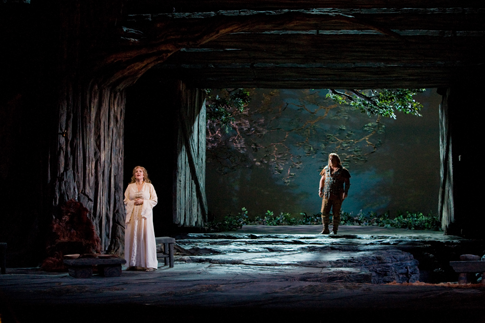
Walkure-_scene_Pieczonka___.pngA scene from Wagner's “Die Walküre” with Adrianne Pieczonka as Sieglinde and Clifton Forbis as Siegmund.

She also cuts a handsome figure and bounds about the rocky sets with youthful athleticism, as a hard-riding warrior goddess ought to — but how many do? In the orchestra, I had doubts about the size of the voice when it came to filling the Met, and friends who sat upstairs shared them, but this was an honorable attempt that gave much pleasure. If her health on Monday is not the reason for her weak top, however, she is hardly the woman to sing the higher Brünnhilde of Siegfried. This experience of her made one interested in hearing her under optimum circumstances and in many roles. (A revival of Frau ohne Schatten would suit her nicely — she’s sung both soprano leads in Germany.)
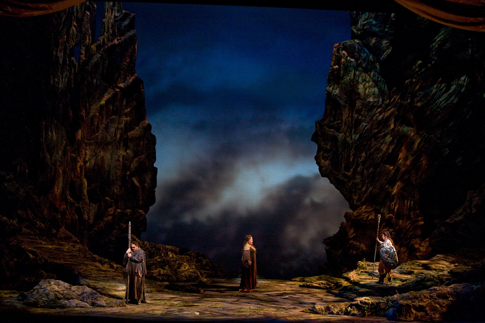
Walkure-_scene_0086.pngA scene from Wagner's “Die Walküre” with (from left) James Morris as Wotan, Stephanie Blythe as Fricka, and Lisa Gasteen as Brünnhilde

Among the smaller roles, Mikhail Petrenko was especially striking — joining the lengthy list of Hundings whom one wishes had more to do, or big juicy roles in something else in the very near future. (Whatever became of Stephen Milling?) Kelly Cae Hogan, a singer new to me, was first off the mark among the valkyries, and one wished her war-cry, clear and focused and bright, had somehow been substituted for Gasteen’s cautious one; the rest of the gang were also happy choices.

The stage direction seemed to have been tightened, and was especially well synchronized at such tricky moments as Siegmund’s death (and Sieglinde’s flight) and the valkyrie ensembles. The diction all around was exceptional, precise without being intrusive. Lighting for this production seems to be getting steadily dimmer — which makes things like the magic fire all the more effective.

Lorin Maazel’s approach to Wagner was vivid and the pace snappier than we are used to, which rather heightened the excitement of a happy occasion. As at every great Wagner performance, one heard things, instrumental colors, one had never noticed before. Consider, for instance, Wagner’s use of kettledrums for everything but beating time: enhancing this, emphasizing that, pointing words or other instruments, a sudden insertion of ominous texture in the midst of a leitmotiv associated with things not ominous — insofar as anything in the Ring is free from shadow.

John Yohalem
Send to a friend

Send a link to this article to a friend with an optional message.

Friend's Email Address: (required)

Your Email Address: (required)

Message (optional):