20 Jan 2008
John Adams' Doctor Atomic in Chicago
John Adams, whose opera Nixon in China set the bar for post-minimalism in the lyric theatre, has once again scored a success with his latest work.
English Touring Opera are delighted to announce a season of lyric monodramas to tour nationally from October to December. The season features music for solo singer and piano by Argento, Britten, Tippett and Shostakovich with a bold and inventive approach to making opera during social distancing.
This tenth of ten Live from London concerts was in fact a recorded live performance from California. It was no less enjoyable for that, and it was also uplifting to learn that this wasn’t in fact the ‘last’ LfL event that we will be able to enjoy, courtesy of VOCES8 and their fellow vocal ensembles (more below …).
Ever since Wigmore Hall announced their superb series of autumn concerts, all streamed live and available free of charge, I’d been looking forward to this song recital by Ian Bostridge and Imogen Cooper.
Although Stile Antico’s programme article for their Live from London recital introduced their selection from the many treasures of the English Renaissance in the context of the theological debates and upheavals of the Tudor and Elizabethan years, their performance was more evocative of private chamber music than of public liturgy.
Evidently, face masks don’t stifle appreciative “Bravo!”s. And, reducing audience numbers doesn’t lower the volume of such acclamations. For, the audience at Wigmore Hall gave soprano Elizabeth Llewellyn and pianist Simon Lepper a greatly deserved warm reception and hearty response following this lunchtime recital of late-Romantic song.
For this week’s Live from London vocal recital we moved from the home of VOCES8, St Anne and St Agnes in the City of London, to Kings Place, where The Sixteen - who have been associate artists at the venue for some time - presented a programme of music and words bound together by the theme of ‘reflection’.
'Such is your divine Disposation that both you excellently understand, and royally entertaine the Exercise of Musicke.’
‘And there was war in heaven: Michael and his angels fought against the dragon; and the dragon fought and his angels, And prevailed not; neither was their place found any more in heaven … that old serpent … Satan, which deceiveth the whole world: he was cast out into the earth, and his angels were cast out with him.’
There was never any doubt that the fifth of the twelve Met Stars Live in Concert broadcasts was going to be a palpably intense and vivid event, as well as a musically stunning and theatrically enervating experience.
‘Love’ was the theme for this Live from London performance by Apollo5. Given the complexity and diversity of that human emotion, and Apollo5’s reputation for versatility and diverse repertoire, ranging from Renaissance choral music to jazz, from contemporary classical works to popular song, it was no surprise that their programme spanned 500 years and several musical styles.
The Academy of St Martin in the Fields have titled their autumn series of eight concerts - which are taking place at 5pm and 7.30pm on two Saturdays each month at their home venue in Trafalgar Square, and being filmed for streaming the following Thursday - ‘re:connect’.
The London Symphony Orchestra opened their Autumn 2020 season with a homage to Oliver Knussen, who died at the age of 66 in July 2018. The programme traced a national musical lineage through the twentieth century, from Britten to Knussen, on to Mark-Anthony Turnage, and entwining the LSO and Rattle too.
With the Live from London digital vocal festival entering the second half of the series, the festival’s host, VOCES8, returned to their home at St Annes and St Agnes in the City of London to present a sequence of ‘Choral Dances’ - vocal music inspired by dance, embracing diverse genres from the Renaissance madrigal to swing jazz.
Just a few unison string wriggles from the opening of Mozart’s overture to Le nozze di Figaro are enough to make any opera-lover perch on the edge of their seat, in excited anticipation of the drama in music to come, so there could be no other curtain-raiser for this Gala Concert at the Royal Opera House, the latest instalment from ‘their House’ to ‘our houses’.
"Before the ending of the day, creator of all things, we pray that, with your accustomed mercy, you may watch over us."
The doors at The Metropolitan Opera will not open to live audiences until 2021 at the earliest, and the likelihood of normal operatic life resuming in cities around the world looks but a distant dream at present. But, while we may not be invited from our homes into the opera house for some time yet, with its free daily screenings of past productions and its pay-per-view Met Stars Live in Concert series, the Met continues to bring opera into our homes.
Music-making at this year’s Grange Festival Opera may have fallen silent in June and July, but the country house and extensive grounds of The Grange provided an ideal setting for a weekend of twelve specially conceived ‘promenade’ performances encompassing music and dance.
There’s a “slide of harmony” and “all the bones leave your body at that moment and you collapse to the floor, it’s so extraordinary.”
“Music for a while, shall all your cares beguile.”
The hum of bees rising from myriad scented blooms; gentle strains of birdsong; the cheerful chatter of picnickers beside a still lake; decorous thwacks of leather on willow; song and music floating through the warm evening air.
John Adams, whose opera Nixon in China set the bar for post-minimalism in the lyric theatre, has once again scored a success with his latest work.
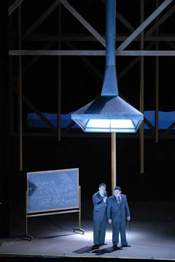
Doctor Atomic, now making its second appearance in North America at Lyric Opera of Chicago after a successful premier in San Francisco, has at its core the sound that we have come to expect from a work bearing Adams’ autograph, but the composer has expanded his sonic language, embracing an approach that straddles a very delicate compositional line: Adams, unlike many of his contemporaries, is able to be at once harmonically complex and accessible. The dense score is simultaneously engaging and tuneful.
The drama of the opera concerns itself with the work of J. Robert Oppenheimer and his team at the test site of the first atomic bomb outside Los Alamos, New Mexico during the days leading up to the first detonation. Tensions build as the test approaches and conditions become less and less favorable. Oppenheimer and his staff consider the implications of their work and the strong possibility that their labor and calculations could end in folly.
The role of Oppenheimer, sung exquisitely by Gerald Finley, begs the ethical scientific questions of the first half of the 20th century. First, is a mastery of science reason enough to employ the laws of nature to destructive ends? And, additionally, if we respect the dignity of life, what are the criteria we use to decide when the time has arrived to employ devastation on such a large scale? Adams paints with broad strokes well suited to operatic characters. Acquiescing to the commands of those more powerful than he and arguing that morality has no place in a lab, Oppenheimer struggles to convince himself that he is not responsible for the global annihilation of which his “gadget” is capable. Conflicted but moving ever forward, Finley’s Oppenheimer is representative of humanity itself. Finley’s end of act one tour-de-force soliloquy “Batter my Heart” is a crystallization of this dramatic idea.
On opposite sides of the allegorical spectrum, Robert Wilson and Richard Teller respectively oppose and condone the experiment. Thomas Glenn handles the vocally demanding role of Robert Wilson securely in spite of its relentlessly high tessitura. Glenn’s characterization is appropriately urgent, as he eloquently implores Oppenheimer and the rest of the team to petition Washington to stand down on the attack until the Japanese have been given clear terms of peace. Richard Paul Fink’s characterization of Teller is chillingly laissez-faire, his matter-of-fact delivery as frightening as the bomb itself, which hangs overhead throughout the entire performance.
As Kitty Oppenheimer, Jessica Rivera provides an attractive foil to a mostly male cast. Her warm tones bring true beauty to “Am I in your light”, and her mastery of the angular, cross-registral lines show the singer off to great success. If Meredith Arwady’s vocal line is not as smooth as one might have hoped, her portrayal of Pasquelita is characterized by a rich and booming contralto. A member of Lyric Opera’s Ryan Center, Ms. Arwady’s career is definitely one to watch.
Under the leadership of Donald Nally, the ensemble gives an effective, moody opening chorus and provides commentary throughout. The sense of ensemble is sure, and the musicianship unfaltering and clear. The corps de ballet, however, does not fare as well. Lucinda Childs’ choreography was abstract and moving, and it provided a great deal of much appreciated spectacle, but it is, unfortunately, executed somewhat weakly by the dancers, who seemed on several occasions dangerously off-balance. Peter Sellars’ compiled libretto is serviceable but suffers under comparison to the brilliant work of Alice Goodman, who prepared the incomparable text for Nixon in China. Sellars’ choice of texts for arioso moments, which range from the metaphysical and symbolist poets to the Bhagavad-Gita is wise, saving the director-librettist from foisting upon the composer the unhappy task of setting less lyrical texts for critical emotional moments. Sets by Adrianne Lobel were industrial and functional, helping the drama to continue along at an exciting pace.
Highest praise, however, must be extended to conductor Robert Spano, who finds the logic of the fascinatingly overwhelming score. Under his baton, Lyric’s orchestra makes sense of the polyrhythmic undulations and pan-tonal implications of the work.
Doctor Atomic is an important addition to the operatic canon. The evening continues the Adams-Sellars collaborative tradition of socio-political examination of definitive moments of modern history, and as such, is perhaps not as narratively satisfying as traditional nineteenth century opera to less experienced theatre-goers. Though it is not overwrought, this evening of theatre is operatic, and this sentiment can be found in the cardinal expression of the human heart in ethical conflict with itself. This anxiety is not particular to modernism, but its application in Doctor Atomic is extremely timely and makes for a thoroughly entertaining evening. Those who attend hoping for stage pyrotechnics and a “big bang” will be disappointed, but those who attend looking for distilled ethical conflict will leave more than satisfied.
Gregory Peebles © 2008