03 Jan 2008
Oppenheimer opera charts new course in music
In this country art and politics are rarely bedfellows — strange or otherwise; indeed, it’s seldom that the two meet under the same roof.
English Touring Opera are delighted to announce a season of lyric monodramas to tour nationally from October to December. The season features music for solo singer and piano by Argento, Britten, Tippett and Shostakovich with a bold and inventive approach to making opera during social distancing.
This tenth of ten Live from London concerts was in fact a recorded live performance from California. It was no less enjoyable for that, and it was also uplifting to learn that this wasn’t in fact the ‘last’ LfL event that we will be able to enjoy, courtesy of VOCES8 and their fellow vocal ensembles (more below …).
Ever since Wigmore Hall announced their superb series of autumn concerts, all streamed live and available free of charge, I’d been looking forward to this song recital by Ian Bostridge and Imogen Cooper.
Although Stile Antico’s programme article for their Live from London recital introduced their selection from the many treasures of the English Renaissance in the context of the theological debates and upheavals of the Tudor and Elizabethan years, their performance was more evocative of private chamber music than of public liturgy.
Evidently, face masks don’t stifle appreciative “Bravo!”s. And, reducing audience numbers doesn’t lower the volume of such acclamations. For, the audience at Wigmore Hall gave soprano Elizabeth Llewellyn and pianist Simon Lepper a greatly deserved warm reception and hearty response following this lunchtime recital of late-Romantic song.
For this week’s Live from London vocal recital we moved from the home of VOCES8, St Anne and St Agnes in the City of London, to Kings Place, where The Sixteen - who have been associate artists at the venue for some time - presented a programme of music and words bound together by the theme of ‘reflection’.
'Such is your divine Disposation that both you excellently understand, and royally entertaine the Exercise of Musicke.’
‘And there was war in heaven: Michael and his angels fought against the dragon; and the dragon fought and his angels, And prevailed not; neither was their place found any more in heaven … that old serpent … Satan, which deceiveth the whole world: he was cast out into the earth, and his angels were cast out with him.’
There was never any doubt that the fifth of the twelve Met Stars Live in Concert broadcasts was going to be a palpably intense and vivid event, as well as a musically stunning and theatrically enervating experience.
‘Love’ was the theme for this Live from London performance by Apollo5. Given the complexity and diversity of that human emotion, and Apollo5’s reputation for versatility and diverse repertoire, ranging from Renaissance choral music to jazz, from contemporary classical works to popular song, it was no surprise that their programme spanned 500 years and several musical styles.
The Academy of St Martin in the Fields have titled their autumn series of eight concerts - which are taking place at 5pm and 7.30pm on two Saturdays each month at their home venue in Trafalgar Square, and being filmed for streaming the following Thursday - ‘re:connect’.
The London Symphony Orchestra opened their Autumn 2020 season with a homage to Oliver Knussen, who died at the age of 66 in July 2018. The programme traced a national musical lineage through the twentieth century, from Britten to Knussen, on to Mark-Anthony Turnage, and entwining the LSO and Rattle too.
With the Live from London digital vocal festival entering the second half of the series, the festival’s host, VOCES8, returned to their home at St Annes and St Agnes in the City of London to present a sequence of ‘Choral Dances’ - vocal music inspired by dance, embracing diverse genres from the Renaissance madrigal to swing jazz.
Just a few unison string wriggles from the opening of Mozart’s overture to Le nozze di Figaro are enough to make any opera-lover perch on the edge of their seat, in excited anticipation of the drama in music to come, so there could be no other curtain-raiser for this Gala Concert at the Royal Opera House, the latest instalment from ‘their House’ to ‘our houses’.
"Before the ending of the day, creator of all things, we pray that, with your accustomed mercy, you may watch over us."
The doors at The Metropolitan Opera will not open to live audiences until 2021 at the earliest, and the likelihood of normal operatic life resuming in cities around the world looks but a distant dream at present. But, while we may not be invited from our homes into the opera house for some time yet, with its free daily screenings of past productions and its pay-per-view Met Stars Live in Concert series, the Met continues to bring opera into our homes.
Music-making at this year’s Grange Festival Opera may have fallen silent in June and July, but the country house and extensive grounds of The Grange provided an ideal setting for a weekend of twelve specially conceived ‘promenade’ performances encompassing music and dance.
There’s a “slide of harmony” and “all the bones leave your body at that moment and you collapse to the floor, it’s so extraordinary.”
“Music for a while, shall all your cares beguile.”
The hum of bees rising from myriad scented blooms; gentle strains of birdsong; the cheerful chatter of picnickers beside a still lake; decorous thwacks of leather on willow; song and music floating through the warm evening air.
In this country art and politics are rarely bedfellows — strange or otherwise; indeed, it’s seldom that the two meet under the same roof.
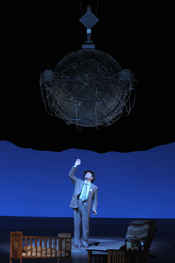
That is one thing that makes John Adams’ “Doctor Atomic” unique among recent American operas. At the same time, the success of the work gives hope that the national ear is not totally deaf to the urgency that speaks so strongly from this account of the anxious hours leading up to the first explosion of a nuclear bomb in the New Mexico desert on July 16, 1945. “Doctor Atomic,” directed by sometimes enfant terrible Peter Sellars, who also wrote the libretto, was premiered by the San Francisco Opera in 2005. Following performances in Amsterdam last summer, the Chicago Lyric Opera has revived the SFO staging as a major event of its current season.
Adams first tried his hand at contemporary history in 1987 with “Nixon in China.” And Sellars — as Edward Said commented on his work with Hindemith’s “Mathis der Mahler” in London in 1986 — is one of the few in this country “who connect opera to an ongoing social political debate” in an effort to combat “the prevailing belief that operas are essentially harmless, if not completely antiseptic.” There is obviously nothing either harmless or antiseptic about “Doctor Atomic,” defined by Adams as “an unflinching drama of contemporary humanity in crisis.” And the acute sense of crisis in today’s world, where leaders threaten the use of nuclear weapons with the ease that their forefathers played with tin soldiers, underscores the sense of urgency felt in the audiences that pack the city’s Lyric Theatre for eight performances beginning in December and continuing on into January.
The 1945 detonation of “the Gadget,” as those involved in the Manhattan Project called that first bomb, stands as the major turning point in all of human history, for with it mankind unleashed a power capable not only of heretofore unknown destruction, but able even to destroy the earth itself. The fear shared of igniting the atmosphere that haunted Robert J. Oppenheimer, father of the first bomb, informs “Doctor Atomic” from beginning to end, and Adams has done an incredible job of expressing it — in part through electronically generated sounds woven seamlessly into the score — to create what he has called “a post-nuclear holocaust landscape.” The opera ends openly at “zero minus one,” leaving the audience to deal with the consequences of the scientists’ “success” in the desert. It is thus an intentionally discomforting work about events, the relevance of which has grown immensely over the past half century.
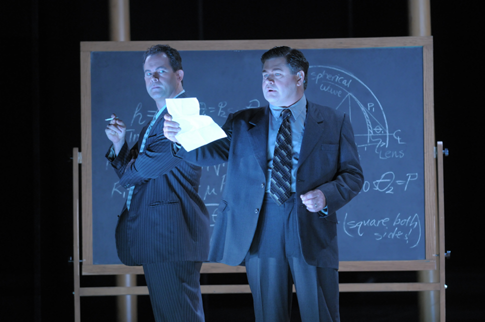 Gerald Finley (l.) stars as Robert Oppenheimer and Richard Paul Fink (r.) stars as Edward Teller in the Peter Sellars-directed Doctor Atomic, a Lyric Opera of Chicago premiere for the 2007-08 season. Photo by Dan Rest/Lyric Opera of Chicago.
Sellars, drawing deftly upon documentary material — much of it only recently made public — and poetry to which deeply intellectual Oppenheimer and his troubled wife Kitty were attached — stresses that the physicist in his challenge of the unknown was the Faust of the 20th century, and he pairs him tellingly with Mephistophelean Edward Teller, later famous as the mastermind of the hydrogen bomb. It is the confrontation of Oppenheimer’s intellectual honesty with Teller’s lust for power that elevates “Doctor Atomic” beyond “mere” art in its concert for moral and ethical issues.
The Lyric is fortunate in having five of the SFO principles in its cast, and Canadian baritone Gerald Finley is even more of a dead ringer for nervous, chain-smoking Oppenheimer than he was at the premiere. And Richard Paul Fink, the reigning Alberich in today’s “Ring” cycles, makes Teller more threatening that he was two years ago. Highlight of the Chicago staging, seen on December 18, was Finley’s delivery of the haunting “Batter my heart, three-person’d God,” that concludes Act One. (The text is by John Donne.)
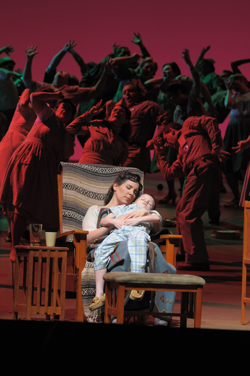 Jessica Rivera stars as Kitty Oppenheimer in the Peter Sellars-directed Doctor Atomic, a Lyric Opera of Chicago premiere for the 2007-08 season. Photo by Dan Rest/Lyric Opera of Chicago.
In extensive revisions of the score Kitty Oppenheimer is now a soprano, warmly sung by Jessica Rivera, who has made her mark as both as both Nuria and Margarita in Osvaldo Golijov’s “Ainadamar.” One critic called “Am I in your light?,” her Act-One “serenade” of her husband “a bundled Mahlerian adagietto of emotion,” and in Act Two she brings Cassandra-like insight into her exchange with Native-American nursemaid, sung with earthy sensuousness by Lyric studio artist Meredith Arwady.
Despite revisions since the premiere, however, the tension that has the audience writhing in Act One is lost in Act Two, in which the score loses its impulse. It will be interesting to see what further revisions are made when Penny Woolcock directs a totally new production of “Doctor Atomic” at the Met next season.
Conductor Robert Spano, enviously at home with contemporary scores, brings a sharp focus to Adams’ score. Questionable, however, are the largely aimless gyrations of an octet of dancers choreographed by Lucinda Childs.
Peter Sellars sums up “Doctor Atomic” as “a reality that we’re living with every minute,” and the overall excellence of the Chicago staging left no doubt about. Indeed, as Thomas Mann once wrote in another context, the opera focuses attention on a time in which “so much began that has not yet left off beginning.”
The positive response of the Chicago audience is encouraging, for it indicates a willingness — indeed, perhaps a need — for opera that is unafraid to engage itself in compelling and complex issue. True, “Doctor Atomic” will never replace “Carmen” and “Butterfly” in public favor, but its success indicates the existence of a vast number of opera-goers who seek more than mere entertainment. It is a work that demands a critical response from all who see it. And the opera is of particular relevance to Chicago, for it was beneath the football field at the University of Chicago that Enrico Fermi set off the first controlled nuclear chain reaction in history.
A film to watch for
It is sad indeed that a major companion piece to “Doctor Atomic” is largely unavailable to the current audience of the opera. Although “Wonders Are Many: The Making of Doctor Atomic” has been shown at several film festivals, it is not yet available through regular DVD channels.
Made for public television, word is that the film will not be distributed until it has been seen on PBS, and at present no date has been set for its showing there. An engaging counterpoint of details from Oppenheimer’s life and career and the creation of “Doctor Atomic,” the film reflects the same anxiety that accounts for the on-stage apprehension so compellingly portrayed by Sellars and Adams. It is the work of filmmaker Jon Else, whose credits include award-winning documentary on Oppenheimer and the Manhattan Project “The Day After Trinity” Those who see “Doctor Atomic” should watch PBS schedules.
Wes Blomster