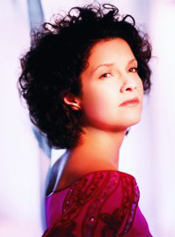
Appearances be damned, I
simply could not pass up the chance to experience first hand a glorious voice
deployed by an impeccable artist. I was the richer for the journey.
For this was not just any-old-concert of crowd pleasing arias by a
much-recorded and marketed glam diva with a competent orchestra being paced
by a conductor-as-time-beater. No, the program featured no less than Berlioz’
wonderfully complex and seldom-heard “Les nuits d’ete” and the band was none
other than the luminous Kammerorchester Basel, led with insight and
conviction by Paul McCreesh. This highly skilled musical ensemble proved a
real partner in the total success of the program.
That Ms. Kirschlager is a treasurable recording artist with a rich and
gorgeous tone was well known to me. Already an admirer, I was still not fully
prepared for the scope of dynamic variations, the detailed musical
observations, and the utterly secure vocal technique at both extremes of her
range that she effortlessly commands. These six songs are anything but an
“easy sing.” From the sprightly tune of the “Villanelle” to the moodiness of
“Le spectre de la rose” and the haunting despair that creeps into “Au
cimitiere” and “L’ile inconnue,” there is virtuoso singing (and playing)
required throughout.
For not only the vocal line, but also instrumental solo lines are often
fragmented, halting, and rangy in tessitura and volumes. It is a supreme
challenge to make phrases, songs, and the whole shebang hang together, much
less make it musical and meaningful. It is to the great credit of the singer,
conductor, and the entire ensemble that they took us on a most compelling
journey through each of these six pieces, by turns joyous, grief-stricken,
questioning, and uplifting. Quite a range of shifting moods, that.
Everything about Ms. Kirschlager (save her exceptional talent) strikes me
as untemperamental, unfussy, and unaffected. She appeared looking lovely in a
modest black gown with little adornment, very light make-up, and a simple
coiffure. She seems content to let the music emanate from within and provide
all the glamor needed, indeed to be the evening’s raison-d’etre.
If she seemed ever so slightly uncomfortable on the platform at first,
perhaps she was indisposed. Although never noticeable in her music-making,
she turned upstage and let forth with some good throat-clearing coughs after
songs three, four and five. And there was no hint of an encore to be
offered.
She did use the music, which kept her eyes diverted to the music stand a
fair amount of the time. While this did somewhat limit her contact with the
audience, it did not really diminish her very real achievement communicating
these musical jewels. For she was always totally in command of the material,
scoring every musical and emotional moment. Surely she is going to either
record these songs, or perform them again, or both. Her stylish rendition
would be a most welcome addition to anyone’s CD collection.
Singing in clear, idiomatic French, I did sometimes wonder if it was wise
to let final (unvoiced in normal speech) syllables go off the voice. Or to
use an injected breathiness fairly frequently on selected syllables as a
device for dramatic effect. Or to use the occasional backward-placed French
“r.” I was seated very close and lost nothing, but I wondered how that might
be telegraphing to the further reaches of the house.
But these are very very minor points that are mere blips in a wholly
successful performance by a very major artist. In the flesh, Angelika
Kirschlager exceeded all the high expectations that I had been promised by
that first recital CD gift a friend sent me some years ago. I will assuredly
not wait so long before I seek her out again.
The program framed the Berlioz with two staples of orchestral literature.
The opening overture from Weber’s “Oberon” was as heady and jauntily played
as I have ever heard it, while the second half consisted of the evergreen
selections from Mendelssohn’s incidental music for “A Midsummer Night’s
Dream.”
I honestly thought about leaving at intermission, having been quite sated
by the Berlioz, but damn if I’m not glad I stayed. These pieces are popular
for a reason, and no recording could do justice to my first-ever live
experience with them, in which I realized a whole palette of orchestral
colors and minute detail I never noticed before.
The Kammerorchester Basel is a truly fine group of players, not only
technically accomplished, but (are you seated?) they are a group of
professional musicians who seem to radiate a joy of playing. They brought
real freshness and delight to these oft-played warhorses, yes, even (maybe
especially) the Wedding March, which was marked by expansive exuberance.
The audience responded in kind with a prolonged ovation that prompted an
encore, the very short “Elf’s Dance” from the same composition. Maestro
McCreesh was excellent throughout in coaxing results from his orchestra, but
here he turned positively playful, and with the two “false endings” turned
each time to the crowd with a look of “ya think it’s over?” and then quickly
turning back to conduct again. In a final tweak, the violists sprung to their
feet to saw away at their penultimate tremolo, and the whole evening
concluded with panache.
On a side note: Even though it was a winter Monday, it was distressing to
see the hall only half full at best. The large top ring was closed off
entirely and unlit, but still this was a decidedly poor showing for artists
of this caliber. Time was when this Pro Arte orchestra series was so heavily
subscribed that it was hard to get in. Are times changing that much?
James Sohre