
17 Feb 2008
Navajo oratorio a triumph in Phoenix
A sound designer? Isn’t that merely a euphemistic upgrade of “sound engineer?”
English Touring Opera are delighted to announce a season of lyric monodramas to tour nationally from October to December. The season features music for solo singer and piano by Argento, Britten, Tippett and Shostakovich with a bold and inventive approach to making opera during social distancing.
This tenth of ten Live from London concerts was in fact a recorded live performance from California. It was no less enjoyable for that, and it was also uplifting to learn that this wasn’t in fact the ‘last’ LfL event that we will be able to enjoy, courtesy of VOCES8 and their fellow vocal ensembles (more below …).
Ever since Wigmore Hall announced their superb series of autumn concerts, all streamed live and available free of charge, I’d been looking forward to this song recital by Ian Bostridge and Imogen Cooper.
Although Stile Antico’s programme article for their Live from London recital introduced their selection from the many treasures of the English Renaissance in the context of the theological debates and upheavals of the Tudor and Elizabethan years, their performance was more evocative of private chamber music than of public liturgy.
Evidently, face masks don’t stifle appreciative “Bravo!”s. And, reducing audience numbers doesn’t lower the volume of such acclamations. For, the audience at Wigmore Hall gave soprano Elizabeth Llewellyn and pianist Simon Lepper a greatly deserved warm reception and hearty response following this lunchtime recital of late-Romantic song.
For this week’s Live from London vocal recital we moved from the home of VOCES8, St Anne and St Agnes in the City of London, to Kings Place, where The Sixteen - who have been associate artists at the venue for some time - presented a programme of music and words bound together by the theme of ‘reflection’.
'Such is your divine Disposation that both you excellently understand, and royally entertaine the Exercise of Musicke.’
‘And there was war in heaven: Michael and his angels fought against the dragon; and the dragon fought and his angels, And prevailed not; neither was their place found any more in heaven … that old serpent … Satan, which deceiveth the whole world: he was cast out into the earth, and his angels were cast out with him.’
There was never any doubt that the fifth of the twelve Met Stars Live in Concert broadcasts was going to be a palpably intense and vivid event, as well as a musically stunning and theatrically enervating experience.
‘Love’ was the theme for this Live from London performance by Apollo5. Given the complexity and diversity of that human emotion, and Apollo5’s reputation for versatility and diverse repertoire, ranging from Renaissance choral music to jazz, from contemporary classical works to popular song, it was no surprise that their programme spanned 500 years and several musical styles.
The Academy of St Martin in the Fields have titled their autumn series of eight concerts - which are taking place at 5pm and 7.30pm on two Saturdays each month at their home venue in Trafalgar Square, and being filmed for streaming the following Thursday - ‘re:connect’.
The London Symphony Orchestra opened their Autumn 2020 season with a homage to Oliver Knussen, who died at the age of 66 in July 2018. The programme traced a national musical lineage through the twentieth century, from Britten to Knussen, on to Mark-Anthony Turnage, and entwining the LSO and Rattle too.
With the Live from London digital vocal festival entering the second half of the series, the festival’s host, VOCES8, returned to their home at St Annes and St Agnes in the City of London to present a sequence of ‘Choral Dances’ - vocal music inspired by dance, embracing diverse genres from the Renaissance madrigal to swing jazz.
Just a few unison string wriggles from the opening of Mozart’s overture to Le nozze di Figaro are enough to make any opera-lover perch on the edge of their seat, in excited anticipation of the drama in music to come, so there could be no other curtain-raiser for this Gala Concert at the Royal Opera House, the latest instalment from ‘their House’ to ‘our houses’.
"Before the ending of the day, creator of all things, we pray that, with your accustomed mercy, you may watch over us."
The doors at The Metropolitan Opera will not open to live audiences until 2021 at the earliest, and the likelihood of normal operatic life resuming in cities around the world looks but a distant dream at present. But, while we may not be invited from our homes into the opera house for some time yet, with its free daily screenings of past productions and its pay-per-view Met Stars Live in Concert series, the Met continues to bring opera into our homes.
Music-making at this year’s Grange Festival Opera may have fallen silent in June and July, but the country house and extensive grounds of The Grange provided an ideal setting for a weekend of twelve specially conceived ‘promenade’ performances encompassing music and dance.
There’s a “slide of harmony” and “all the bones leave your body at that moment and you collapse to the floor, it’s so extraordinary.”
“Music for a while, shall all your cares beguile.”
The hum of bees rising from myriad scented blooms; gentle strains of birdsong; the cheerful chatter of picnickers beside a still lake; decorous thwacks of leather on willow; song and music floating through the warm evening air.
A sound designer? Isn’t that merely a euphemistic upgrade of “sound engineer?”
No! — at least not when the designer in question is Mark Grey, who is now emerging as a major American composer. Listen to Grey’s new “Enemy Slayer” and you’ll hear what the difference between a designer and an engineer is. The beneficiary of extensive collaborations with John Adams, Peter Sellars and the Kronos String Quartet and of work at a Norwegian jazz club above the Arctic Circle, Grey understands sound — the raw material of music — as a fashion designer understands fabric, color, cut and style.
“I sit in the audience surrounded by people’s reaction to music,” says Grey, now 41. “I feel their emotional energy and I know how to sustain a tension that keeps them involved.” In “Enemy Slayer” Grey has woven a sonic tapestry that overwhelmed the audience at the premiere of the work by the Phoenix Symphony on February 7.
Commissioned by the orchestra to mark its 60th anniversary, the 70-minute oratorio is something new in music. One does not seek to define the style of the score, but surrenders rather to a flow of energy that parallels the forces of nature. True, Grey employs bi-tonal and bi-diatonic means to make the score increasingly atonal as the story develops, but these are only the externals of an achievement that has all the markings of a Wagnerian Gesamtkunstwerk [italics] — a composite work of art that might well prove a major monument of early 21st- century music. And the contemporary relevance of “Slayer,” subtitled “A Navajo Oratorio,” will astonish those who come to the work “cold,” expecting an evocation of the Native-American past but confronted by a wrenching drama of the present day.
A young Arizona native returns to his people from a desert war, where a cousin died in his arms. "Your blood poured brightly through my hands like a lamb being slaughtered,” sings the baritone soloist. “I could not stop it!"
In the story, told in verse with urgency and economy by Laura Tohe, a Navajo poet on the faculty of Arizona State University, the monsters of native myth become the tormenting memories of death and devastation that haunt the returned soldier and prompt him to tell his story. Although Grey’s ideas for the oratorio reach back several years, the work — once defined — was quickly written. Grey met Michael Christie, now in his third year as music director of the Phoenix Symphony, in 2004 in Rotterdam, where both were involved in the staging of John Adams’ “Death of Klinghofer.”

“Several times we took the train to Amsterdam to hear the Concertgebouw and visit museums,” Grey says. “The trip was an hour each way, and that gave us time to swap ideas.” Christie premiered Grey’s violin concerto “Elevation” at the (Boulder) Colorado Music Festival in 2005 with Leila Josephowicz as soloist. The conductor had just accepted the Phoenix appointment and talked with Grey about a new score for the orchestra‘s up-coming anniversary. “Michael is eager to premiere new and exciting works,” Grey says. “And although he left the door open to me, the idea of an oratorio came up immediately.”
Grey thought about a re-telling of the David and Goliath story, but found that it had little meaning for Phoenix. At that point he stumbled on Monster Slayer and his brother, central figures in the Navajo epic of creation. Twin warriors, they made the world safe for others. Grey was especially fascinated by Nidaa', the Navajo ceremony that washes away the psychic torments resulting from violent acts. When Enemy Slayer returned from killing the monsters that had threatened his people, he went through this ceremony. The relevance to a modern veteran is obvious.
“We were not out to make this a literal translation of myth," Grey says, "but to view a ceremonial path through a contemporary lens.” Grey found librettist Laura Tohe by googling [does that need quotes?]“Navajo” and “poet.”
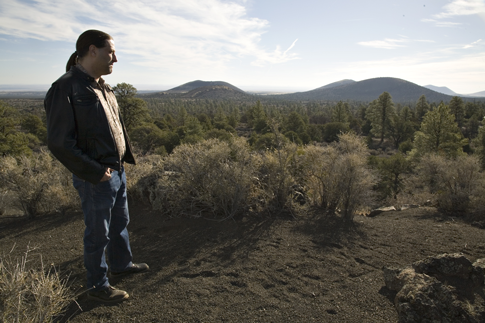 Mark Grey
Born on the Arizona reservation and educated in one of its boarding schools, Tohe is now professor of English at Arizona State in near-by Tempe. And although Tohe admits that when she accepted the assignment as librettist she had to look up both “libretto” and “oratorio,” the idea of an updated version of native myth caught her fancy.
As Grey continued his research he saw this story increasingly within the context of the entire Southwest, for the Navajo reservation, the largest in the United States, reaches into New Mexico and Utah. “It’s a region rich in creation stories,” Grey says, “and more and more I felt the energy of this region with its mountain spirits, deities and monsters. “And it was clear to me that this would be a large work — a work for mammoth chorus and orchestra.”
Grey’s source material, of course, came from oral tradition, and that posed a problem. “The minute you write something down, you remove it from its ceremonial function,” he says. “And out of understanding for the Navajos and their community, we did not want to do that. “What we wanted was a contemporary window on a very old story.” And Grey opted for a single solo voice, a baritone protagonist as the suffering soldier and kept at his reading while Tohe moved the project forward. “Laura got me involved in a dialogue with the Navajo community,” Grey says. “She put together a group of elders, and with them we discussed cultural sensitivity — what was appropriate and what wasn’t. “She opened doors and built a bridge between us.”
Grey speaks of his collaboration with Tohe as “a shared passion.” “We achieved an incredible balance between Navajo tradition and a contemporary dialogue,” he says of the Strauss-Hofmannsthal relationship that characterized their collaboration from the beginning. “It was back and forth from the outset; we worked in tandem. I sent Laura fragments of the score, and she came by to talk with me. “Together we visited places associated with the story, and the cultural palette grew wider and wider.”
In one of their first conversations they agreed that there would be no effort to make the score “sound Indian.” Grey was determined to avoid the stereotypes that one encounters in films — and in contemporary operas. (Well-intended recent operatic exercises in cultural tourism come to mind: Henry Mallicone’s “Coyote Tales” (Kansas City, 1998). David Carlsons’ “Dreamkeepers” (Salt Lake, 1996; Tulsa, 1998, and Anthony Davis’ “Wakonda’s Dream” (Omaha, 2007). Grey felt no temptation to “import” drummers and dancers from the Navajo nation. “Their tales are told with dance,” he sys. “It is all part of a myth-rooted ceremony. You cannot take its components out of this context.”
The chorus — director Gregory Gentry expanded the PSO Chorus to 150 for the premiere — speaks for the Navajo people and in a larger sense for all humanity. “Family and community are especially important for the Navajos,” says Grey, noting that the chorus functions here much as it does in Greek tragedy. “The ensemble speaks with an ancestral voice; it is there to help — and to cleanse the returned soldier.” (Tohe tells of an older brother who never recovered from his involvement in the Vietnam War. Upon his return to Arizona he refused ceremonial cleansing and died at 40 from his exposure to the toxic environment of war.)
Given the power of Grey’s music and Tohe’s poetry the inclusion of a visual perspective on this story might seem superfluous. However, what photographer Deborah O’Grady contributes to this production is far removed from the travelogue sometimes considered a bonus at concerts. With what she defines as “projected visualizations” O’Grady has brought another dimension to the oratorio. Using the latest digital software, she underscores the sweep of the music with images that move and morph and make the Arizona landscape an integral part of the work. "I tried as much as I could to be sensitive to the music," O’Grady. “And with digital technology, you can do something more sophisticated than just one picture fading into another."
Most moving are O’Grady’s shots of the tattered flags above the Fort Defiance Navajo Veterans Cemetery. (O’Grady, by the way, is married to composer John Adams.) Soloist for the premiere was Scott Hendricks, a youthful American now in great demand in European opera houses.
“Enemy Slayer” is a big work — in the sense the Mahler is big. It requires space to tell a story of urgent importance that reaches across cultures and centuries, and at the premiere Christie demonstrated a refined understanding for the spaciousness of the score. The carefully prepared performance of Grey’s lush and loving music brought home just how original the composer is in his understanding of the design of music. He has created here a collage of colors that brings the many voices of soloist, choir and instruments together with near-magical homogeneity.
In “Enemy Slayer” Grey might well have composed cthe requiem that laments America’s unfortunate adventure in the Middle East. The work deserves to be widely performed. Michael Christie will conduct “Enemy Slayer” at the Colorado Music Festival in Boulder, Colorado, on July 24 and 25, 2008. Soloist at that time will be Daniel Belcher. For information, visit www.coloradomusicfest.org.
West Blomster