03 Feb 2008
Verdi's Falstaff at Chicago
There is nothing redeeming about Sir John Falstaff, one of Shakespeare’s most lively comic characters and the subject of Verdi’s final opera, and yet, inexplicably, we love him.
English Touring Opera are delighted to announce a season of lyric monodramas to tour nationally from October to December. The season features music for solo singer and piano by Argento, Britten, Tippett and Shostakovich with a bold and inventive approach to making opera during social distancing.
This tenth of ten Live from London concerts was in fact a recorded live performance from California. It was no less enjoyable for that, and it was also uplifting to learn that this wasn’t in fact the ‘last’ LfL event that we will be able to enjoy, courtesy of VOCES8 and their fellow vocal ensembles (more below …).
Ever since Wigmore Hall announced their superb series of autumn concerts, all streamed live and available free of charge, I’d been looking forward to this song recital by Ian Bostridge and Imogen Cooper.
Although Stile Antico’s programme article for their Live from London recital introduced their selection from the many treasures of the English Renaissance in the context of the theological debates and upheavals of the Tudor and Elizabethan years, their performance was more evocative of private chamber music than of public liturgy.
Evidently, face masks don’t stifle appreciative “Bravo!”s. And, reducing audience numbers doesn’t lower the volume of such acclamations. For, the audience at Wigmore Hall gave soprano Elizabeth Llewellyn and pianist Simon Lepper a greatly deserved warm reception and hearty response following this lunchtime recital of late-Romantic song.
For this week’s Live from London vocal recital we moved from the home of VOCES8, St Anne and St Agnes in the City of London, to Kings Place, where The Sixteen - who have been associate artists at the venue for some time - presented a programme of music and words bound together by the theme of ‘reflection’.
'Such is your divine Disposation that both you excellently understand, and royally entertaine the Exercise of Musicke.’
‘And there was war in heaven: Michael and his angels fought against the dragon; and the dragon fought and his angels, And prevailed not; neither was their place found any more in heaven … that old serpent … Satan, which deceiveth the whole world: he was cast out into the earth, and his angels were cast out with him.’
There was never any doubt that the fifth of the twelve Met Stars Live in Concert broadcasts was going to be a palpably intense and vivid event, as well as a musically stunning and theatrically enervating experience.
‘Love’ was the theme for this Live from London performance by Apollo5. Given the complexity and diversity of that human emotion, and Apollo5’s reputation for versatility and diverse repertoire, ranging from Renaissance choral music to jazz, from contemporary classical works to popular song, it was no surprise that their programme spanned 500 years and several musical styles.
The Academy of St Martin in the Fields have titled their autumn series of eight concerts - which are taking place at 5pm and 7.30pm on two Saturdays each month at their home venue in Trafalgar Square, and being filmed for streaming the following Thursday - ‘re:connect’.
The London Symphony Orchestra opened their Autumn 2020 season with a homage to Oliver Knussen, who died at the age of 66 in July 2018. The programme traced a national musical lineage through the twentieth century, from Britten to Knussen, on to Mark-Anthony Turnage, and entwining the LSO and Rattle too.
With the Live from London digital vocal festival entering the second half of the series, the festival’s host, VOCES8, returned to their home at St Annes and St Agnes in the City of London to present a sequence of ‘Choral Dances’ - vocal music inspired by dance, embracing diverse genres from the Renaissance madrigal to swing jazz.
Just a few unison string wriggles from the opening of Mozart’s overture to Le nozze di Figaro are enough to make any opera-lover perch on the edge of their seat, in excited anticipation of the drama in music to come, so there could be no other curtain-raiser for this Gala Concert at the Royal Opera House, the latest instalment from ‘their House’ to ‘our houses’.
"Before the ending of the day, creator of all things, we pray that, with your accustomed mercy, you may watch over us."
The doors at The Metropolitan Opera will not open to live audiences until 2021 at the earliest, and the likelihood of normal operatic life resuming in cities around the world looks but a distant dream at present. But, while we may not be invited from our homes into the opera house for some time yet, with its free daily screenings of past productions and its pay-per-view Met Stars Live in Concert series, the Met continues to bring opera into our homes.
Music-making at this year’s Grange Festival Opera may have fallen silent in June and July, but the country house and extensive grounds of The Grange provided an ideal setting for a weekend of twelve specially conceived ‘promenade’ performances encompassing music and dance.
There’s a “slide of harmony” and “all the bones leave your body at that moment and you collapse to the floor, it’s so extraordinary.”
“Music for a while, shall all your cares beguile.”
The hum of bees rising from myriad scented blooms; gentle strains of birdsong; the cheerful chatter of picnickers beside a still lake; decorous thwacks of leather on willow; song and music floating through the warm evening air.
There is nothing redeeming about Sir John Falstaff, one of Shakespeare’s most lively comic characters and the subject of Verdi’s final opera, and yet, inexplicably, we love him.
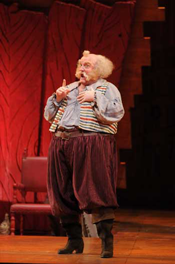
A bloated, insult-wielding drunkard who finds himself suddenly broke, he seeks to free himself from debt by wooing two wealthy women—both with the exact same love letter. When Alice Ford and Meg Page, the ladies in question, discover that they are being played for fools, they band together with the help of their friend Mistress Quickly and plan to dupe Falstaff. The musical result is one of the rare occasions when comic opera is actually funny. Played, as such evenings often are, to the blind in the 10th balcony, the laughs at Lyric are more often than not collective good-natured chuckles than guffaws of genuine surprise. Still, on opening night, the audience clearly enjoyed the opera’s style of comedy, investing in the show and audibly rooting for its favorite characters. This notion is further reinforced by Frank Phillipp Schlössmann’s Globe Theatre-inspired sets, which immediately transplant the audience into a world where a broader method of presentation is the norm. Costumes were traditional, but the bold colors contrasted beautifully with the amber-toned sets.
An audience can expect a thoroughly enjoyable evening of theatre—even if there are slight problems with the production—with a Falstaff from a top-notch company like Lyric Opera of Chicago. Picky imperfections in performance pale in the shadow of the brilliance of the work itself, obviously a labor of the composer’s love.
Like any comedy, a Falstaff is only as strong as its sense of ensemble, and, in something of a coup, by utilizing the brightly burning talents of current members of the Ryan Opera Center and supplementing them with the Center’s alumni, the administration has gathered a group of artists used to working with each other and who, out-singing most of the imported stars of the evening, present a tidy troupe. Even though director Olivier Tambosi fails to tighten the comic timing to sharp punctuality, the general mirth on stage more than carries the evening’s entertainment. Once again stepping forward with her booming voice, Meredith Arwady sparkles as Mistress Quickly, and her “Riverenza” scene inspired most of the genuine laughs of the evening. Elizabeth DeShong’s Meg Page is sprightly and attractive of voice. Of the current Ryan Opera Center’s roster, the most notable singer in this opera is Bryan Griffin, whose turn as Fenton is marked by a lyric tenor voice of both sweetness and strength, and Ryan Center alum Stacey Tappan’s crystalline Nannetta soars opposite Mr. Griffin. David Cangelosi, whose character tenor roles are well known at Lyric for their physicality, seems positively subdued next to the boisterous commedia dell’ arte characterization of fellow alumnus Rodell Rosel’s Bardolfo.
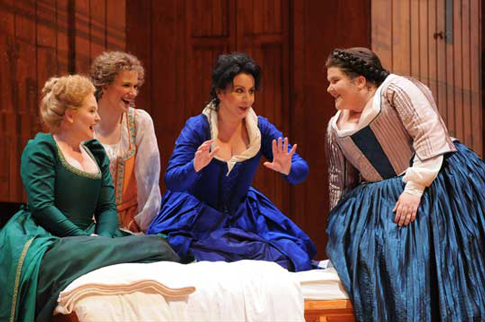 Alice Ford (Veronica Villarroel, third l.) describes her plan to feign interest in Falstaff's wooing as Meg Page (far l.), Nanetta (second l.), and Mistress Quickly (far r.) listen with delight in Lyric Opera of Chicago's 2007-08 production of Falstaff.
Though not advertised as Megastars, one would expect the leads of this production to outshine the ensemble easily, but such was not the case. As Alice, Veronica Villaroel is not the plastic prima donna spinning measure after measure of line while ignoring the baser nature of the material; the Chilean soprano found some joy in even the subtler moments of the comedy. Neither is Villaroel the soprano with very little in the way of voice, but with star power to burn. (In fact, she sang Alice with no apparent strain.) Villaroel lands this role instead somewhere in the unfortunate pleasant-enough middle ground and manages neither to offend nor excite. Similarly, Andrew Shore in the title role perhaps does not have the wherewithal to color more lyrical moments with the vocal subtlety he intends; however, he does make a convincing Falstaff, barking and seducing at regular intervals. The audience may forgive the slow moving actor because of the additional costuming required to render him obese, but his physical comedy fell short of the standard set by other members of the cast. Boaz Daniel, on the other hand, as Signore Ford, turns in a thoroughly engaging vocal performance, his robust and appealing baritone easily launching itself expressively over the orchestra for his aria “È sogno? O realtà…”
Andrew Davis, conducting what the official press release calls his ‘’favorite Verdi opera”, keeps the evening well paced in this reviewer’s opinion. His tempi, though, may have been a little slow for those on stage; the singers consistently tried to rush the Act One finale. Granted: the Act One finale is incredibly difficult to keep together, and the cast does a noble job of trying, perhaps, though, it could stand to watch the bouncing head of hair up front a little more. Still, the opera itself is sung very well across the board, the stagecraft solid, and the evening spent in the Civic Opera House absorbing Verdi’s last masterpiece is well spent.
Gregory Peebles © 2008