Or at least, to think. Plus, he is a darn nice guy.
Having admired both the musical dramas "Dead Man Walking" and the revised "The End of the Affair," as well as any number of his recorded songs, I was greatly looking forward to the Houston Grand Opera premiere of his newest work, "Last Acts." To say the least, I was not disappointed.
Gene Scheer's libretto takes as its inspiration a very short work by Terence McNally, and features only three singers: "Madeline Mitchell," an actress, and "Charlie" and "Beatrice," her children, all of whom seem to live in Dysfunction Junction. There is actually a fourth, if absent character, the late husband/father, whose untimely death informs much of the conflict.
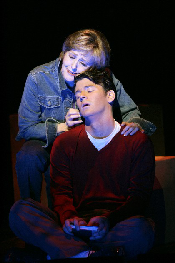
"Madeline" is a consummate stage mother, although not in the "Mama Rose" mold. She lives to be on stage, driven to deriving fulfillment from her approving audiences to the exclusion of the children after the loss of her husband. Although she is the pivotal figure, the emotional journey of "Last Acts" is more that of her gay son (whose partner is dying of AIDS), and alcoholic daughter (whose marriage cannot compensate for the early loss of her father), who long for her acceptance, or well, just plain recognition.
McNally's early piece was conceived for the concert platform (an AIDS benefit with the NYC Gay Men's Chorus) and uses a unifying dramatic device of the mother's annual, appallingly self-centered Christmas letter. As expanded here, the three acts are set a decade apart starting in 1986, at the height of the cataclysmic AIDS casualties here in the US.
Act One begins with baritone Keith Phares (exceedingly handsome of voice and face) and soprano Kristin Clayton (also looking radiant with singing to match), commiserating on the telephone over the contents of this annual letter, and lamenting their mother's detachment.
This act belongs most to "Charlie" as we come to learn of his partner's affliction, his craving of mom's approval, and ultimately, his co-dependence on his sister. A fine actor, Mr. Phares delivered a powerfully affecting, high-flying solo without a trace of self-pity, and joined Ms. Clayton at act's end for a deeply moving, beautifully sung duet about the memory of their father. "Bea" remembers dad (or idealizes him) as a benevolent patriarch in a comfortable easy chair. "Charlie" despairs that he remembers only . . .the chair. This was moving stuff, and arguably one of the high points in a score filled with pleasures.
Act Two gives way to "Beatrice's" demons, and Ms. Clayton is up to the challenge, with a bountiful lyric voice and spot-on projection throughout the range. She makes the most out of an extended scene of trying on mom's dresses (to accompany her to the Tony's), and delights us in a witty duet with her brother, extolling the virtues of "buying shoes" (a metaphor for therapy). Shortly after, she does a turn-about and has a searing confrontation with her mother, hurling powerfully sung phrases, and provoking a dramatic revelation about her idealized dad.
Any opera featuring the luminous mezzo Frederica von Stade ("Madeline Mitchell") at its center already has a lot going for it. This remarkable artist has been favoring us with consistently fine performances for over three decades. In my own experience, I cherish vivid memories of her Hamburg "Rosina," Brussels "Cendrillon," Paris "Octavian," New York "Cherubino," and most recently her "Mother" in San Francisco's "Dead Man Walking." The good news is that she is not only still a classy, beautiful, consummate artist, but she is also still singing very very well.
If the sheen and spin of her younger days is a bit diminished, it is amply compensated for by a hint of full-bodied, mature earthiness that was not there before. And if there is a very slight shifting of gears in and out of the chest voice now, she negotiates this rangy role with knowing skill. And our composer has given her some wonderful musical moments that play to all her interpretive strengths. She charms, she rants, she belts, she caresses, she provokes, she soothes, and she pours out phrase after phrase of plangent sound.
Act Three ultimately made "Madeline" a more fully rounded and sympathetic character, and ended by bringing her to the apron to invoke her philosophy of life which also happens to be the final phrase of her latest Christmas epistle. This act is much shorter than the either of the first two and seems more a postlude. Indeed the program heading says "an opera in two acts" although it later lists three, with an intermission between the first two.
To its credit and benefit, it does not hurt that "Last Acts" had the full arsenal of the HGO's first rate production values at its disposal, starting with director/designer Leonard Foglia. He placed the chamber orchestra on stage at the top level of some stepped platforms, making good, varied use of this playing space, to include raising and lowering actors and set pieces on the hydraulic pit apron.
By also flying in well-chosen minimal set pieces, and factoring in a flawless lighting design from Brian Nason, Mr. Leonard scored a lot of points for focus and variety. Cesar Galinda's wonderfully effective, occasionally dazzling costumes were also a great contribution, not least of which was the "reveal" of our diva's sequined red show gown from under a short cocktail dress as the scene progressed from entertainment at a private party to a Broadway show performance. Not since Effie White's "I Am Changing" turn in "Dreamgirls" has this effect been seen to better, more magical advantage.
But it was not just flash and dazzle and sleight of hand from our director. Add to the above an unerring sense of communicating character relationships, and a clarity in relating the story line, resulting in our being treated to some uncommonly fine acting.
The music was typically tuneful, dramatically engaging Heggie. In addition to the afore-mentioned set pieces, there were several hauntingly lovely motifs that caught the ear, Mme. von Stade had a wonderful scena when she reveals all about dad, and there were two sinuously intertwining trios that were achingly beautiful. Each character had a telling, well-considered monologue. And our composer sure knows how to deliver comedic punch lines with well-paced set-up and accurate pay-offs. The "Shoe Duet" in 3/4 time was reminiscent of Sondheim's "A Little Priest" without the Macabre.
That is not to say that absolutely everything worked, "Madeline's" comic party piece was missing that final "something" that would have made it play like the showstopping Cy Coleman novelty number it aspired to be. And early in Act Two, the libretto occasionally seemed too pat, bringing in a gratuitous reference or two about the father, or lacking clear definition of "Bea's" alcoholism and motivation for her to turn on her mother. But these are points that will be worked out as these talented creators play it for an audience. It remains to be said that this is a lovely chamber opera that greatly pleased its audience.
One quibble: since the three vocalists all had exemplary English diction, why the surtitles? They occasionally trumped the actors in giving away the dramatic and comic lines too soon, and why? They're not singing Polish, for God's sake! Turn that pacifier off when we can damn well hear and understand the words ourselves! (Thanks, I feel better now. . .)
The effective orchestration calls for five strings, oboe/English horn, one woodwind with doublings, percussion, and two keyboards played by the composer himself and HGO Music Director and conductor Patrick Summers. Maestro Summers has been instrumental in championing Heggie, and conducted the premieres of all three of his operas to date. As on other occasions, he led this group of superlative musicians with skill, dramatic savvy, and sensitive support.
"Last Acts" has other productions lined up starting in San Francisco, where it will play under its new title "Three Decembers." A rose by any other name should sound as sweet, especially if it has a cast, orchestra, and production support as top notch as that assembled by Houston Grand Opera. Mssrs. Heggie and Summers are young men. Here's hoping that they collaborate on many many more "Last Acts" of this high quality before their careers are finished.
James Sohre