02 Mar 2008
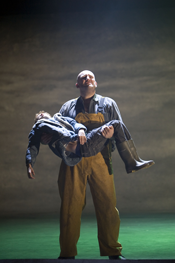
Peter Grimes by Opera North
Opera North is one of the most innovative opera companies in Britain.
English Touring Opera are delighted to announce a season of lyric monodramas to tour nationally from October to December. The season features music for solo singer and piano by Argento, Britten, Tippett and Shostakovich with a bold and inventive approach to making opera during social distancing.
This tenth of ten Live from London concerts was in fact a recorded live performance from California. It was no less enjoyable for that, and it was also uplifting to learn that this wasn’t in fact the ‘last’ LfL event that we will be able to enjoy, courtesy of VOCES8 and their fellow vocal ensembles (more below …).
Ever since Wigmore Hall announced their superb series of autumn concerts, all streamed live and available free of charge, I’d been looking forward to this song recital by Ian Bostridge and Imogen Cooper.
Although Stile Antico’s programme article for their Live from London recital introduced their selection from the many treasures of the English Renaissance in the context of the theological debates and upheavals of the Tudor and Elizabethan years, their performance was more evocative of private chamber music than of public liturgy.
Evidently, face masks don’t stifle appreciative “Bravo!”s. And, reducing audience numbers doesn’t lower the volume of such acclamations. For, the audience at Wigmore Hall gave soprano Elizabeth Llewellyn and pianist Simon Lepper a greatly deserved warm reception and hearty response following this lunchtime recital of late-Romantic song.
For this week’s Live from London vocal recital we moved from the home of VOCES8, St Anne and St Agnes in the City of London, to Kings Place, where The Sixteen - who have been associate artists at the venue for some time - presented a programme of music and words bound together by the theme of ‘reflection’.
'Such is your divine Disposation that both you excellently understand, and royally entertaine the Exercise of Musicke.’
‘And there was war in heaven: Michael and his angels fought against the dragon; and the dragon fought and his angels, And prevailed not; neither was their place found any more in heaven … that old serpent … Satan, which deceiveth the whole world: he was cast out into the earth, and his angels were cast out with him.’
There was never any doubt that the fifth of the twelve Met Stars Live in Concert broadcasts was going to be a palpably intense and vivid event, as well as a musically stunning and theatrically enervating experience.
‘Love’ was the theme for this Live from London performance by Apollo5. Given the complexity and diversity of that human emotion, and Apollo5’s reputation for versatility and diverse repertoire, ranging from Renaissance choral music to jazz, from contemporary classical works to popular song, it was no surprise that their programme spanned 500 years and several musical styles.
The Academy of St Martin in the Fields have titled their autumn series of eight concerts - which are taking place at 5pm and 7.30pm on two Saturdays each month at their home venue in Trafalgar Square, and being filmed for streaming the following Thursday - ‘re:connect’.
The London Symphony Orchestra opened their Autumn 2020 season with a homage to Oliver Knussen, who died at the age of 66 in July 2018. The programme traced a national musical lineage through the twentieth century, from Britten to Knussen, on to Mark-Anthony Turnage, and entwining the LSO and Rattle too.
With the Live from London digital vocal festival entering the second half of the series, the festival’s host, VOCES8, returned to their home at St Annes and St Agnes in the City of London to present a sequence of ‘Choral Dances’ - vocal music inspired by dance, embracing diverse genres from the Renaissance madrigal to swing jazz.
Just a few unison string wriggles from the opening of Mozart’s overture to Le nozze di Figaro are enough to make any opera-lover perch on the edge of their seat, in excited anticipation of the drama in music to come, so there could be no other curtain-raiser for this Gala Concert at the Royal Opera House, the latest instalment from ‘their House’ to ‘our houses’.
"Before the ending of the day, creator of all things, we pray that, with your accustomed mercy, you may watch over us."
The doors at The Metropolitan Opera will not open to live audiences until 2021 at the earliest, and the likelihood of normal operatic life resuming in cities around the world looks but a distant dream at present. But, while we may not be invited from our homes into the opera house for some time yet, with its free daily screenings of past productions and its pay-per-view Met Stars Live in Concert series, the Met continues to bring opera into our homes.
Music-making at this year’s Grange Festival Opera may have fallen silent in June and July, but the country house and extensive grounds of The Grange provided an ideal setting for a weekend of twelve specially conceived ‘promenade’ performances encompassing music and dance.
There’s a “slide of harmony” and “all the bones leave your body at that moment and you collapse to the floor, it’s so extraordinary.”
“Music for a while, shall all your cares beguile.”
The hum of bees rising from myriad scented blooms; gentle strains of birdsong; the cheerful chatter of picnickers beside a still lake; decorous thwacks of leather on willow; song and music floating through the warm evening air.
Opera North is one of the most innovative opera companies in Britain.
It doesn’t get quite the international attention it deserves, however, because it’s based “up North”, as Londoners would say, in what was once the nation’s industrial heartland. This award-winning production of Britten’s Peter Grimes shows why the company earns its excellent reputation.
Opera North has a real affinity for Britten, so with Phyllida Lloyd as director, this production is something of a milestone in Peter Grimes performance. Lloyd’s style grows from the inner dynamic of the opera. Everything focuses on the music, nothing distracts. The curtain lifts to reveal the corpse of the apprentice who died of thirst while lost at sea. It’s a metaphor for the whole opera. In the trial scene, Grimes is fenced in, claustrophobically, by a wall of pallets, held up by the townsfolk. Later these pallets are the bastions of the church, and the walls of the pub. It’s a simple device but effective, underlining the fundamental conflict between Grimes and the populace who inoculate themselves from the outside world with prayer and drink. Britten embeds this dichotomy firmly within his music. The “church” chorus and Ellen Orford’s monologue with the boy exist in parallel, without interaction. There’s drama enough in the orchestra, so Lloyd keeps things simple. Similarly, she doesn’t need to depict the sea, as such. Britten’s cadences sweep upwards and down like waves. “A ceaseless motion”, goes the text, “comes and goes like the tide,…rolls and ebbs, terrible and deep”.
This uncompromising focus on the drama in the music intensifies the disturbing psychological aspects of the opera. Jeffrey Lloyd-Roberts’s Grimes was perceptive : he’s not meant to be sympathetic, but neither is he an object of hate. He may be cruelly insensitive, but both boys died of natural causes. This role requires a wide range, which Lloyd-Roberts delivers. He created Grimes when this production was premièred in October 2006, and much of the depth of the characterisation is due to him. If on this particular evening, his voice was a little tired at first, he vindicated himself totally in the “What is home” scene, when Grimes confronts the horror of his situation. This time, “the tide will not turn”, he will not “begin again”. The intensity of Lloyd-Roberts performance makes his decision to die at sea completely logical. That last scene, where the townsfolk sing of the tide pulling back out to sea “with string magnetic speed” was magical. Grimes is absorbed into the sea, and for a few moments, something quite magical happens in the orchestra, as the strings surge and the flute rises luminously above. This ending was brilliant, for Lloyd understands that, throughout the opera, Britten has stressed the relentless hard grind of the fishermen’s lives. “This unrelenting work”, as Ellen sings, that lets up for no man. So as the music fades, but on stage, the rhythm of life continues…..it’s a small detail, but expressing the spirit of the opera very perceptively.
Unlike some more matronly Ellen Orfords, Giselle Allen‘s vibrant characterisation gave a strong sexual charge to her relationship with Grimes. This is important to the interpretation of the opera, because it shows why Grimes drives himself so hard, because he wants to make a new life with Ellen, whom he sees as his redemption. He pushes his apprentices harshly because life at sea is harsh, as no doubt he learned himself a boy. Sexuality is a theme in this opera, from which this production bravely does not shirk away. The townsfolk hint that there’s something unhealthy about Grimes and his boys, so they mount a witch hunt. The chorus “Bring the branding iron and fire” was sung with frenzied energy, hinting that perhaps Grimes wasn’t the only person with desires to suppress. Indeed, Britten makes this clear in the text. Auntie and her “nieces” most certainly provide an outlet for some. As Auntie says, she and her girls say, “we comfort men”. One of the more disturbing, but entirely trenchant, aspects of this production was that the nieces were portrayed as children, one wearing pink and blue with white knee
socks. She’s underage, just like the boys Grimes is hunted down for harming. When she’s propositioned by the town lawyer, that pillar of society, the text is painfully explicit, but some productions shy away. Currently in the UK news, there’s a huge story about child abuse in Jersey, apparently covered up by official whitewash, so watching this production was decidedly uncomfortable. But it serves to show that Britten knew far more about hypocrisy and sexual bullying than he was able to articulate. In 1945, productions couldn’t really confront these issues openly. Now, we are unfortunately more able to appreciate just how deeply Britten understood the pain.
Yet Britten doesn’t judge. In contrast, Mrs Smedley delights in judging. “Crime is my hobby” she says. Although she’s right to be concerned about the boys, her motivation isn’t their welfare, but her own enjoyment of misery. Ethna Robinson’s Mrs Smedley bristles with barely contained hysteria, in contrast to Jonathan Summer’s Captain Balstrode, who stands for common sense. Good vignette parts all round, especially Yvonne Howard’s Auntie and Roderick Williams’s Ned Keene.
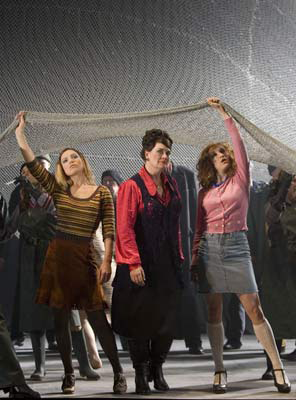 Claire Booth as Niece 2, Yvonne Howard as Auntie and Amy Freston as Niece 1.
Britten valued the orchestral elements in this opera so much that the Sea Interludes are often performed on their own as concert pieces. Farnes’s conducting was precise and muscular : there’s ambiguity aplenty in the music, so there shouldn’t be in performance. The solos, flute, violin and oboe were particularly moving, like extra voices, commenting on the action. What made this production, however, was the way it was built around the music. A lot of fuss is made of directing style, but in this case, the direction served totally to reveal deeper levels of meaning. The secret, I suspect, is “know your composer” and “know your opera”, through and through. Anyone wanting further evidence of Lloyd’s work with Opera North on Britten might be interested in their DVD of Gloriana.
Anne Ozorio © 2008