But
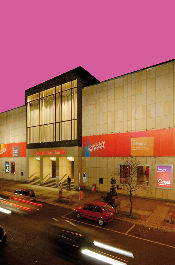
there’s much that makes the company, housed in an 1890’s variety venue in
downtown Behrensstrasse, unique — and exciting. And for those who know the
KO it’s not at all surprising that in 2007 Opernwelt, Germany’s
leading opera journal, singled out the KO as the country’s “Opera House
of the Year.”
To appreciate the KO fully, one needs to know a bit about the history of
the company that dates back to a production of Fledermaus launched
on December 23, 1947. Of the four victors in the war against Nazi Germany, it
was the Russians who took culture most seriously; and they made a great
effort to make their half of occupied Berlin a showcase for culture. Perhaps
their shrewdest move was appointing Walter Felsenstein the founding director
of the KO.
As an Austrian Felsenstein was viewed officially as a man from a country
that had been a victim of Hitler (forget those photos of exuberant crowds
welcoming the Führer to Vienna in 1938!). And not even a pro-forma communist
he lived in a better district of West Berlin and even after the Wall was
built in 1961 he drove his Mercedes to work. Pre-Wall West Berliners —
especially students — flocked to the KO, which balanced Bertolt Brecht’s
Berliner Ensemble just minutes away as a site of artistic adventure and
experimentation. Nonetheless, although Felsenstein remainder in charge of the
KO until his death in 1975, the brilliance of the company diminished. After
the Wall was built in the West it was considered politically incorrect to pay
30 marks merely to enter the East, where the government was increasingly
hard-pressed to come up with the hard currency that Felsenstein needed to
make things shine at the KO. And following the founder’s death Götz
Friedrich, his major assistant and seeming heir apparent, managed to move to
West Berlin, where he eventually ran the Deutsche Oper for two decades.
The new chief of the KO was Harry Kupfer, who — although he had had no
direct association with Felsenstein — ran the company with some distinction
even after the two Germanys were united. Kupfer’s successor is Andreas
Homoki. A still youthful man, Berlin — and Kupfer — trained, Homoki
distinguished himself as a director throughout Europe before being named to
the KO position in 2004. Limited only by the ever-increasing budget problems
that plague Germany’s capital, Homoki has taken obvious advantage of the
freedom that now goes with his position to honor the Felsenstein heritage
that once distinguished the KO. It was Felsenstein, after all, who —
although he did not coin the word — introduced the concept of
Regieoper to the opera world, making the director all powerful in
the staging of opera. It is Regieoper, known in the USA largely
through co-productions with European companies, that — to cite only two
popular examples — encouraged American director James Robinson to stage
La Bohème during World War One and to set Mozart’s
Abduction on the Orient Express.
Three productions from the KO’s current repertory, staged in the
handsomely refurbished Behrensstrasse house during Easter week, offered a
telling cross-section of the work currently being done there. Two of the
stagings — true taxi rides to the dark side — underscore the desire of
today’s directors to make opera politically relevant within the current
world situation. Both Handel’s Theseus and Gluck’s Iphigenie
auf Tauris — everything at the KO is sung in German — were staged as
outspoken anti-war declarations made with an obvious eye towards Iraq. The
approach worked well in Theseus, less so in the Gluck, with stagings
during the past year in San Francisco, Seattle and New York becoming
something of an American “hit.”
Composed in 1713 and one of Handel’s early London successes,
Theseus tells of Medea’s involvement in complex romantic
attachments following the gruesome murder of her children and husband. Athens
is at war, where Theseus leads the troops that defend the city. With
Allesandro de Marchi in charge of an energetic ensemble that included early
instruments, the staging by Benedikt von Peter kept the audience on March 14
breathless through almost four hours of da capo arias. A TV crew was
present to take advantage of violence in progress, and at one point an
exhausted Theseus sat on stage holding a sign that said — in English —
“NO MORE WAR.”
Much of the five-act work, performed with a single intermission, played
— literally — on a muddy battle field — something that left one
wondering about the KO’s laundry bill. The large cast was uniformly
excellent and — true to Felsenstein — consisted of young and attractive
artists superbly coached as singing actors. Elisabeth Starzinger was
compelling in the title role, while Stella Doufexis was a Medea passionate in
her desire to reduce the world to ashes. David Lee and Hagen Matzeit
underscored the easy availability of gifted counter tenors in today’s opera
world. It was a powerful production.
Abu Ghraid, Guantanamo? It’s clear from where Barry Kosky took his cues
in staging Iphigenie, which went the limit with waterboarding and
soldiers in American uniforms urinating on prisoners. Kosky was clearly out
to shock and awe. The curtain rose on Agamemnon’s daughter gleefully
slitting the throats of captives while the chorus caught the blood in plastic
trays and continued with blood and violence everywhere. It might well be that
it’s the truth that sets us free, but Kosky’s political overlay was more
than this graceful score by the great revolutionary of opera could
comfortably bear. The performers played against a large stone plate, which
stage designer Klaus Grünberg had suspended, along with changing lighting
effectively designed by Franck Evin. Yet the bleak darkness of Kosky’s
concept was essentially alien to Gluck’s music.
Kosky introduced a chorus of elderly, war-weary citizens — including the
ghosts of Iphigenie’s parents, who roamed the stage only in underwear.
Discomforting at first, one soon saw that these silent players were the
Erinyes (Eumenides) of antiquity bringing retribution upon modern man for
past wrongs. But the weight of the message was in painful contrast to
Gluck’s wonderfully animated music. One looked away as ever more blood
flowed.
Again, however, the cast was impressive. Slovenly in dress, Geraldine
McGreevy, left one eager to hear her as Strauss’ Marschallin, a role in
which she has won critical kudos at the KO. Kevin Greenlaw and Peter Lodahl
were of Hollywood handsomeness as Orestes and Pylades, both with voices that
would be the sensation of opera anywhere. One tired, however, of immense Jens
Larsen’s blustering Thoas, feeling again that Gluck demands moments of
gentleness and repose.
Kosky, however, was simply too literal in his fascination with the
violence of this story. For an American these two productions, though
admirable in their intention, raise the question of politicized classics.
Art, always in service of the good, true and beautiful, should awaken and
arouse. In music such as this, however, a commitment to its beauty must
remain primary. One further wonders whether such productions do not end up
speaking only to the already converted. How, otherwise, was it possible for
Germany’s Nazis to perform Beethoven’s Ninth Symphony at the drop of a
swastika?
Most problematic of the week’s productions was Hans Neuenfels’ staging
of Mozart’s Magic Flute, seen on March 18. Born in 1941, Neuenfels
is Germany’s senior — and most controversial — master of
Regieoper. Here to he went beyond the liberties that a director can
allow himself. It was Neuenfels who upset Karita Mattila by sending her on
stage in a Salzburg Così fan tutte in 2000 walking two men, in
leather and chains, as if they were dogs. The Finnish soprano called it the
worst experience she ever had. The premiere in 2003 of his new production of
Mozart's Idomeneo at Berlin’s Deutsche Opera Berlin was postponed
because of fears that a scene, in which Idomeneo staggers on stage carrying
the decapitated heads of Neptune, Jesus, Buddha and Muhammad might present a
security risk.
While the current Flute involves no such threats, it was
nonetheless a staging too far at odds with traditional Mozart. While Peter
Sellars’ stagings of Figaro, Così and Giovanni,
seen on PBS in 1991 upset elders, the director did not interfere with
Mozart’s music. Here Neuenfels added to the opera an on-stage producer, who
— to cite only one example — explained to her assistants that Tamino was
paranoid out to hunt the serpent for fear of being hunted himself. Continuing
interventions in the story were equally disturbing. In lieu of a flute, the
Three Ladies — proper British governesses — presented Tamino with a
yard-long colored glass penis that might have come from the studios of Dale
Chihuly. The Queen of the Night dismembers herself during her first aria and
is carried from the stage on a stretcher, leaving one leg behind. An ailingSarastro — did Neuenfels have Amfortas in mind? — appears in a wheelchairand dies on stage during the triumphal final chorus.
Such nonsense stretched the performance to well over three hours, whichmight explain conductor Kimbo Ishii-Eto’s relentless rushing of Mozart’smusic. What is amazing is that the KO cast is able to sing superbly in themidst of such mayhem. And it is safe to predict a fantastic future for JamesCreswell, the Sarastro of this Flute. Daniel Barenboim regularlyinvites the young American bass, a Yale graduate, to sing major roles at theState Opera.
Looking back on a week at Berlin’s Komische Oper one is surprised at the“take” that these productions are, even when one might have preferred amore traditional approach to the works on stage there. And from that point ofview they are successful. To appreciate them one need only walk down toBrecht’s old theater and recall his commitment to didactic stagings — incontrast to what he called “the culinary theater” that seeks only toentertain.
Wes Blomster