![Peter Marsh (Male Chorus), Nathaniel Webster (Prince Tarquinius) [Photo: Barbara Aumüller]](http://www.operatoday.com/lucretia11.png)
08 Apr 2008
Frankurt Opera — The Rape of Lucretia
Plainly put, Frankfurt Opera’s “The Rape of Lucretia” could be offered as a textbook example of just how great a performance can be when everything goes right.
English Touring Opera are delighted to announce a season of lyric monodramas to tour nationally from October to December. The season features music for solo singer and piano by Argento, Britten, Tippett and Shostakovich with a bold and inventive approach to making opera during social distancing.
This tenth of ten Live from London concerts was in fact a recorded live performance from California. It was no less enjoyable for that, and it was also uplifting to learn that this wasn’t in fact the ‘last’ LfL event that we will be able to enjoy, courtesy of VOCES8 and their fellow vocal ensembles (more below …).
Ever since Wigmore Hall announced their superb series of autumn concerts, all streamed live and available free of charge, I’d been looking forward to this song recital by Ian Bostridge and Imogen Cooper.
Although Stile Antico’s programme article for their Live from London recital introduced their selection from the many treasures of the English Renaissance in the context of the theological debates and upheavals of the Tudor and Elizabethan years, their performance was more evocative of private chamber music than of public liturgy.
Evidently, face masks don’t stifle appreciative “Bravo!”s. And, reducing audience numbers doesn’t lower the volume of such acclamations. For, the audience at Wigmore Hall gave soprano Elizabeth Llewellyn and pianist Simon Lepper a greatly deserved warm reception and hearty response following this lunchtime recital of late-Romantic song.
For this week’s Live from London vocal recital we moved from the home of VOCES8, St Anne and St Agnes in the City of London, to Kings Place, where The Sixteen - who have been associate artists at the venue for some time - presented a programme of music and words bound together by the theme of ‘reflection’.
'Such is your divine Disposation that both you excellently understand, and royally entertaine the Exercise of Musicke.’
‘And there was war in heaven: Michael and his angels fought against the dragon; and the dragon fought and his angels, And prevailed not; neither was their place found any more in heaven … that old serpent … Satan, which deceiveth the whole world: he was cast out into the earth, and his angels were cast out with him.’
There was never any doubt that the fifth of the twelve Met Stars Live in Concert broadcasts was going to be a palpably intense and vivid event, as well as a musically stunning and theatrically enervating experience.
‘Love’ was the theme for this Live from London performance by Apollo5. Given the complexity and diversity of that human emotion, and Apollo5’s reputation for versatility and diverse repertoire, ranging from Renaissance choral music to jazz, from contemporary classical works to popular song, it was no surprise that their programme spanned 500 years and several musical styles.
The Academy of St Martin in the Fields have titled their autumn series of eight concerts - which are taking place at 5pm and 7.30pm on two Saturdays each month at their home venue in Trafalgar Square, and being filmed for streaming the following Thursday - ‘re:connect’.
The London Symphony Orchestra opened their Autumn 2020 season with a homage to Oliver Knussen, who died at the age of 66 in July 2018. The programme traced a national musical lineage through the twentieth century, from Britten to Knussen, on to Mark-Anthony Turnage, and entwining the LSO and Rattle too.
With the Live from London digital vocal festival entering the second half of the series, the festival’s host, VOCES8, returned to their home at St Annes and St Agnes in the City of London to present a sequence of ‘Choral Dances’ - vocal music inspired by dance, embracing diverse genres from the Renaissance madrigal to swing jazz.
Just a few unison string wriggles from the opening of Mozart’s overture to Le nozze di Figaro are enough to make any opera-lover perch on the edge of their seat, in excited anticipation of the drama in music to come, so there could be no other curtain-raiser for this Gala Concert at the Royal Opera House, the latest instalment from ‘their House’ to ‘our houses’.
"Before the ending of the day, creator of all things, we pray that, with your accustomed mercy, you may watch over us."
The doors at The Metropolitan Opera will not open to live audiences until 2021 at the earliest, and the likelihood of normal operatic life resuming in cities around the world looks but a distant dream at present. But, while we may not be invited from our homes into the opera house for some time yet, with its free daily screenings of past productions and its pay-per-view Met Stars Live in Concert series, the Met continues to bring opera into our homes.
Music-making at this year’s Grange Festival Opera may have fallen silent in June and July, but the country house and extensive grounds of The Grange provided an ideal setting for a weekend of twelve specially conceived ‘promenade’ performances encompassing music and dance.
There’s a “slide of harmony” and “all the bones leave your body at that moment and you collapse to the floor, it’s so extraordinary.”
“Music for a while, shall all your cares beguile.”
The hum of bees rising from myriad scented blooms; gentle strains of birdsong; the cheerful chatter of picnickers beside a still lake; decorous thwacks of leather on willow; song and music floating through the warm evening air.
Plainly put, Frankfurt Opera’s “The Rape of Lucretia” could be offered as a textbook example of just how great a performance can be when everything goes right.
Britten wrote this complex chamber opera after his large-scale masterpiece “Peter Grimes” and it could not be less alike, not only in scale, but in the method of storytelling. For “Lucretia” is a concept work from the get-go, a tale of violent criminal sexual behavior in ancient Rome juxtaposed with a narration and commentary characterized by Christian proselytizing from a solo “Male and Female Chorus,” one each.
Peripatetic baritone Dale Duesing, while still performing well himself, has been venturing into stage direction in the early autumn of his vocal career, and he has come up with a stunning solution in which to frame the piece. He made the two “Chorus” soloists insidiously engaging televangelists, and the clean and effective “pure” white stage setting (by Boris Kudlicka) their TV studio set. Indeed, the effect would not have been out of place on the Praise the Lord Network.
Like a PTL pre-show, the “ministers” mingled with and greeted the real life audience, and the rest of the cast/production team joined them onstage for a prayer circle before the telecast began. A video cam was used selectively throughout with telling effect, sometimes creating a TV show atmosphere, sometimes manipulating its target worshipers with calculated inspirational imagery, but often as not capturing characters in the cross hairs of emotional flash points with a chilling freeze frame effect.
As the enactment of “Tarquinius’” pre-meditated, unutterably evil ravishment of “Lucretia” unfolded (as played by the TV “cast”), the line between an elusive “good” and faux piety began to blur inexorably. It was soon hard to reconcile ugly reality with pious posturings, which indeed initially reveled in re-telling this sordid tale as something merely to be rather salaciously exploited for moralizing effect. As the whole scenario careened out of anyone’s control it morphed into a profound spiritual tragedy which would not be soothed away by empty religious platitudes of convenience. When the “moral” televangelists are as spiritually bankrupt as the godless “Tarquinius,” to whom does one turn for succor? (Stop me if this sounds familiar. Jerry? Tammy Fay? Oral?)
This compact two-acter crams a lot of provocative imagery into its rather short running time: The ravishment of innocence. Radical religious pronouncements. Exploitation of power. Objectification of women. Political one upsmanship at any cost. Mindless degradation of a perceived rival. Military misdeeds. All this in a piece penned in 1956. Find any contemporary resonance here? Let’s see a show of hands. . .
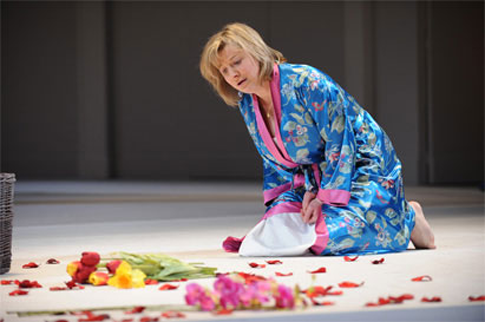 Claudia Mahnke (Lucretia)
In addition to his shatteringly correct concept, Mr. Duesing not only showed a refined skill for varied and meaningful blocking, but more important, he coaxed highly individual and deeply internalized characterizations from a uniformly excellent ensemble of singers, cast from strength. A sure directorial hand infused the piece with a palpable tension building to the titular act of uncommon menace, brutality, and pre-meditation.
The largest ovation of the night was earned by baritone Andrew Ashwin for a top notch reading of “Junius.” This young performer, with his robust, focused voice and a strapping presence, seems on the verge of a major career. Simon Bailey’s sympathetic demeanor and warm, burnished tone brought dignity and compassion to “Collatinus.”
The lovely young lyric soprano Krenare Gashi served Britten’s high-flying leaps and turns with spot-on precision in a wholly engaging turn as “Lucia.” She was matched in artistry and stage presence by the plummier mezzo of Arlene Rolph as “Claudia.” Their extended bucolic duet scene “the morning after” was immaculately voiced. Nathaniel Webster was a fine “Tarquinius,” and not of the mere “eye candy” variety that other recent star singers have brought to the part. Mr. Webster not only sang with force and beauty throughout, but he can also color and declaim his threats with a biting urgency, and even sexual huskiness. His uninhibited, disrobed physicalization of “the deed” was powerful stagecraft.
As the “Chorus,” Anja Fidelia Ulrich and, especially, Peter Marsh were frighteningly focused on their “mission,” as grinning disingenuous money lenders who needed to be driven from the temple. (Where’s a Messiah when you need one?) Although I have always found the “Female Chorus” to be less interesting musically, Ms. Ulrich certainly sang it well, and found plenty to work with dramatically as her character arguably became the most sympathetic onlooker in the the tragedy. Only she appeared to realize what they, and God had wrought in setting this tale in motion. Mr. Marsh seemed born to sing his role. Part snake oil salesman, part brain-washed believer, his characterization was disturbingly well-rounded, and as well sung as you are likely to hear.
That leaves our heroine, and Claudia Mahnke created a noble heroic figure, pitying and pitiable, strong-willed yet accepting of her fate in a way similar to the young wife in the recent film “No Country for Old Men.” Confronted with consummate evil, she knows why “Tarquinius” is there, and is helplessly doomed to be his prey. Whether singing full tilt or scaling down to a whisper, this splendid house mezzo deployed her smoky-hued voice to full effect in sculpting a multi-faceted portrayal. Her defiled appearance before her husband in purple gown (just one of Nicky Shaw’s excellent costumes), and subsequent slitting of her wrists ending in a bloody death on the flower-strewn, lit white steps in a crucifixion pose, was just one more chilling image in an evening filled with visual artistry.
The chamber orchestra under Maurizio Barbacini could hardly have been bettered. Soloists all, they relished their individual moments as virtuosically as they essayed the concerted ensemble efforts. Britten’s harp effects always strike me afresh as magical calculations, and his masterful scoring was well served by the skilled Frankfurt instrumentalists.
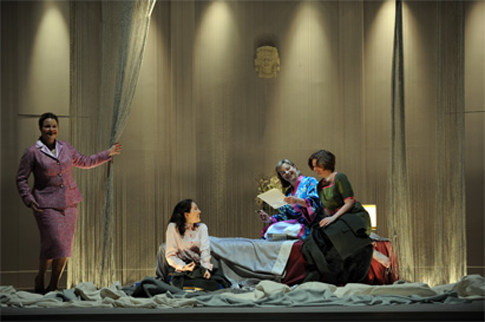 Anja Fidelia Ulrich (Female Chorus), Krenare Gashi (Lucia), Claudia Mahnke (Lucretia), Arlene Rolph (Bianca)
As true testament to the success of “The Rape of Lucretia,” not only were there waiting lines for ticket returns for each show (for “Lucretia” of all things!), but I cannot remember the last time I was a member of an audience that was so still, so engaged, so attentive to every phrase, every musical utterance. Honestly, the promise of thrilling evenings like these is why I continue to go to the opera.
Suffice it to say if this is an example of Dale Duesing’s directorial skill, I may have to become a groupie. And Frankfurt should seriously consider reviving this splendid production, a triumph for all concerned. Bravi tutti!
James Sohre