21 Apr 2008
(Mostly) Pretty Poison
What to make of "Lucrezia Borgia"? I have always felt that, some lovely arias notwithstanding, this Donizetti work never really gets going until the slam-bang soprano-baritone duet in Act II.
English Touring Opera are delighted to announce a season of lyric monodramas to tour nationally from October to December. The season features music for solo singer and piano by Argento, Britten, Tippett and Shostakovich with a bold and inventive approach to making opera during social distancing.
This tenth of ten Live from London concerts was in fact a recorded live performance from California. It was no less enjoyable for that, and it was also uplifting to learn that this wasn’t in fact the ‘last’ LfL event that we will be able to enjoy, courtesy of VOCES8 and their fellow vocal ensembles (more below …).
Ever since Wigmore Hall announced their superb series of autumn concerts, all streamed live and available free of charge, I’d been looking forward to this song recital by Ian Bostridge and Imogen Cooper.
Although Stile Antico’s programme article for their Live from London recital introduced their selection from the many treasures of the English Renaissance in the context of the theological debates and upheavals of the Tudor and Elizabethan years, their performance was more evocative of private chamber music than of public liturgy.
Evidently, face masks don’t stifle appreciative “Bravo!”s. And, reducing audience numbers doesn’t lower the volume of such acclamations. For, the audience at Wigmore Hall gave soprano Elizabeth Llewellyn and pianist Simon Lepper a greatly deserved warm reception and hearty response following this lunchtime recital of late-Romantic song.
For this week’s Live from London vocal recital we moved from the home of VOCES8, St Anne and St Agnes in the City of London, to Kings Place, where The Sixteen - who have been associate artists at the venue for some time - presented a programme of music and words bound together by the theme of ‘reflection’.
'Such is your divine Disposation that both you excellently understand, and royally entertaine the Exercise of Musicke.’
‘And there was war in heaven: Michael and his angels fought against the dragon; and the dragon fought and his angels, And prevailed not; neither was their place found any more in heaven … that old serpent … Satan, which deceiveth the whole world: he was cast out into the earth, and his angels were cast out with him.’
There was never any doubt that the fifth of the twelve Met Stars Live in Concert broadcasts was going to be a palpably intense and vivid event, as well as a musically stunning and theatrically enervating experience.
‘Love’ was the theme for this Live from London performance by Apollo5. Given the complexity and diversity of that human emotion, and Apollo5’s reputation for versatility and diverse repertoire, ranging from Renaissance choral music to jazz, from contemporary classical works to popular song, it was no surprise that their programme spanned 500 years and several musical styles.
The Academy of St Martin in the Fields have titled their autumn series of eight concerts - which are taking place at 5pm and 7.30pm on two Saturdays each month at their home venue in Trafalgar Square, and being filmed for streaming the following Thursday - ‘re:connect’.
The London Symphony Orchestra opened their Autumn 2020 season with a homage to Oliver Knussen, who died at the age of 66 in July 2018. The programme traced a national musical lineage through the twentieth century, from Britten to Knussen, on to Mark-Anthony Turnage, and entwining the LSO and Rattle too.
With the Live from London digital vocal festival entering the second half of the series, the festival’s host, VOCES8, returned to their home at St Annes and St Agnes in the City of London to present a sequence of ‘Choral Dances’ - vocal music inspired by dance, embracing diverse genres from the Renaissance madrigal to swing jazz.
Just a few unison string wriggles from the opening of Mozart’s overture to Le nozze di Figaro are enough to make any opera-lover perch on the edge of their seat, in excited anticipation of the drama in music to come, so there could be no other curtain-raiser for this Gala Concert at the Royal Opera House, the latest instalment from ‘their House’ to ‘our houses’.
"Before the ending of the day, creator of all things, we pray that, with your accustomed mercy, you may watch over us."
The doors at The Metropolitan Opera will not open to live audiences until 2021 at the earliest, and the likelihood of normal operatic life resuming in cities around the world looks but a distant dream at present. But, while we may not be invited from our homes into the opera house for some time yet, with its free daily screenings of past productions and its pay-per-view Met Stars Live in Concert series, the Met continues to bring opera into our homes.
Music-making at this year’s Grange Festival Opera may have fallen silent in June and July, but the country house and extensive grounds of The Grange provided an ideal setting for a weekend of twelve specially conceived ‘promenade’ performances encompassing music and dance.
There’s a “slide of harmony” and “all the bones leave your body at that moment and you collapse to the floor, it’s so extraordinary.”
“Music for a while, shall all your cares beguile.”
The hum of bees rising from myriad scented blooms; gentle strains of birdsong; the cheerful chatter of picnickers beside a still lake; decorous thwacks of leather on willow; song and music floating through the warm evening air.
What to make of "Lucrezia Borgia"? I have always felt that, some lovely arias notwithstanding, this Donizetti work never really gets going until the slam-bang soprano-baritone duet in Act II.
I was hoping that a new production at Torino's Teatro Regio might change my mind. And indeed, their substantial effort had many excellent components.
Angelo Sala's handsome, angled colonnade unit (which would not have been out of place on neighboring Via Po) may have initially looked a bit slate-gray, socialist-utilitarian, but it was re-dressed handsomely (and relatively quickly) for the several changes of locale, without at all giving the impression that we were looking at scenery-on-the cheap Very simple but highly effective, and well-detailed.
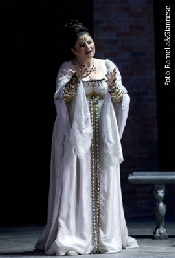
Lovely, too, were the sumptuous court costumes of Cristina Aceti, which not only provided ample delights to dazzle the eye, but displayed a well-considered color palette, from the opening act's silvers, blacks and grays, to the more colorful street and social life of Ferrara. "Lucrezia," as should be, looked every inch the alluring diva in some knock-out gowns. One major slip-up was the unflattering gray schmatte that poor "Gennaro" got stuck in. With his long hair and round face, in profile the unfortunate effect was that he looked alarmingly like Mama Cass.
Andrea Anfossi's lighting was sensitive, atmospheric, and well-cued. Tiziana Tosco's choreography was inventive and appropriate. So what more could I want? Well, let's see, more meaningful direction from Francesco Bellotto would have been nice. Blocking was rather workaday routine, if not downright obvious; characters did not relate to each other nearly often enough; and for all the detail and inventiveness in the the design elements, there was precious little on display in the histrionics.
Example: "Orsini" is given a goblet of wine (empty but we are meant to believe it "full") which he flails about indiscriminately, turning it upside down at one point, then shortly thereafter we are asked to believe he is still able to "drink" from it as he toasts and quaffs with his comrades. There was scant attention paid to discovering nuances, or even fleshing out the the big chunks to provide any substantially helpful dramatic support to the music.
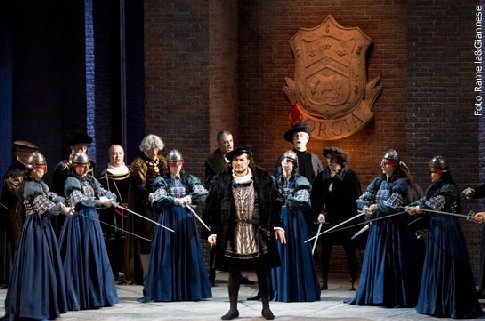 A scene from Act I
To his credit, even though he did not greatly illuminate it, Signor Bellotto also did not get in the way of the sense of the story. However, there was a "mysterious" young girl who covers the sleeping "Gennaro" with a red cloth in Act I, then is carried on dead with grieving parents in tow in Act II (ignored by all on stage), reappearing with the family in Act III to block "Lucrezia's" way as she seeks to get help for the poisoned "Gennaro," the girl later covering his corpse with the same red cloth. (Ooooooooooh)
Okay, do you get this? 'Cause I don't. Who are they? And do our characters see them? Or not? Here today, gone domani? A consistent point of view might have yielded a good dramatic device instead of another minor distraction.
Happily, on the musical side, Torino's forces delivered the goods. I originally went planning to see Fiorenza Cedolins in the Sunday matinee, only to find she had been replaced. (I didn't ask. This is Italy.) So, I opted to swap the ticket for Saturday evening (can you imagine doing that at the Met?!) to hear another soprano I have read a lot about: Angeles Blancas Gulin. And I was quite glad I did.
Up front, the lovely Ms. Gulin's singing will not please all tastes. I have the feeling that, like the great Scotto, she has a full lyric instrument with good point, that she is pushing to the limit, albeit often with thrilling results. A beat crept into a few of the very top notes, and while she did nail a climatic note in-Alt at Act I's end, we (and she) might have been happier with a lower option.
But she is indisputably a creature of the stage, prowling and hissing, sparking and ranting, singing alternately with controlled beauty, hushed introspection and inflamed dramatic declamation. Her impassioned portrayal earned her a huge ovation, and ultimately she won me over and took me along on her journey owing more to her total commitment and musicianship than to her overall vocal production. Still, it is a rare treat to hear the piece, and a joy to hear the role embodied so thoroughly.
Tenor Salvatore Cordella ("Gennaro") was a stand-in for Raul Hernandez, also not singing as announced (see above, this-is-Italy-don't-ask-don't-tell). Mr. Cordella has a sweet voice deployed with a sound technique, and he husbanded his resources well. However, there is a difference between sensible pacing, and marking. And I felt our tenor was so croony on so many passages that he gave the impression of feeling over-parted, scaling back on the parlando passages so he could pour out the tone convincingly on the money sections. A young man, experience may remedy this effect and even out his vocal portrayal.
No such problem from our "Don Alfonso," Simone del Savio. He is possessed of a very substantial, warmly engaging baritone that has even production throughout, admirable portamento, and plenty of presence. If the top notes didn't quite rattle the chandeliers like Milnes or MacNeill, they were nevertheless well-focused and full-voiced.
Arguably, the vocal performance of the night was the knock-out turn by Barbara di Castri as "Orsini." From the first time she opened her mouth and let fly with a phrase in chest voice that would have made Horne proud, this was announcement of a major talent. It is true that she sang "just" under the pitch in some of Act I's higher reaches, but this vanished completely in the remainder of the piece, as she claimed the stage at every moment with a well-sung, committed portrayal of great power and vocal beauty.
The resident orchestra was in fine form under the sure hand of veteran Bruno Campanella. Hearing these pieces played by Italians is most always a revelation to me. They seem to effortlessly embrace this style, bringing fire, artistry and excitement to even the most simplistic of melodic phrases, and to the most trite of predictable rhythmic effects. More important, Maestro Campanella and his band partnered their soloists with care and sensitivity.
Overall, then this outing offered compelling music-making, excellent production values, and non-offensive staging. While Act I of "Lucrezia Borgia" may still fail to excite me, a musical reading as persuasive as this could convince me to give it yet another listen. And with some loving attention to character relationships, Torino could transform this "Lucrezia" from merely a very good evening into a truly memorable night at the opera.
James Sohre