21 Apr 2008
The Minotaur — Royal Opera, Covent Garden
Harrison Birtwistle’s new full-scale opera, commissioned by the Royal Opera House, Covent Garden, is a study of isolation and imprisonment.
English Touring Opera are delighted to announce a season of lyric monodramas to tour nationally from October to December. The season features music for solo singer and piano by Argento, Britten, Tippett and Shostakovich with a bold and inventive approach to making opera during social distancing.
This tenth of ten Live from London concerts was in fact a recorded live performance from California. It was no less enjoyable for that, and it was also uplifting to learn that this wasn’t in fact the ‘last’ LfL event that we will be able to enjoy, courtesy of VOCES8 and their fellow vocal ensembles (more below …).
Ever since Wigmore Hall announced their superb series of autumn concerts, all streamed live and available free of charge, I’d been looking forward to this song recital by Ian Bostridge and Imogen Cooper.
Although Stile Antico’s programme article for their Live from London recital introduced their selection from the many treasures of the English Renaissance in the context of the theological debates and upheavals of the Tudor and Elizabethan years, their performance was more evocative of private chamber music than of public liturgy.
Evidently, face masks don’t stifle appreciative “Bravo!”s. And, reducing audience numbers doesn’t lower the volume of such acclamations. For, the audience at Wigmore Hall gave soprano Elizabeth Llewellyn and pianist Simon Lepper a greatly deserved warm reception and hearty response following this lunchtime recital of late-Romantic song.
For this week’s Live from London vocal recital we moved from the home of VOCES8, St Anne and St Agnes in the City of London, to Kings Place, where The Sixteen - who have been associate artists at the venue for some time - presented a programme of music and words bound together by the theme of ‘reflection’.
'Such is your divine Disposation that both you excellently understand, and royally entertaine the Exercise of Musicke.’
‘And there was war in heaven: Michael and his angels fought against the dragon; and the dragon fought and his angels, And prevailed not; neither was their place found any more in heaven … that old serpent … Satan, which deceiveth the whole world: he was cast out into the earth, and his angels were cast out with him.’
There was never any doubt that the fifth of the twelve Met Stars Live in Concert broadcasts was going to be a palpably intense and vivid event, as well as a musically stunning and theatrically enervating experience.
‘Love’ was the theme for this Live from London performance by Apollo5. Given the complexity and diversity of that human emotion, and Apollo5’s reputation for versatility and diverse repertoire, ranging from Renaissance choral music to jazz, from contemporary classical works to popular song, it was no surprise that their programme spanned 500 years and several musical styles.
The Academy of St Martin in the Fields have titled their autumn series of eight concerts - which are taking place at 5pm and 7.30pm on two Saturdays each month at their home venue in Trafalgar Square, and being filmed for streaming the following Thursday - ‘re:connect’.
The London Symphony Orchestra opened their Autumn 2020 season with a homage to Oliver Knussen, who died at the age of 66 in July 2018. The programme traced a national musical lineage through the twentieth century, from Britten to Knussen, on to Mark-Anthony Turnage, and entwining the LSO and Rattle too.
With the Live from London digital vocal festival entering the second half of the series, the festival’s host, VOCES8, returned to their home at St Annes and St Agnes in the City of London to present a sequence of ‘Choral Dances’ - vocal music inspired by dance, embracing diverse genres from the Renaissance madrigal to swing jazz.
Just a few unison string wriggles from the opening of Mozart’s overture to Le nozze di Figaro are enough to make any opera-lover perch on the edge of their seat, in excited anticipation of the drama in music to come, so there could be no other curtain-raiser for this Gala Concert at the Royal Opera House, the latest instalment from ‘their House’ to ‘our houses’.
"Before the ending of the day, creator of all things, we pray that, with your accustomed mercy, you may watch over us."
The doors at The Metropolitan Opera will not open to live audiences until 2021 at the earliest, and the likelihood of normal operatic life resuming in cities around the world looks but a distant dream at present. But, while we may not be invited from our homes into the opera house for some time yet, with its free daily screenings of past productions and its pay-per-view Met Stars Live in Concert series, the Met continues to bring opera into our homes.
Music-making at this year’s Grange Festival Opera may have fallen silent in June and July, but the country house and extensive grounds of The Grange provided an ideal setting for a weekend of twelve specially conceived ‘promenade’ performances encompassing music and dance.
There’s a “slide of harmony” and “all the bones leave your body at that moment and you collapse to the floor, it’s so extraordinary.”
“Music for a while, shall all your cares beguile.”
The hum of bees rising from myriad scented blooms; gentle strains of birdsong; the cheerful chatter of picnickers beside a still lake; decorous thwacks of leather on willow; song and music floating through the warm evening air.
Harrison Birtwistle’s new full-scale opera, commissioned by the Royal Opera House, Covent Garden, is a study of isolation and imprisonment.
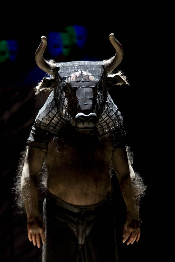
The Minotaur is a man imprisoned in a non-human body with non-human desires, itself imprisoned inside a labyrinth, and his spirit is imprisoned by his inability to use human language. Ariadne is imprisoned by being physically stranded on Crete, and by the skeletons in her family’s closet. All — including the unfortunate Innocents who are delivered annually to Crete as the Minotaur’s sacrificial prey — are prisoners of fate. Birtwistle’s score is based on various permutations of a single, inescapable melodic line throughout, and Alison Chitty’s set is highly effective in its depiction of, alternately, a shoreline surrounded by a sea and sky which constantly seem to close in on one another, and a curved, claustrophobic chamber in the bowels of the labyrinth.
Although they do not realise it, everybody has much the same standing in this miserable situation. Asterios, the Minotaur, is Ariadne’s half-brother, and in the opera’s version of events he is also Theseus’s — David Harsent’s libretto has it that the Minotaur’s bull-father, rather than being a familiar of the sea-god Poseidon, was probably Poseidon himself in bull form. The denouement has the Minotaur recoiling at the sight of Theseus’s face — partly at the recognition of him as the dark shadow who, along with Ariadne, has haunted his dreams, but perhaps partly too as he recognises a human form of himself. The Oracle has said that Theseus will triumph, so we all know it is inevitable — but in the final battle, there is a moment when the two ‘brothers’ seem absolutely the equal of one another.
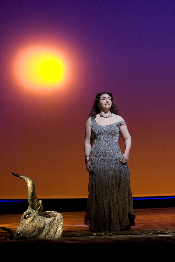 CHRISTINE RICE AS ARIADNE
The piece focuses on the Minotaur far more as man than as monster, and the situation leads even the ‘complete’ humans to exhibit animalistic traits — one of the finest pieces of choreographic judgement in Langridge’s production is the moment where the First Innocent (Rebecca Bottone) finds herself flung into the presence of the Minotaur. Stalked by the creature, she skitters around the floor, legs flailing like a newborn fawn in the presence of an inescapable predator, before being raped and killed. The distinction between human and animal is less clear-cut than those outsiders who persecute the Minotaur would like to imagine.
The title role has been written for John Tomlinson, an inspired piece of dramatic visualisation on the part of the composer. Tomlinson’s singing, wordless except in the ‘dream’ scenes, is muscular and imbued with pathos, and he successfully conveys a suffering animal in his gait and stature.
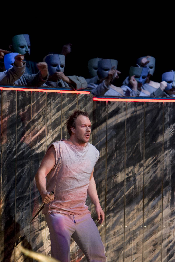 JOHAN REUTER AS THESEUS
However, the opera at first seems to be about Ariadne, a tour de force for the mezzo Christine Rice (though the character is sketchily developed considering the length of time she spends on stage) with the focus shifting to the Minotaur and his showdown with Theseus (Johan Reuter) later on. But it matters little which way round the situation is seen, as these people are inextricably bound together. Ariadne needs Theseus in order that she can escape Crete (Theseus rejects her romantic advances, and their agreement to return to Athens together as man and wife after the Minotaur’s death is purely a business arrangement). Both Ariadne and Theseus need the Minotaur, or rather a victory over the Minotaur, as a way of defeating their own demons. The Minotaur needs Ariadne as his link with the outside world, and Theseus as his release.
The Minotaur’s only company, if it can be referred to as such, is the chorus — faceless spectators at the heart of the labyrinth, forever hungry for carnage and slaughter. They often speak in Ancient Greek, left untranslated in the surtitles, so the audience is encouraged to share the terrible isolation experienced by the Minotaur on account of his inability to use language.
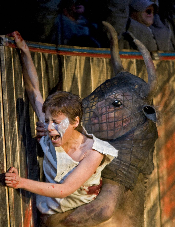 BOTTONE AS FIRST INNOCENT & TOMLINSON AS THE MINOTAUR
The piece is pervaded by a sense of primaeval inevitability, underlined by projected images between scenes showing a slowly rolling slate-grey sea. This creates a stasis which unfortunately has not been adequately addressed in terms of its effect on the dramatic pacing, and the need to compensate for it. The Minotaur barely moves, and is usually discovered standing still, centre stage; the length of the scenes seems determined by the amount of business that has to be got through rather than by any dramaturgical calculation. The opera’s structure seems front-heavy, with the piece’s natural centre being the extraordinary Oracle scene populated by the monstrous, androgynous Snake Goddess (countertenor Andrew Watts) and her Hiereus (Philip Langridge) who translates her incomprehensible pronouncements for Ariadne and Theseus. It is the only scene which takes place in a location other than the barren shoreline or the heart of the labyrinth, and it is where the drama takes a step forward with Ariadne’s self-revelation and the prophecy of Theseus’s success. This is in fact Scene 10 of 13. Although the slow pace does succeed in throwing into relief the faster-paced sequences, it cannot be overlooked that the opera is too long for its subject matter — the first part could be edited down by almost half, and the opera performed in a single act with the Oracle scene in the middle.
There is clumsiness in the staging, too. Killings which should be shockingly violent are trivialised by the requirement for each victim, once ‘wounded’, to run halfway off stage in order to be given a supply of stage blood to enable their wounds to look realistic. It is left to the nightmarish Keres — black-winged vulture-like harpies who feast upon the entrails of the dead and dying — to provide an injection of sheer visceral horror, scored with guttural shrieks and jagged rhythms.
With a near-perfect cast and Antonio Pappano at the musical helm, Birtwistle’s new opera could hardly have been given a better start in life. The work itself, and its promising staging, could do with a little revision if a revival is to be attempted.
Ruth Elleson © 2008