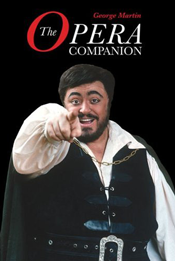
Opera guide books tend to be a bit stuffy and boring, if indispensable.
One of the best, first issued in 1961, has just been updated and reissued in
a handsome softback from Amadeus Press.
It is “The Opera Companion,” a 693-page, good-quality paperback by the
noted writer George Martin (a great bargain at $19.95). I cannot recommend
this engaging book too highly; in fact, if my library had to be restricted to
one book on opera, this would likely be it. Martin’s edition is of singular
design and organization. It consists of three major sections, The Casual
Operagoer’s Guide, a discursive consideration of many topics in opera –
pitch, the opera orchestra, history of the art form, the nature of melody –
and numerous others in a short, intelligent and pithy mode.
The second section is a dictionary-glossary of operatic and musical terms,
while the third section of Martin’s “Opera Companion” is a quite
detailed discussion of all aspects of forty-seven popular operas, from plot
to musical analysis. Martin’s accounts are so reasonable and well-informed,
I wish the number of operas treated were much larger. But he has chosen those
most often heard by today’s audiences, and in spite of my own sixty-years
of attending opera, I actually learned some new things about Gounod’s
Faust, for example, and Mozart’s Così fan tutte from
Martin.
In a time when that Mozart opera is foolishly treated by musicologists,
who find in Così deep and dark contradictions or profound psychological
themes, Martin’s clear-headed intelligent exposition of the music and text
is exactly what’s called for; he understands the opera and its style and
how it should be played. After reading Martin, you will too! His treatment of
Faust as a melodic operetta rather than deep grand opera is exactly right; I
recommend it and the entire book without reservation.
* * * * *
Put your hand up if you want to read a new tenor biography! Ummm....not
very many hands. I don’t blame you, they can be a self-aggrandizing bore;
most singer bios are. An exception was the Jussi Bjoerling book of a few
years ago, in which his truthful wife spoke out with refreshing candor.
Another exception is the new (2008) Amadeus Press biography of the greatest
Italian tenor of my lifetime, the golden Franco Corelli. In terms of vocal
power, color, quality and effectiveness, the Corelli tenor voice eclipsed all
others; in terms of a balanced lifestyle, the poor man suffered greatly from
all kinds of personal demons, stage fright and tenor-mania.
Holland-based René Seghers has written “Franco Corelli: Prince of
Tenors,” a beautifully printed and illustrated book, that thrives because
of excellent research, interviewing, and a strong narrative style. I picked
up this book about 4 p.m. one day, and in just a few pages I was hooked – I
read it all in one sitting, late into the night. I recommend starting
earlier!
Seghers treats all aspects of Corelli’s history, from birth in Ancona on
the Adriatic coast, to death in August 2003 in Milan, a demented and
emaciated 84-y.o. millionaire, whose wife would not keep him at home for she
feared his senile rages. The author, unlike many others, does not glamorize
his subject, nor does he soften the rough edges of Loretta Di Lelio,
Corelli’s possessive and controlling wife, who many believe made the
“adolescent” tenor’s huge career possible. Loretta herself freely
described her husband as immature and requiring constant care and attention.
This she supplied in abundance, though in later years he somehow escaped her
control and undertook some love affairs, which caused a temporary separation
of the Corellis. This contrasts with hilarious scenes of the Corellis’
backstage rituals before performances, when the terrified tenor, insecure and
superstitious, was sprinkled with holy water by Loretta, who would rub a
crucifix on his throat just before she pushed him onto the stage. The Corelli
anecdotes are legendary, as are his wars with opera managers, especially New
York’s Rudolf Bing, and Seghers gives them full treatment, even dispelling
some (Franco did not bite Birgit Nilsson in the Boston Turandot).
Of greater interest is Seghers’ thorough discussion of the evolution of
Corelli’s stunning vocal technique, which he worked on constantly
throughout his career. In the 1960s, in his forties, he often was in Spain
seeking to make his voice more fluid and lyric through studies with the great
Italian tenor of a generation before, Giacomo Lauri-Volpe, who helped him
significantly. Corelli’s finest vocal period was the mid and later-1960s,
and he readily credited the coaching of the senior Italian tenor di
forza.
Corelli’s major public career extended from about 1958 to 1975. The
author organizes the greater part of his book chronologically, touching upon
each season, where and what Corelli sang, and often with somea critical
analysis. This required prodigious research, and Seghers’ account has the
strong flavor of authenticity. In mid-career Corelli moved to New York City
and lived there until old-age; this facilitated his many seasons of dominance
at the Metropolitan Opera, where, along with Milan’s La Scala, the handsome
Corelli established himself as the most vocally potent and popular Italian
tenor of his era. “Prince of Tenors,” as a book, is a keeper; it is going
on my shelf and I expect to take it down often. Among other virtues, author
Seghers is an accomplished photographer and knows the value of visuals, so
has furnished his 526-page book richly with photographs, many never seen
before. The list price is a steep $34.95; Amazon is offering copies at
$21.95. Amadeus Press and René Seghers have done the vocal world a service
by publishing this invaluable biography of the wondrous Corelli.
* * * * *
Now, to the noted composer Dr. Paul Moravec. He is currently visiting
professor at the Institute for Advanced Studies, Princeton, NJ, and is in
addition a professor of music at Adelphi University. Thus, Moravec is an
academic composer and distinguished musical scholar. His music, to my ear,
sounds exactly that – “academic,” if highly competent.
I bring this up because in Season 2009 you’ll be hearing a lot more
about Moravec, as his first-ever opera, “The Letter” (based on a 1927
play by Somerset Maugham, famous from the Bette Davis 1940 movie), is being
premiered at Santa Fe Opera, starring Patricia Racette in the Davis role of a
murderous wife.
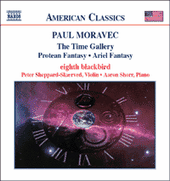 I just listened several times to two Naxos recordings of Moravec’s
music, one, “Tempest Fantasy,” is a Pulitzer prize winner (Naxos 8.559323
), the other is “The Time Gallery” (Naxos 8.559267). Both are
interesting, and they share some traits. While the music lacks lyric line, it
is energetic -- busy and chattery (one friend called it “molecular”),
except when it makes a point to be quiet and mellow, which doesn’t last
very long, for its heart lies in smart antics and excitement, though these
particular selections are not much for originality or melodic effect.
I just listened several times to two Naxos recordings of Moravec’s
music, one, “Tempest Fantasy,” is a Pulitzer prize winner (Naxos 8.559323
), the other is “The Time Gallery” (Naxos 8.559267). Both are
interesting, and they share some traits. While the music lacks lyric line, it
is energetic -- busy and chattery (one friend called it “molecular”),
except when it makes a point to be quiet and mellow, which doesn’t last
very long, for its heart lies in smart antics and excitement, though these
particular selections are not much for originality or melodic effect. 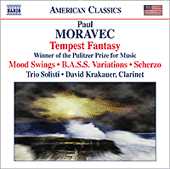 There
is a lot more to this composer than these two CDs, and I wont comment more
because I have not heard his lyric writing. But considering that opera, even
“opera noir,” as Santa Fe is calling the forthcoming show, must be about
singing and lyric reach – if that does not occur, rather than true opera,
you have a play with music. While a novice opera composer, Moravec is an
accomplished and sophisticated man; and his text collaborator, the jazz
critic Terry Teachout, is a bright one too. So they may come up with a good
show; how “operatic” it will be remains to be seen. We hear it’s
90-minutes in length, with an orchestral interlude. Bette Davis is a hard act
to follow, but maybe clever Santa Fe can pull it off. The talented
singing-actress soprano Racette is clearly an asset; she was recently
reported advising the composition team on how to make their ending more
dramatic. Will this be opera by committee?
There
is a lot more to this composer than these two CDs, and I wont comment more
because I have not heard his lyric writing. But considering that opera, even
“opera noir,” as Santa Fe is calling the forthcoming show, must be about
singing and lyric reach – if that does not occur, rather than true opera,
you have a play with music. While a novice opera composer, Moravec is an
accomplished and sophisticated man; and his text collaborator, the jazz
critic Terry Teachout, is a bright one too. So they may come up with a good
show; how “operatic” it will be remains to be seen. We hear it’s
90-minutes in length, with an orchestral interlude. Bette Davis is a hard act
to follow, but maybe clever Santa Fe can pull it off. The talented
singing-actress soprano Racette is clearly an asset; she was recently
reported advising the composition team on how to make their ending more
dramatic. Will this be opera by committee?
J. A. Van Sant © 2008