Subscribe to
Opera Today

Receive articles and news via RSS feeds or email subscription.


twitter_logo[1].gif


UCP_9780226043425.gif

Recently in Performances

Baltimore Premieres Camelot Requiem

In May of 2013, the Spire Series at the First Presbyterian Church in Baltimore, Maryland, observed the fiftieth anniversary of the death of President John F. Kennedy by presenting a work dealing with the 1963 assassination.

Domingo Conducts Holdridge’s New Opera Dulce Rosa

Dulce Rosa, a brand new opera, had its world premiere Friday night, May 17, 2013 at the Broad Stage in Santa Monica, California. It was produced by Los Angeles Opera, but staged in the smaller theater.

Verdi’s Falstaff at Glyndebourne

Richard Jones’ 2009 production of Verdi’s Falstaff translates the action from the first Elizabethan age to the start of the second.

Gareth John, Wigmore Hall

Baritone Gareth John is rapidly accumulating a war-chest of honours. Winner of the 2013 Kathleen Ferrier Award, he recently won the Royal Academy of Music Patrons’ Award and was presented the Silver Medal by the Worshipful Company of Musicians.

La bohème at ENO

This second revival of Jonathan Miller’s La bohème was the first time I had caught the production.

Rolando Villazón: Verdi (International Opera Stars Series 2013)

It’s Verdi’s bicentenary year and Rolando Villazón has two new CDs to plug — titled somewhat confusingly, ‘Villazón: Verdi’ and ‘Villazón’s Verdi’, the latter a ‘personal selection’ of favourite numbers performed by stars of the past and present.

Brahms Third in San Francisco

Nicola Luisotti and the San Francisco Opera Orchestra climbed out of the War Memorial pit, braved the wind whipped bay and held spellbound an audience at Cal Performances’ Zellerbach Auditorium at UC Berkeley.

Glyndebourne: Ariadne auf Naxos

Utterly mad but absolutely right — Richard Strauss’s Ariadne auf Naxos started the Glyndebourne 2013 season with an explosion. Strauss could hardly have made his intentions more clear. Ariadne auf Naxos is not “about” Greek myth so much as a satire on art and the way art is made.

Wozzeck at ENO

“Man is an abyss. It makes one dizzy to look into it.” So utters Georg Büchner’s Woyzeck, repeating what was also a recurring motif in the playwright’s own letters.

Mulhouse: Rare Britten Well Done

National Opera Company of the Rhine has marked this year’s Benjamin Britten celebration with a remarkably compelling, often gripping new production of the seldom-seen Owen Wingrave.

Frankfurt's Intriguing Idomeneo

Once upon a time, Frankfurt Opera had the baddest ass reputation in Germany as “the” cutting edge producer of must-see opera.

Rigoletto at Lyric Opera of Chicago

Productions of Giuseppe Verdi’s Rigoletto can serve as a vehicle for individual singers to make a strong impression and become afterward associated with specific roles in the opera.

Britten Sinfonia with Ian Bostridge

Just in case we were not aware that the evening’s programme was ‘themed’, the Britten Sinfonia designed a visual accompaniment to their musical exploration of night, sleep and dreams.

Aida, Manitoba Opera

Poor Aida! She never seems to have anything go her way.

Superlative singing: Don Carlo, Royal Opera House

Is it possible to upstage Jonas Kaufmann? Kaufmann was brilliant in this Verdi Don Carlo at the Royal Opera House, London, but the rest of the cast was so good that he was but first among equals. Don Carlo is a vehicle for stars, but this time the stars were everyone on stage and in the pit. Even the solo arias, glorious as they are, grow organically out of perfect ensemble. This was a performance that brought out the true beauty of Verdi's music.

Sarah Connolly: French Song at Wigmore Hall

The big names were absent: Duparc, D’Indy, Debussy, Ravel … and while Fauré, Chausson, Roussel and several members of Les Six put in an appearance, in less than familiar guises, this survey of French song of the early 20th century and interwar years deliberately took us on a journey through infrequently travelled terrain.

Rare restoration: Handel’s Esther 1720

Composed between 1718 and 1720, Handel’s Esther is sometimes described as the ‘first English Oratorio’, but is in fact a hybrid form, mixing elements of oratorio, masque, pastoral and opera.

The Damnation of Faust, London

Hector Berlioz's légende dramatique, La Damnation de Faust, exists somewhere between cantata and opera. Berlioz's flexible attitude to dramatic form made the piece unworkable on the stages of early 19th century Paris and his music is so vivid that you wonder whether the piece needs staging at all.

Elizabeth Connell Memorial Concert, St John's Smith Square

St. John’s Smith Square was the site of Elizabeth Connell’s final London concert, intended as a farewell to London on her moving to Australia. It was rendered ultimately final by her unexpected death.

Aida with all the Trimmings, Even a Blue Silk Elephant!

With the building of the Suez Canal, Egypt became more interesting to Western Europeans. Khedive Ismail Pasha wanted a hymn by Verdi for the opening of a new opera house in Cairo, but the composer said he did not write occasional pieces.

OPERA TODAY ARCHIVES »

Performances

James Maddalena as John Brown at the Lyric Opera of Kansas City
12 May 2008

John Brown lives again in Kansas City

John Brown might have been a’mouldering in his grave since he was hanged in 1859, but he was resurrected — in body and spirit — on May 3, when the Lyric Opera of Kansas City staged the world premiere of Kirke Mechem’s John Brown.

Kirke Mechem: John Brown

Above: James Maddalena as John Brown
All photos by Douglas Hamer courtesy of Lyric Opera of Kansas City


Like the nursery rhymes of childhood, Dred Scott, Harper’s Ferry and John Brown are words that resonate only indistinctly in the minds of today’s elders; an ahistorical younger generation knows them not at all. Thus the astonishment that prevailed in the Lyric’s aged venue at the contemporary relevance — indeed, the urgency — of the story of the man determined to end slavery in this country — even by force, if necessary.

Although decades in the making Mechem’s monumental score — it runs slightly over three hours, less two intermissions — comes to the stage as racism rumbles beneath the surface of a major political campaign. Brown, if not totally a’mouldered, would turn nervously in its grave at the sight of current events.
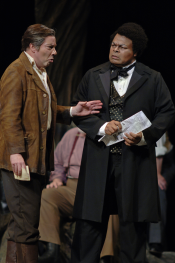
Brown_Douglass.pngJames Maddalena as John Brown and Donnie Ray Albert as Frederick Douglass.

Mechem, author of the Brown libretto as well, has done his homework in his use of the archives in what is in many ways a documentary drama. Furthermore, for Mechem Brown is a family matter, for his historian father once attempted to tailor this story for the opera stage. Much to his credit, the younger Mechem, born in 1925, has resurrected Brown in all his ambiguity. At the very center of his opera is the confrontation between Brown and Frederick Douglass, the eloquent black leader who insisted upon abolition by legal and peaceful means. Brown, on the other hand, killed no one, but approved the murder of six men to achieve his goal. Thus questions of violence and terrorism, ghosts that lingers from the years of opposition to the Vietnam war, add weight — and darkness — to Mechem’s tale.

The Lyric could hardly have done better than casting James Maddalena and veteran black baritone Donnie Ray Albert as Brown and Douglass. Maddalena, on stage almost without interruption, makes of Brown a towering and commanding figure, and although Mechem portrays him positively in sometimes mesmerizing music, he never evades the complex issues encountered in Brown’s position. Albert makes Douglass, a man to whom ambiguity was alien, a veritable Rock of Gibraltar in the middle of this story. Indeed, this role must be a major triumph in Albert’s long and distinguished career.
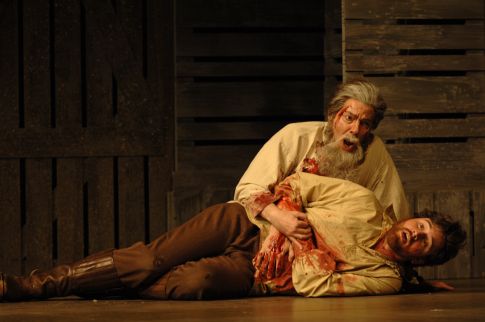
Death_Oliver.pngDeath of Oliver at Harper’s Ferry: James Maddalena as John Brown and Patrick Miller as Oliver Brown.

Mechem adds a person dimension to Brown’s story with a sub-plot involving his family and the hesitation of those next to him to support his plans for the raid on the armory at Harper’s Ferry, the attempt to free slaves that failed and resulted in his arrest and execution. Son Oliver Brown, movingly sung by tenor Patrick Miller, and daughter-in-law Martha, sensitively played by soprano Jennifer Aylmer, underscore the human toll taken by history.

Mechem’s lush score abounds in moments of richness, such as the love duet between Oliver and Martha that opens Act Two, when Vanessa Thomas steps forth from the wings to read a letter by a young slave’s wife and when Oliver dies in his father’s arms. The score is often marvelous both in sound and emotion, yet it is always measured. It is tonal and lyric throughout, but never trite, and a major strength lies in Mechem’s experienced hand as a choral composer. In many especially moving moments he concludes a crucial scene with a chorus that never stands by itself, but is always an integral continuation of what has gone before. The choruses “I’m Free” and “Stoke the Fire” are as stirring as anything Verdi ever wrote.

Mechem makes no secret of the deep religious convictions that motivate Brown, who sees himself doing God’s work in fighting slavery. However, he treats this aspect of his hero’s character with reserve, never allowing him to seem a zealot — despite many Biblical references and the inclusion of hymn tunes in his score. There are points in the opera at which Mechem hauntingly recalls Bach’s passions in his portrayal of Brown’s agony. Lyric artistic director Ward Holmquist conducted members of the Kansas City Symphony to fine effect.

It is clear that John Brown, a commission that celebrates the Lyric’s 50th anniversary, should move on to other stages. Before it does so, however, revision is needed. The opera now runs over three hours; and, word from within was that considerable cuts had already been made.

The first act is totally absorbing in its dramatic force. The final act, on the other hand, wanders and lacks focus. It could end at a number of places, and the contribution of the post-scripted Apotheosis to the score is questionable. One knows by then what Brown’s fate is to be, and to have him swing visibly above the stage on the hangman’s rope is — well — overkill and even raises questions of taste.
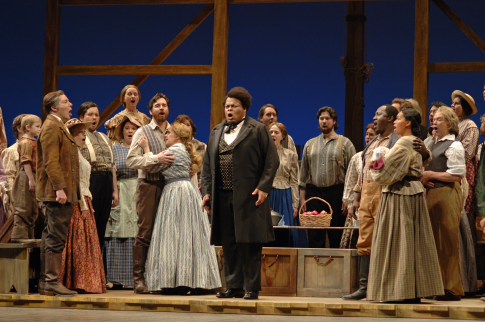
Douglass_Cast.pngDonnie Ray Albert as Frederick Douglass with cast

The Lyric, set to move into a new performing arts center next year, has outdone itself in staging John Brown in its current outdated home. Book — and flag-burning — to mention only two special effects — are staged credibly. One does not often seek a message in opera, but there is one here and it is of particular urgency today. “One of the uncomfortable truths this opera asks us to confront,” writes director Kristine McIntyre in comments in the program, “is that most people, even when confronted with a great wrong, are simply afraid to stand up and be counted. We don’t want to be stirred out of our complacency and we aren’t ready to have our preconceptions challenged.”

Wes Blomster
Send to a friend

Send a link to this article to a friend with an optional message.

Friend's Email Address: (required)

Your Email Address: (required)

Message (optional):