Subscribe to
Opera Today

Receive articles and news via RSS feeds or email subscription.


twitter_logo[1].gif


UCP_9780226043425.gif

Recently in Performances

Gareth John, Wigmore Hall

Baritone Gareth John is rapidly accumulating a war-chest of honours. Winner of the 2013 Kathleen Ferrier Award, he recently won the Royal Academy of Music Patrons’ Award and was presented the Silver Medal by the Worshipful Company of Musicians.

La bohème at ENO

This second revival of Jonathan Miller’s La bohème was the first time I had caught the production.

Rolando Villazón: Verdi (International Opera Stars Series 2013)

It’s Verdi’s bicentenary year and Rolando Villazón has two new CDs to plug — titled somewhat confusingly, ‘Villazón: Verdi’ and ‘Villazón’s Verdi’, the latter a ‘personal selection’ of favourite numbers performed by stars of the past and present.

Brahms Third in San Francisco

Nicola Luisotti and the San Francisco Opera Orchestra climbed out of the War Memorial pit, braved the wind whipped bay and held spellbound an audience at Cal Performances’ Zellerbach Auditorium at UC Berkeley.

Glyndebourne: Ariadne auf Naxos

Utterly mad but absolutely right — Richard Strauss’s Ariadne auf Naxos started the Glyndebourne 2013 season with an explosion. Strauss could hardly have made his intentions more clear. Ariadne auf Naxos is not “about” Greek myth so much as a satire on art and the way art is made.

Wozzeck at ENO

“Man is an abyss. It makes one dizzy to look into it.” So utters Georg Büchner’s Woyzeck, repeating what was also a recurring motif in the playwright’s own letters.

Mulhouse: Rare Britten Well Done

National Opera Company of the Rhine has marked this year’s Benjamin Britten celebration with a remarkably compelling, often gripping new production of the seldom-seen Owen Wingrave.

Frankfurt's Intriguing Idomeneo

Once upon a time, Frankfurt Opera had the baddest ass reputation in Germany as “the” cutting edge producer of must-see opera.

Rigoletto at Lyric Opera of Chicago

Productions of Giuseppe Verdi’s Rigoletto can serve as a vehicle for individual singers to make a strong impression and become afterward associated with specific roles in the opera.

Britten Sinfonia with Ian Bostridge

Just in case we were not aware that the evening’s programme was ‘themed’, the Britten Sinfonia designed a visual accompaniment to their musical exploration of night, sleep and dreams.

Aida, Manitoba Opera

Poor Aida! She never seems to have anything go her way.

Superlative singing: Don Carlo, Royal Opera House

Is it possible to upstage Jonas Kaufmann? Kaufmann was brilliant in this Verdi Don Carlo at the Royal Opera House, London, but the rest of the cast was so good that he was but first among equals. Don Carlo is a vehicle for stars, but this time the stars were everyone on stage and in the pit. Even the solo arias, glorious as they are, grow organically out of perfect ensemble. This was a performance that brought out the true beauty of Verdi's music.

Sarah Connolly: French Song at Wigmore Hall

The big names were absent: Duparc, D’Indy, Debussy, Ravel … and while Fauré, Chausson, Roussel and several members of Les Six put in an appearance, in less than familiar guises, this survey of French song of the early 20th century and interwar years deliberately took us on a journey through infrequently travelled terrain.

Rare restoration: Handel’s Esther 1720

Composed between 1718 and 1720, Handel’s Esther is sometimes described as the ‘first English Oratorio’, but is in fact a hybrid form, mixing elements of oratorio, masque, pastoral and opera.

The Damnation of Faust, London

Hector Berlioz's légende dramatique, La Damnation de Faust, exists somewhere between cantata and opera. Berlioz's flexible attitude to dramatic form made the piece unworkable on the stages of early 19th century Paris and his music is so vivid that you wonder whether the piece needs staging at all.

Elizabeth Connell Memorial Concert, St John's Smith Square

St. John’s Smith Square was the site of Elizabeth Connell’s final London concert, intended as a farewell to London on her moving to Australia. It was rendered ultimately final by her unexpected death.

Aida with all the Trimmings, Even a Blue Silk Elephant!

With the building of the Suez Canal, Egypt became more interesting to Western Europeans. Khedive Ismail Pasha wanted a hymn by Verdi for the opening of a new opera house in Cairo, but the composer said he did not write occasional pieces.

Die Zauberflöte, Royal Opera

Back for its fourth revival, David McVicar’s 2003 production of Mozart’s Die Zauberflöte has much charm, beauty and artistry.

The Marriage of Figaro Ends Season at Arizona Opera

Wolfgang Amadeus Mozart's opera The Marriage of Figaro has a libretto by Lorenzo daPonte based on the French play La folle journée, ou le Mariage de Figaro (The Crazy Day or the Marriage of Figaro) by Pierre Caron de Beaumarchais (1732-1799).

Baden’s Flute Goes Barefoot in the Park

For its world class Easter Festival, Baden-Baden mounted a Die Zauberflöte that owed more to the grey penitential doldrums of Lent than to the unbridled jubilance of re-birth.

OPERA TODAY ARCHIVES »

Performances

Natalie Dessay and Juan Diego Florez
04 May 2008

La Fille du Régiment at the Met

When the Met presented La Fille du Régiment for Lily Pons during World War II, she sought permission to wave the Cross of Lorraine, symbol of Charles de Gaulle’s Free French, during the Salut à la France in Act II.

Gaetano Donizetti: La Fille du Régiment
Metropolitan Opera, performance of April 29.

Marie: Natalie Dessay; Tonio: Juan Diego Florez; Marquise: Dame Felicity Palmer; Sulpice: Alessandro Corbelli. Conducted by Marco Armiliato.

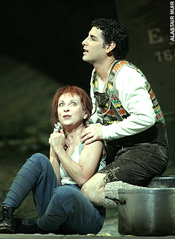
Above: Natalie Dessay (Marie) and Juan Diego Florez (Tonio)


The Met management opposed the idea (what next? setting operas in contemporary costumes?), but Pons was a diva of the old school, impossible to discipline or embarrass — she knew the wartime audience would roar and that Met General Manager Edward Johnson wouldn’t dare reprimand her. As for the opera — if a diva is cute and funny and has the high notes (Pons, we hear, scored on all three counts — so, in my own experience, did Sutherland and, at least in early years, Sills), then nothing can go wrong: Donizetti’s vehicle is a ’54 Chevy, handsome, unpretentious and unbreakable. Fill ’er up with high octane and she’ll take you where you want to go.

Too, since Pavarotti revealed the opera as a tenor vehicle as well, the boys get to share the limelight, and for the last few years (at least since Hermione Gingold began to camp it up — recent entrants include Montserrat Caballé at Covent Garden), the two-line speaking role of the Duchess of Krakenthorp has expanded like an accordion to become a major player. At the Met these days, Marion Seldes gets two scenes and two outfits, as many costumes as the prima donna.

Having heard last Saturday’s broadcast (full of audience giggle), I went to the Met’s new production of La Fille (shared with Covent Garden and Vienna) expecting to lean back and enjoy myself, and I did. So, as far as I could tell, did everyone else in the packed house. First of all, there’s the irresistible Donizetti fable, full of sentimental regret (during the reign of pacific Louis-Philippe) for the days of Napoleonic gloire, with march-time send-ups and regimental ditties (what does “rat-a-plan” mean? It’s not in my Larousse), as well as sentimental numbers that almost play themselves — the duet where Tonio and Marie “prove” their love to each other’s exacting specifications, the delicious trio of old comrades, “Tous les trois réunis” — all of it melodious, hilarious, touching by turns, a musical with good singing and no agonized American idols. La Fille couples lack of pretension with Donizetti’s deft, professional hand at achieving exactly what he wants to achieve: the characters do not surprise us — they’re much too straightforward for that — but they’re worthy of the happiness they want, and our hearts are warm when they get it.

Laurent Pelly’s production has a backdrop concocted by Chantal Thomas from nineteenth-century European maps that form a mountainous Tyrolean landscape on which Juan Diego Florez (who grew up in the even steeper Andes, right?) takes an occasional pratfall while otherwise twirling like a curly-headed Fred Astaire in lederhosen. If the guy, lately married in the cathedral of Lima, loves his new bride half as much as he loves cutting up for 4000 strangers she’s a lucky woman.

Natalie Dessay is charming when singing showpiece roulades while ironing longjohns, when advancing on the enemy while seated on the floor in a doll-like position, when striding about the stage with robotic gestures — the same gestures and movements that tickled us when she played Olympia in Hoffman and Zerbinetta in Ariadne. But the constant mugging, intentionally or not, distract from imperfect fioritura and breathless concluding notes, indeed from vocalism — you have to force yourself to pay attention to the singing to notice it is being done at all. I could have done without a great deal of the frenetic business — she never calmed down long enough to let us enjoy the beautiful music she and Donizetti might have made together. Charm is undercut by this level of aggression, and it is possible to charm, even in knockabout farce, without channeling Lucy Ricardo. Nor is it necessary to make invidious comparisons to the equally funny but musically richer performances of Sutherland or Sills (or Freni, who sang the loveliest, purest “Il faut partir” I’ve ever heard). Merely cast an eye on Florez for balance: yes, he gallivanted adorably, yes he sang eighteen high C’s — pure, even, perfectly produced high C’s at that — in order to provide an encore, and stepped out of character to bow when they were done — but when it was his turn to be Tonio, the naïve and ardent lover, and to be quietly sincere, then quiet sincerity is what he gave us. He knows when to turn off the spigot of farce and still be present. Dessay does not seem to know how to do this, and her constantly jokey performance in due course tired me out. Perhaps if she’d put a little of that gag energy into maintaining a bel canto line, we’d have real opera here.

When Florez first set foot on the Met stage a few years back, his rapture at having an audience to delight was like an electric shock passing visibly through his body and outwards to tingle everyone present, but though his Rossini technique was surely the most extraordinary of any tenor in a hundred years, the voice itself (as he admits) was gruff, unbeautiful, lacking sensuality. The instrument has lately grown larger and more lyrical, more capable of sustaining beautiful sound, with no noticeable decline in flexibility and an ease at filling an enormous theater that can only thrill. Too, he knows how to act like an oaf so as to win any and every heart. A perfect performance.

Felicity Palmer makes an elegant eldritch marquise (though why her German schloss of Berkenfeld has added a letter to become the English Berkenfield is a puzzle) and Alessandro Corbelli a stout, bald Sergeant Sulpice. After a scrappy slog through the overture, Marco Armiliato shaped up in the pit, and gave every sign of enjoying himself. Mention should be made of choreographer Agathe Mélinand, whose four housemaids polishing furniture while doing ballet exercises had us all in stitches, and who — I presume it was her idea — had the soldiers keep waltz-time with their helmeted heads to Florez’s encore.

John Yohalem
Send to a friend

Send a link to this article to a friend with an optional message.

Friend's Email Address: (required)

Your Email Address: (required)

Message (optional):