27 May 2008
Masterpiece Masterfully Rendered in Toronto
I can still remember my first ever “Pelleas et Melisande” in my first ever outing at San Francisco Opera during my first ever visit to that beautiful town.
English Touring Opera are delighted to announce a season of lyric monodramas to tour nationally from October to December. The season features music for solo singer and piano by Argento, Britten, Tippett and Shostakovich with a bold and inventive approach to making opera during social distancing.
This tenth of ten Live from London concerts was in fact a recorded live performance from California. It was no less enjoyable for that, and it was also uplifting to learn that this wasn’t in fact the ‘last’ LfL event that we will be able to enjoy, courtesy of VOCES8 and their fellow vocal ensembles (more below …).
Ever since Wigmore Hall announced their superb series of autumn concerts, all streamed live and available free of charge, I’d been looking forward to this song recital by Ian Bostridge and Imogen Cooper.
Although Stile Antico’s programme article for their Live from London recital introduced their selection from the many treasures of the English Renaissance in the context of the theological debates and upheavals of the Tudor and Elizabethan years, their performance was more evocative of private chamber music than of public liturgy.
Evidently, face masks don’t stifle appreciative “Bravo!”s. And, reducing audience numbers doesn’t lower the volume of such acclamations. For, the audience at Wigmore Hall gave soprano Elizabeth Llewellyn and pianist Simon Lepper a greatly deserved warm reception and hearty response following this lunchtime recital of late-Romantic song.
For this week’s Live from London vocal recital we moved from the home of VOCES8, St Anne and St Agnes in the City of London, to Kings Place, where The Sixteen - who have been associate artists at the venue for some time - presented a programme of music and words bound together by the theme of ‘reflection’.
'Such is your divine Disposation that both you excellently understand, and royally entertaine the Exercise of Musicke.’
‘And there was war in heaven: Michael and his angels fought against the dragon; and the dragon fought and his angels, And prevailed not; neither was their place found any more in heaven … that old serpent … Satan, which deceiveth the whole world: he was cast out into the earth, and his angels were cast out with him.’
There was never any doubt that the fifth of the twelve Met Stars Live in Concert broadcasts was going to be a palpably intense and vivid event, as well as a musically stunning and theatrically enervating experience.
‘Love’ was the theme for this Live from London performance by Apollo5. Given the complexity and diversity of that human emotion, and Apollo5’s reputation for versatility and diverse repertoire, ranging from Renaissance choral music to jazz, from contemporary classical works to popular song, it was no surprise that their programme spanned 500 years and several musical styles.
The Academy of St Martin in the Fields have titled their autumn series of eight concerts - which are taking place at 5pm and 7.30pm on two Saturdays each month at their home venue in Trafalgar Square, and being filmed for streaming the following Thursday - ‘re:connect’.
The London Symphony Orchestra opened their Autumn 2020 season with a homage to Oliver Knussen, who died at the age of 66 in July 2018. The programme traced a national musical lineage through the twentieth century, from Britten to Knussen, on to Mark-Anthony Turnage, and entwining the LSO and Rattle too.
With the Live from London digital vocal festival entering the second half of the series, the festival’s host, VOCES8, returned to their home at St Annes and St Agnes in the City of London to present a sequence of ‘Choral Dances’ - vocal music inspired by dance, embracing diverse genres from the Renaissance madrigal to swing jazz.
Just a few unison string wriggles from the opening of Mozart’s overture to Le nozze di Figaro are enough to make any opera-lover perch on the edge of their seat, in excited anticipation of the drama in music to come, so there could be no other curtain-raiser for this Gala Concert at the Royal Opera House, the latest instalment from ‘their House’ to ‘our houses’.
"Before the ending of the day, creator of all things, we pray that, with your accustomed mercy, you may watch over us."
The doors at The Metropolitan Opera will not open to live audiences until 2021 at the earliest, and the likelihood of normal operatic life resuming in cities around the world looks but a distant dream at present. But, while we may not be invited from our homes into the opera house for some time yet, with its free daily screenings of past productions and its pay-per-view Met Stars Live in Concert series, the Met continues to bring opera into our homes.
Music-making at this year’s Grange Festival Opera may have fallen silent in June and July, but the country house and extensive grounds of The Grange provided an ideal setting for a weekend of twelve specially conceived ‘promenade’ performances encompassing music and dance.
There’s a “slide of harmony” and “all the bones leave your body at that moment and you collapse to the floor, it’s so extraordinary.”
“Music for a while, shall all your cares beguile.”
The hum of bees rising from myriad scented blooms; gentle strains of birdsong; the cheerful chatter of picnickers beside a still lake; decorous thwacks of leather on willow; song and music floating through the warm evening air.
I can still remember my first ever “Pelleas et Melisande” in my first ever outing at San Francisco Opera during my first ever visit to that beautiful town.
Having run into a local friend unexpectedly at intermission, and having related the above information, he hurriedly said, “ohhhhhhh, you should come back sometime for a real opera.”
Judging from intermission comments recently in Toronto, and some empty seats for part two, the piece apparently remains caviar for the gourmand, rather than bread and butter for the masses. I am hard pressed to quite understand why, especially when the work is treated to such a world class performance as mounted here by Canadian Opera Company.
Dany Lyne’s gorgeous design — ethereal, timeless and haunting — provided the perfect backdrop and playing environment for Debussy’s masterpiece. While the basic construction featured a girdered bridge which elevated actors about ten feet off the stage floor, visual variety was introduced through the addition of well-chosen set pieces (throne, bed, rickshaw, etc.), and the revelation of fold out features such as a hidden stairway and door leading from above to the “depths” of the debris-strewn floor in which “Pelleas” dwelt during much of the first act.
The stage left third of the structure was able to be raised and lowered, creating “Melisande’s” bedroom tower, a beautiful evocation of a depth to the well, and a final descent to the grave for our heroine’s remains, even while her spirit (in the form of a diaphanous bed canopy) ascended to the heavens.
Scrims, opaque spun fiberglass drops, and a cyclorama fronted by expressive filigreed tree branches, were inventively lit by Thomas C. Hase with his perfectly judged special effects and a highly creative design. He was assisted by John Prautschy. A glowing blue moon, passing torchlight, silhouette imagery, the up-lit fountain, and the down lit bed and stairs were among the superbly calculated effects. A passionate orb of a sun called to mind Stephen Crane’s “the red sun was pasted in the sky like a wafer.”
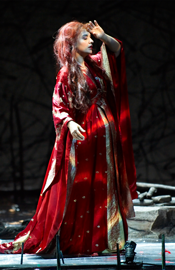
Ms. Lyne’s vibrant Asian-influenced costumes could also hardly have been bettered, and the choice to put “Melisande” in vivid reds proved to be inspired, completely playing against the usual wispy “type” for this mysterious character. Indeed, our heroine’s first appearance behind a scrim, in a rich Chinese red dress with an impossibly long train, and draped in an over-sized off-white veil was a triumph of character statement, making her at once irresistibly alluring and impossibly indefinite. The minute attention to each and every technical detail created true theatrical magic.
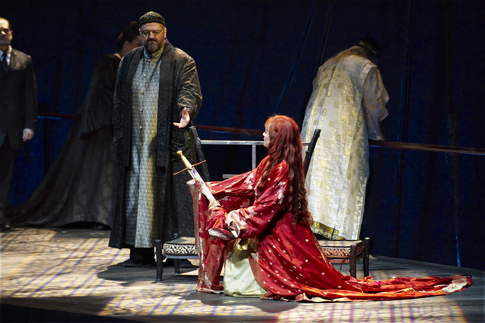 (l – r) Alain Coulombe as the Doctor, Barbara Dever as Geneviève (behind Golaud), Pavlo Hunka as Golaud, Isabel Bayrakdarian as Mélisande and Richard Wiegold as Arkel
Such a top notch design would go for nothing, of course, without a cast up to the musical challenges, and COC came up with winners all around. At any given period there is always a dream team for the title roles, and on the basis of this visit, I would have to say the mantle has been passed to stars Russell Braun and Isabel Bayrakdarian, Canadians both. Although Mr. Braun has more experience with his well-known “Pelleas” (including a memorable Robert Wilson version in Salzburg with Dawn Upshaw), there is nothing in these fearsomely demanding roles that eludes either one of these superb interpreters.
Ms. Bayrakdarian offered a most compelling take on “Melisande” with a bit more starch than some. She displayed a wonderful technique, an even production, fine projection with a pleasing point to the tone, and thorough attention to each quicksilver shift of mood and subtext. Mr. Braun now pretty much owns his role, and he negotiates “Pelleas’“ highest reaches with seasoned perfection, singing with a robust and responsive baritone that has mastered every nuance of his tortured attraction to his brother’s wife.
Pavlo Hunka’s compelling “Golaud” was every inch the powerful linchpin central to the drama, as it needs to be. He managed more variety than other interpreters that I have seen, and his obsession with finding confirmation of the betraying physical act was well-balanced between heartsick introspection and macho bluster.
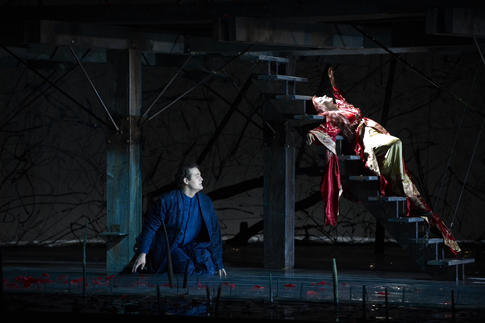 Russell Braun as Pelléas and Isabel Bayrakdarian as Mélisande
Richard Wiegold used his dark imposing bass to etch an unusually detailed portrait of “Arkel,” and he was well rewarded at curtain call for his efforts. Barbara Dever offered dramatic power and a steady outpouring of her rich mezzo for a fine assumption of “Genevieve.” The small role of the “Physician” was fleshed out with wonderful stage business, and the few rolling phrases required were well intoned by Alain Coulombe.” Only Erin Fisher’s attractive if light-voiced “Yniold” seemed one size too small to ride the occasional dense orchestrations.
Director Nicholas Muni made masterful use of every playing space and level available to him; he created memorable, chills-inducing stage pictures and groupings through well-motivated blocking; and he could give a masters class on effective character development and interaction. My God, here is a director who not only understands the work, but serves it! Let’s hope his creative philosophy starts an epidemic in the opera world. For this is decidedly a brilliant mounting of Debussy’s “Pelleas,” rather than Muni’s. Would that all directors “got” that difference.
The superb playing from the pit was diligently led by Jan Latham-Koenig. The acoustic of the house seemed very grateful to this impressionist work, even if I did think that it favored the orchestra slightly more than the singers. This richly detailed reading not only had the wispy, blurry succession of solo lines flawlessly interwoven, but the blocks of woodwinds, strings, and horns were individually and collectively well-knit into a clean ensemble. The passionate outbursts were all the more effective for the placid churnings that came before, and the inner life and forward thrust of the rhythmic pulse was never lost.
The beautiful “new” house in the Four Seasons Center would be an architectural pride of any world city, and it is perfectly complemented on stage by a stunning “Pelleas et Melisande” that makes the best possible case for this elusive work. Will this opus ever become a bread-and-butter opera? Perhaps not.
But for those of us who occasionally relish the highest quality caviar on our musical menu, this totally winning production was a very rich feast.
James Sohre © 2008