Recently in Performances
English Touring Opera are delighted to announce a season of lyric monodramas to tour nationally from October to December. The season features music for solo singer and piano by Argento, Britten, Tippett and Shostakovich with a bold and inventive approach to making opera during social distancing.
This tenth of ten Live from London concerts was in fact a recorded live performance from California. It was no less enjoyable for that, and it was also uplifting to learn that this wasn’t in fact the ‘last’ LfL event that we will be able to enjoy, courtesy of VOCES8 and their fellow vocal ensembles (more below …).
Ever since Wigmore Hall announced their superb series of autumn concerts, all streamed live and available free of charge, I’d been looking forward to this song recital by Ian Bostridge and Imogen Cooper.
Although Stile Antico’s programme article for their Live from London recital introduced their selection from the many treasures of the English Renaissance in the context of the theological debates and upheavals of the Tudor and Elizabethan years, their performance was more evocative of private chamber music than of public liturgy.
Evidently, face masks don’t stifle appreciative “Bravo!”s. And, reducing audience numbers doesn’t lower the volume of such acclamations. For, the audience at Wigmore Hall gave soprano Elizabeth Llewellyn and pianist Simon Lepper a greatly deserved warm reception and hearty response following this lunchtime recital of late-Romantic song.
For this week’s Live from London vocal recital we moved from the home of VOCES8, St Anne and St Agnes in the City of London, to Kings Place, where The Sixteen - who have been associate artists at the venue for some time - presented a programme of music and words bound together by the theme of ‘reflection’.
'Such is your divine Disposation that both you excellently understand, and royally entertaine the Exercise of Musicke.’
‘And there was war in heaven: Michael and his angels fought against the dragon; and the dragon fought and his angels, And prevailed not; neither was their place found any more in heaven … that old serpent … Satan, which deceiveth the whole world: he was cast out into the earth, and his angels were cast out with him.’
There was never any doubt that the fifth of the twelve Met Stars Live in Concert broadcasts was going to be a palpably intense and vivid event, as well as a musically stunning and theatrically enervating experience.
‘Love’ was the theme for this Live from London performance by Apollo5. Given the complexity and diversity of that human emotion, and Apollo5’s reputation for versatility and diverse repertoire, ranging from Renaissance choral music to jazz, from contemporary classical works to popular song, it was no surprise that their programme spanned 500 years and several musical styles.
The Academy of St Martin in the Fields have titled their autumn series of eight concerts - which are taking place at 5pm and 7.30pm on two Saturdays each month at their home venue in Trafalgar Square, and being filmed for streaming the following Thursday - ‘re:connect’.
The London Symphony Orchestra opened their Autumn 2020 season with a homage to Oliver Knussen, who died at the age of 66 in July 2018. The programme traced a national musical lineage through the twentieth century, from Britten to Knussen, on to Mark-Anthony Turnage, and entwining the LSO and Rattle too.
With the Live from London digital vocal festival entering the second half of the series, the festival’s host, VOCES8, returned to their home at St Annes and St Agnes in the City of London to present a sequence of ‘Choral Dances’ - vocal music inspired by dance, embracing diverse genres from the Renaissance madrigal to swing jazz.
Just a few unison string wriggles from the opening of Mozart’s overture to Le nozze di Figaro are enough to make any opera-lover perch on the edge of their seat, in excited anticipation of the drama in music to come, so there could be no other curtain-raiser for this Gala Concert at the Royal Opera House, the latest instalment from ‘their House’ to ‘our houses’.
"Before the ending of the day, creator of all things, we pray that, with your accustomed mercy, you may watch over us."
The doors at The Metropolitan Opera will not open to live audiences until 2021 at the earliest, and the likelihood of normal operatic life resuming in cities around the world looks but a distant dream at present. But, while we may not be invited from our homes into the opera house for some time yet, with its free daily screenings of past productions and its pay-per-view Met Stars Live in Concert series, the Met continues to bring opera into our homes.
Music-making at this year’s Grange Festival Opera may have fallen silent in June and July, but the country house and extensive grounds of The Grange provided an ideal setting for a weekend of twelve specially conceived ‘promenade’ performances encompassing music and dance.
There’s a “slide of harmony” and “all the bones leave your body at that moment and you collapse to the floor, it’s so extraordinary.”
“Music for a while, shall all your cares beguile.”
The hum of bees rising from myriad scented blooms; gentle strains of birdsong; the cheerful chatter of picnickers beside a still lake; decorous thwacks of leather on willow; song and music floating through the warm evening air.
Performances
![Andrew Shore (Punch) / Lucy Schaufer (Judy) [Copyright Catherine Ashmore/English National Opera]](http://www.operatoday.com/2204ashmore590.png)
06 May 2008
Punch & Judy at ENO
English National Opera’s production of Harrison Birtwistle’s ‘Punch and Judy’ is the company’s second collaboration with the Young Vic Theatre — following the premiere of Neuwirth’s ‘Lost Highway’ a few weeks earlier — and remarkably, also the second London production of this early Birtwistle work within a month, the previous one having been at the Linbury Studio Theatre, a collaboration between Music Theatre Wales and the Royal Opera.
ENO has one particular coup up its sleeve. There can be few singers as
well-suited to the grotesque, tragic-comic figure of Mr Punch as the baritone
Andrew Shore, one of ENO’s most distinguished regular guests and a
first-rate singing actor. In full puppet costume, he is the cross between a
naughty child, a vicious murderous thug and a sinister nightmare figure
— a nightmare which eventually implodes on him with the full force of
half-a-dozen Punch clones and the ghosts of his victims.
Giles Cadle’s set and costume designs go all-out to replicate the iconic
‘Punch and Judy show’ look, in primary colours that look slightly shabby and
sun-bleached. The stage is a circus-ring with a canopy of brightly-coloured
fairy lights. But at the back, a freshly-dug grave is a reminder of the
macabre inevitability with which Punch’s serial murders will be carried
out.
Ashley Holland strikes an imposing figure as the Choregos, a Greek
chorus-like figure who acts as a master of ceremonies, a narrator and moral
judge, but who falls victim to Punch just like all the others. It is the
Choregos and his murder that first blur the distinction between make-believe
and reality, an idea which Daniel Kramer’s staging takes further by stripping
away the puppet-costumes from the protagonists as events progress and the
moral themes of the piece are developed. Most — including the Doctor
and Lawyer, played by Graeme Broadbent and Graham Clark respectively —
reach this state of human nakedness at the point at which Punch kills them.
As for Punch himself, by the time he comes to feel remorse for the murder of
his baby — the first of his crimes — he is no more than a bald,
half-dressed, vulnerable human being. Only Gillian Keith’s ringletted,
hyperactive doll of a Pretty Polly remains in ‘character', a fantasy figure
to the last.
Birtwistle’s brutally uncompromising score — which supposedly upset
Benjamin Britten so much at the work’s premiere that he walked out of the
performance — is usually subtle and understated, atonal but far from
tuneless. It juxtaposes banal nursery-ditties with ‘Passion chorales’ and
tragic monologue. The insouciance of the little motif with which Punch shrugs
off each murder strikes a vivid contrast with the murdered Judy’s plea for
Punch’s reform, sung by the versatile American mezzo Lucy Schaufer.
Credit is due to the cast for managing to get the majority of Steven
Pruslin’s wordplay-filled libretto across, and to conductor Leo Hussain
(sharing the opera’s five-night run with ENO’s Music Director, Edward
Gardner) for maintaining such dramatic coherence in the music.
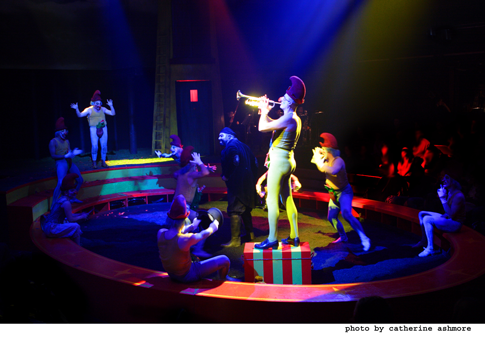 A scene from Punch and Judy
Ruth Elleson © 2008