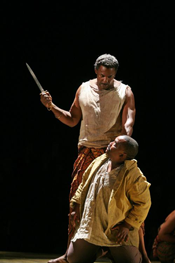
28 May 2008
Revised Amistad makes its mark
Upon its premiere at Chicago’s Lyric Opera in 1997 Anthony Davis’ Amistad found little critical favor. Its undisciplined excesses led one writer to compare it to a high-school pageant.
English Touring Opera are delighted to announce a season of lyric monodramas to tour nationally from October to December. The season features music for solo singer and piano by Argento, Britten, Tippett and Shostakovich with a bold and inventive approach to making opera during social distancing.
This tenth of ten Live from London concerts was in fact a recorded live performance from California. It was no less enjoyable for that, and it was also uplifting to learn that this wasn’t in fact the ‘last’ LfL event that we will be able to enjoy, courtesy of VOCES8 and their fellow vocal ensembles (more below …).
Ever since Wigmore Hall announced their superb series of autumn concerts, all streamed live and available free of charge, I’d been looking forward to this song recital by Ian Bostridge and Imogen Cooper.
Although Stile Antico’s programme article for their Live from London recital introduced their selection from the many treasures of the English Renaissance in the context of the theological debates and upheavals of the Tudor and Elizabethan years, their performance was more evocative of private chamber music than of public liturgy.
Evidently, face masks don’t stifle appreciative “Bravo!”s. And, reducing audience numbers doesn’t lower the volume of such acclamations. For, the audience at Wigmore Hall gave soprano Elizabeth Llewellyn and pianist Simon Lepper a greatly deserved warm reception and hearty response following this lunchtime recital of late-Romantic song.
For this week’s Live from London vocal recital we moved from the home of VOCES8, St Anne and St Agnes in the City of London, to Kings Place, where The Sixteen - who have been associate artists at the venue for some time - presented a programme of music and words bound together by the theme of ‘reflection’.
'Such is your divine Disposation that both you excellently understand, and royally entertaine the Exercise of Musicke.’
‘And there was war in heaven: Michael and his angels fought against the dragon; and the dragon fought and his angels, And prevailed not; neither was their place found any more in heaven … that old serpent … Satan, which deceiveth the whole world: he was cast out into the earth, and his angels were cast out with him.’
There was never any doubt that the fifth of the twelve Met Stars Live in Concert broadcasts was going to be a palpably intense and vivid event, as well as a musically stunning and theatrically enervating experience.
‘Love’ was the theme for this Live from London performance by Apollo5. Given the complexity and diversity of that human emotion, and Apollo5’s reputation for versatility and diverse repertoire, ranging from Renaissance choral music to jazz, from contemporary classical works to popular song, it was no surprise that their programme spanned 500 years and several musical styles.
The Academy of St Martin in the Fields have titled their autumn series of eight concerts - which are taking place at 5pm and 7.30pm on two Saturdays each month at their home venue in Trafalgar Square, and being filmed for streaming the following Thursday - ‘re:connect’.
The London Symphony Orchestra opened their Autumn 2020 season with a homage to Oliver Knussen, who died at the age of 66 in July 2018. The programme traced a national musical lineage through the twentieth century, from Britten to Knussen, on to Mark-Anthony Turnage, and entwining the LSO and Rattle too.
With the Live from London digital vocal festival entering the second half of the series, the festival’s host, VOCES8, returned to their home at St Annes and St Agnes in the City of London to present a sequence of ‘Choral Dances’ - vocal music inspired by dance, embracing diverse genres from the Renaissance madrigal to swing jazz.
Just a few unison string wriggles from the opening of Mozart’s overture to Le nozze di Figaro are enough to make any opera-lover perch on the edge of their seat, in excited anticipation of the drama in music to come, so there could be no other curtain-raiser for this Gala Concert at the Royal Opera House, the latest instalment from ‘their House’ to ‘our houses’.
"Before the ending of the day, creator of all things, we pray that, with your accustomed mercy, you may watch over us."
The doors at The Metropolitan Opera will not open to live audiences until 2021 at the earliest, and the likelihood of normal operatic life resuming in cities around the world looks but a distant dream at present. But, while we may not be invited from our homes into the opera house for some time yet, with its free daily screenings of past productions and its pay-per-view Met Stars Live in Concert series, the Met continues to bring opera into our homes.
Music-making at this year’s Grange Festival Opera may have fallen silent in June and July, but the country house and extensive grounds of The Grange provided an ideal setting for a weekend of twelve specially conceived ‘promenade’ performances encompassing music and dance.
There’s a “slide of harmony” and “all the bones leave your body at that moment and you collapse to the floor, it’s so extraordinary.”
“Music for a while, shall all your cares beguile.”
The hum of bees rising from myriad scented blooms; gentle strains of birdsong; the cheerful chatter of picnickers beside a still lake; decorous thwacks of leather on willow; song and music floating through the warm evening air.
Upon its premiere at Chicago’s Lyric Opera in 1997 Anthony Davis’ Amistad found little critical favor. Its undisciplined excesses led one writer to compare it to a high-school pageant.
Happily, a constellation of circumstances caused Nigel Redden, general director of Spoleto USA, to see Amistad as an ideal work for the 2008 season of the Charleston, South Carolina, festival.
Amistad tells the true story of a Spanish ship taking captive Africans to America to be sold as slaves in 1839. The Africans mutinied, killed most of the ship’s crew and intended to return home. Misguided by the surviving navigator they landed on Long Island. The Spaniards demanded their return, but the still young United States was sharply divided on what action should be taken. The Africans found an eloquent defender in former president John Quincy Adams who pleaded their case before the Supreme Court. Two years later they were released from jail and allowed to return to Africa.
And the circumstances at Spoleto USA? Charleston, commercial and cultural center of the old South, was the epicenter of the slave trade, which — although outlawed by Congress in 1808 — continued illegally. The city’s slave market is maintained as a museum that recalls painful past history.
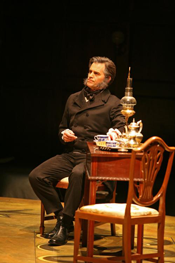 Stephen Morscheck (John Quincy Adams)
The site for Amistad was the totally reconstructed Memminger Auditorium, a
1939 building devastated by Hurricane Hugo in 1989. Once the city’s major
performing arts venue, the building stands at the edge of a mixed
neighborhood near the historic heart of Charleston. What better work to
pinpoint Charleston on the historical map than Amistad?
Redden insisted upon major revision of the score and he, along with Spoleto director of opera and orchestras Emmanuel Villaume, played an active part in the project. With their help Davis and his librettist cousin Thulani Davis made Amistad an opera much leaner, more focused and dramatically far more effective than the original. And in so doing they created not only a masterpiece of American opera, but further a work that — against a contemporary horizon darkened by undercurrents of racism — resonates today far beyond Memminger and Spoleto USA.
The Davises eliminated characters and scenes, and the composer reduced the orchestra from 65 to 45. Amistad — now only slightly more than two hours of music — is a work transparently coherent both in narrative and music, and Spoleto assembled a creative team and cast that made the work, seen at its premiere on May 22 and again on May 25, an opera that should be widely performed. Amistad now has a mass hero of eight Africans, each with significant solos. As their leader Cinque, bass-baritone Gregg Baker was a commanding presence on the oblong Memminger stage, and as Margru, soprano Janinah Burnett gave a poignant account of how women were treated by their captors. It was followed by the overpowering chorus “Ankle and Wrist,” referring to the chains the Africans had worn.
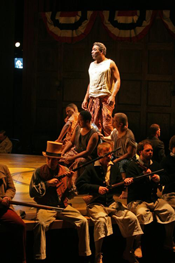 Gregg Baker (Cinque) and ensemble.
Tenor Dennis Petersen led a quartet of reporters out to exploit the
Amistad case as a public sensation, while tenor Brian Frutiger brought
passion to forces advocating abolition of slavery. Bass-baritone Stephen
Morscheck, tall and lean, was an imposingly agitated ex-president Adams in
his confrontation with the Supreme Court.
Davis has woven hints of jazz, blues and even scat so seamlessly into the score that they surrender their identity to his uniquely personal idiom. His use of the hymn “Jesus Savior, Pilot Me” is one of the most moving moments in the opera. Thus the dialectic of American history — the commitment, on the one side, to free men and, on the other, the acceptance of slavery despite the noble wording of basis documents — played out before the Memminger audience. The Davises brought a mythic gloss to Amistad by placing the story of the ship and its captives in the hands of a pair of deities from African mythology. As the Trickster God tenor Michael Forest, both narrator of the story and participant in it, had the lead role in the huge cast, while Mary Elizabeth Williams brought humane concern to the Queen of the Waters with her warm and winning mezzo.
Director Sam Helfrich, set and costume designers Caleb Hale Wertembaker and Kaye Voice, and lighting designer Peter West collaborated to make Amistad flow with ease across the stage in Memminger’s black-box interior. Indeed, the production is a coup of music theater for Spoleto — an experiment in opera grand and intimate and timely in its content. The trial that consumes most of the second act is a superlative achievement of dramatic narrative that reaches back to the beginnings of slave trade and culminates in a vivid reenactment of the mutiny on board the Amistad.
A major contributor to the success of the production was conductor Emmanuel Villaume. Working — he noted — as the many-armed Indian god Shiva, he led his gifted ensemble of young instrumentalists through Davis’ complex score, unfazed by its multiple meters and shifting rhythms to bring musical and dramatic drive and continuity to this compelling story.
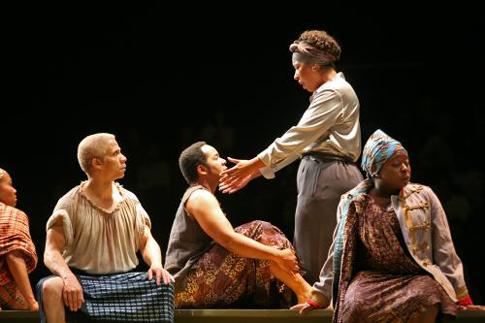 Janinah Burnett (Margru), Herbert Perry (Burnah), Norman Shankle (Kaleh), Mary Elizabeth Williams (Goddess of the Waters), Crystal Charles (Captive).
It is significant that the Spoleto revival of the revised Amistad comes less than a month after the world premiere of another opera that confronts the question of slavery in the years prior to the Civil War: Kirke Mechem‘s John Brown’s Body, premiered by the Kansas City Lyric Opera on May 3. Both works call for careful reconsideration of truths long — and uncritically — held self evident.
It is of interest that while most of the Amistad captives returned to Africa, one — a woman — stayed in this country and earned a degree from Oberlin College.
The 2008 season of Spoleto USA runs through June 8. Visit www.spoletousa.org.
Wes Blomster