09 May 2008
Spoleto USA revives opera, hall
Operas do not often get a second chance. A new work is premiered and — if it’s a co-commission — it moves on to another company or two.
English Touring Opera are delighted to announce a season of lyric monodramas to tour nationally from October to December. The season features music for solo singer and piano by Argento, Britten, Tippett and Shostakovich with a bold and inventive approach to making opera during social distancing.
Conductor Oliver Zeffman has commissioned the very first opera for a socially distanced world, which is now available to watch exclusively on Apple Music. Eight Songs From Isolation has been written by eight leading composers, specifically for streaming - rather than live performance - and is the first opera written for a time when the performers were unable to meet in person.
Leading freelance musicians unite in Parliament Square to call for targeted support for colleagues in the arts and entertainment sector.
Duo Lewis Murphy (composer) and Laura Attridge (writer) have launched a charitable song project entitled Notes From Isolation. The resulting songs, featuring some of the UK's top singing talent, are being released online between August and October 2020 and can be enjoyed free of charge.
The Royal Opera House is thrilled to announce an exciting, wide-ranging new line-up for its autumn programme. For the first time, extraordinary performances will be accessible online for a global audience through livestreams and for socially distanced live audiences at our home in Covent Garden. In a global first, we present a new opera in hyper-reality, alongside repertory favourites from both artistic companies.
Some of the most famous and outstanding stars from the opera world are to take part in a very special evening from Wexford Festival Opera, including Aigul Akhmetshina, Joseph Calleja, Daniela Barcellona, Juan Diego Flórez, Igor Golovatenko, Ermonela Jaho, Sergey Romanovsky, and many more.
Following its successful launch in 2019, OperaStreaming streams nine operas on YouTube from the historic opera houses of Emilia-Romagna during the 2020-21 season, with fully-staged productions of Verdi's La traviata in October from Modena and Verdi'sOtello from Bologna in...
‘A brief history of song’ is the subtitle of the 2020 Oxford Lieder Festival (10th-17th October), which will present an ambitious, diverse and imaginative programme of 40 performances and events.
Bampton Classical Opera returns to the Baroque splendour of London’s St John’s Smith Square on November 6 with a concert performance of Gluck’s one-act opera The Crown, the first in the UK since 1987. The performance will also be filmed and available to watch on demand on the Bampton website from 9 November.
While many of us spent lockdown at home taking it a little easier, composer Andrew Synnott wrote an opera.
Owen Wingrave is part of the new Interim Season of 19 brand new events, all free to view online between September and December 2020.
The Arts Council has awarded innovative UK charity Music and Theatre For All (MTFA) a major new grant to develop three ambitious new projects in the wake of Covid 19.
English National Opera (ENO) will reopen the London Coliseum to socially distanced audiences on 6 and 7 November for special performances of Mozart’s Requiem. These will provide audiences with an opportunity to reflect upon and to commemorate the difficulties the nation has faced during the pandemic.
The Royal Opera House is proud to continue its curated #OurHouseToYourHouse programme into the autumn, bringing audiences the best of the ROH through a new series of Friday Premieres and cultural highlights.
After six months of closure, the Royal Opera House is thrilled to be opening its doors to the public as part of Open House London weekend, giving visitors a taste of one of the world’s most famous theatres for free.
The Academy of St Martin in the Fields is thrilled to announce re:connect - an eight concert series with live socially distanced audiences at its namesake church, St. Martin-in-the-Fields. The autumn concerts will take place at 5pm & 7:30pm on two Saturdays per month with guest artists including baritone Roderick Williams, soprano Carolyn Sampson and composer-conductor-pianist Ryan Wigglesworth performing a wide range of repertoire.
Music and poetry unite and collide across centuries, from the Medieval to the Enlightenment to the present day. This year, the Oxford Lieder Festival will present a thrilling and innovative programme comprising more than forty events streamed over eight days.
The English Concert with artistic director Harry Bicket is delighted to announce a series of concerts from 1-15 October 2020. The concerts take place in historic London venues with star soloists and will be performed and streamed live to a paying audience at 7pm GMT on each performance date. The programmes include first-class vocal and instrumental works from the two pillars of the English Baroque, covering different aspects of the repertoire.
Glyndebourne has announced plans for a ‘staycation’ series of socially-distanced indoor performances, starting on 10 October 2020.
The Royal Opera House is delighted to announce two packed evenings of opera and ballet, live from our stage in Covent Garden and available to view wherever you are in the world online.
Operas do not often get a second chance. A new work is premiered and — if it’s a co-commission — it moves on to another company or two.
Then the score retreats to libraries, waiting to be listed in the next edition of the Grove Dictionary of Opera.
Recent successes such as Mark Adamo’s “Little Women” and “Dead Man Walking” by Jake Heggie are happy exceptions. Thus it’s good news that Anthony Davis’ “Amistad,” premiered by the Chicago Lyric Opera late in 1997, is being revived by Spoleto USA, the Charleston, South Carolina, all-arts festival that has a special “feel” for unusual works. Now it’s being revived in a greatly revised version by the composer to re-open Charleston’s Memminger Auditorium, the city’s former arts venue that had fallen upon hard times until that Spoleto “feel” sensed its value as a unique performance space.
A gala performance of “Amistad” opens the 2008 Spoleto season and inaugurates the rebuilt hall. When Davis accepted Chicago’s commission to write “Amistad,” the mutiny of heroic Africans about to be sold into slavery was a story whose time had come. Steven Spielberg’s film version also appeared in 1997, and it led — in turn — to David Pesci‘s novel on the mutiny and the court case that was a first step toward the abolition of slavery in this country.
Yet in the original version of the opera Davis seemed — so to speak — to have missed the boat. Critics were not kind to the work. Davis and his librettist cousin Thulani Davis, some felt, had “leached” a great story of its energy. The Trickster God, an African folk deity, did too much of the talking, allowing one-dimensional characters little opportunity for meaningful exchange. The opera was too long; it was static and did not excite the audience. The Amistad case — the Spanish owners of the ship tried to claim the Africans as their property — had gone all the way to the Supreme Court. Yet, one observer wrote, the scene that focused on John Quincy Adams's courtroom defense of the captives was “a snore.”
Nonetheless Spoleto general director Nigel Redden saw “Amistad” as a work of particular relevance for Charleston and decided to bring it back to life in a theatrically and musically vital way. It would be ideal, he felt, for the inauguration of the re-built Memminger. “I was at the Chicago premiere,” Redden says, “and I thought of “Amistad” immediately when we started making plans for Memminger. “It’s important to me that people feel this is a theater for everyone, and I wanted a work that would attract a wide spectrum from the community.”
Although only minutes away from King Street, the Charleston’s major downtown shopping artery, Memminger stands in the middle of a very mixed neighborhood off the regular path of festival visitors. The city’s once-active and well preserved slave market is a horror of history close at hand. “ ‘Amistad’ was an obvious choice for Memminger,” Redden says. “It’s a work that belongs here.” Redden sat down with Davis, who gained early fame for his “Malcolm X,” and made suggestions for the revision of the opera.
“It’s a work that relates to a major issue in Charleston’s history,” says Spoleto director of opera and concerts Emmanuel Villaume, “and staging it in Memminger underscores the impact that Spoleto has — and has had — on the city.” Villaume will be on the podium for all six performances of “Amistad.” And Villaume is pleased that the opera is open minded and without a narrowly defined political position.
“Anthony had been hoping for a chance to return ‘Amistad’ to the stage,” he says. “He has put a lot of effort into the new version, shortening the work and making it more concentrated. “It’s now for smaller forces used more efficiently, and it’s far more intimate than it was in Chicago.” “‘Amistad’ will gain from the location and the legacy of Charleston,” Davis says. “It’s now shorter and tighter, and there will be a better balance between singers and orchestra.”
A totally new cast has been recruited for the Memminger production, which will be directed by Sam Helfrich with costumes by Kaye Voyce and an imaginative set by Caleb Wertenbaker. Leading the list of 21 singers are Gregg Baker, Stephen Morscheck, Mary Elizabeth Williams and Michael Forest.
Redden points out that 2008 is of particular significance for “Amistad,“ for it marks the bicentennial of the abolition of the transatlantic slave trade. “This brings a particular resonance to the Spoleto production,” he says. Spoleto has planned numerous events related to the opera, including artist talks and roundtables at the Avery Research Center for African American History and Culture, guided tours of the newly-renovated Old Slave Mart Museum, followed by a walking tour of sites related to African-American history in Charleston and screenings of related films. The Freedom Schooner Amistad – a replica of the slave ship currently on an 18-month transatlantic voyage – will be docked at the Charleston Maritime Center from May 16 through the opening weekend of the season.
****************
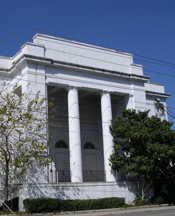
It is, however, not only Amistad that is getting a second chance at Spoleto this season. Memminger Auditorium, once Charleston’s major arts venue, has undergone a $6-million renovation, and will reopen on May 22 with a gala performance of “Amistad.” Designed by the Charleston architect Albert Simons, Memminger was completed in 1939 as a Federal Works Agency. It was home to the Charleston Symphony Orchestra prior to the opening of Gaillard Auditorium in 1968. It was also the site of high-school basketball games. Neglected after Gaillard was built, Memminger lost its roof in Hurricane Hugo in 1989. Emergency repairs saved the structure, which was filled with pigeons and cobwebs when Nigel Redden envisioned the ruin as the site for Spoleto extravaganzas. With makeshift air conditioning and miles of duct tape to save the audience’ clothes from splintered seats, Memminger reopened with a performance of Heiner Goebbels’ massive “Surrogate Cities” in 2000. Mahler symphonies and China’s “Peony Pavilion” — complete with a moat for live ducks — followed. The 2004 staging of Mozart’s “Don Giovanni” was so successful that it was repeated in 2005. It also prompted the decision to rebuild Memminger as a black-box theater. “Memminger has an edge to it,” Redden says. “Frankly, it’s fabulous. It makes a very strong statement.”
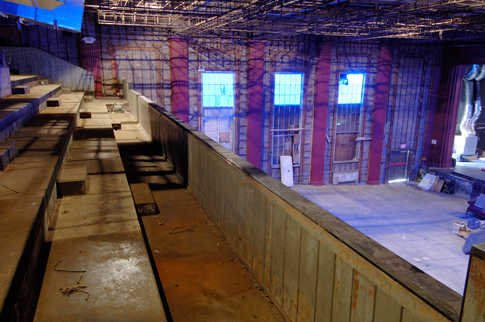 The balcony of Memminger Auditorium prior to renovations.
This season Memminger will also be home to Spoleto’s twice-daily chamber-music recitals, the most popular events of the festival, while the historic Dock Street Theatre is remodeled. Memminger is now handicap accessible and it has an attractive lobby with upgraded restrooms. The stage now has wings, and a garden will welcome audience members during intermissions.
****************
The second opera of the 2008 Spoleto season is Rossini’s “La Cenerentola,” which opens in Gaillard Auditorium on May 23. Charles Roubaud, whose Spoleto credits include a shimmering “Lakmé” and a rollicking “Ariadne auf Naxos,” directs; Matteo Beltrami is the conductor. Sandra Piques Eddy sings the title role; others in the cast are Victor Ryan Robertson, Tim Nolen and Bruno Taddia.
For complete information on Spoleto USA, visit www.spoletousa.org.
Wes Blomster