![Sarah Tynan (Sophie) / Sarah Connolly (Octavian) [Photo © Clive Barda / ENO]](http://www.operatoday.com/Rosenkavalier_ENO_01.png)
04 Jun 2008
Der Rosenkavalier at ENO
It is worth remembering that prior to the première of Strauss’s opera in 1911, the working title was ‘Ochs auf Lerchenau’.
English Touring Opera are delighted to announce a season of lyric monodramas to tour nationally from October to December. The season features music for solo singer and piano by Argento, Britten, Tippett and Shostakovich with a bold and inventive approach to making opera during social distancing.
This tenth of ten Live from London concerts was in fact a recorded live performance from California. It was no less enjoyable for that, and it was also uplifting to learn that this wasn’t in fact the ‘last’ LfL event that we will be able to enjoy, courtesy of VOCES8 and their fellow vocal ensembles (more below …).
Ever since Wigmore Hall announced their superb series of autumn concerts, all streamed live and available free of charge, I’d been looking forward to this song recital by Ian Bostridge and Imogen Cooper.
Although Stile Antico’s programme article for their Live from London recital introduced their selection from the many treasures of the English Renaissance in the context of the theological debates and upheavals of the Tudor and Elizabethan years, their performance was more evocative of private chamber music than of public liturgy.
Evidently, face masks don’t stifle appreciative “Bravo!”s. And, reducing audience numbers doesn’t lower the volume of such acclamations. For, the audience at Wigmore Hall gave soprano Elizabeth Llewellyn and pianist Simon Lepper a greatly deserved warm reception and hearty response following this lunchtime recital of late-Romantic song.
For this week’s Live from London vocal recital we moved from the home of VOCES8, St Anne and St Agnes in the City of London, to Kings Place, where The Sixteen - who have been associate artists at the venue for some time - presented a programme of music and words bound together by the theme of ‘reflection’.
'Such is your divine Disposation that both you excellently understand, and royally entertaine the Exercise of Musicke.’
‘And there was war in heaven: Michael and his angels fought against the dragon; and the dragon fought and his angels, And prevailed not; neither was their place found any more in heaven … that old serpent … Satan, which deceiveth the whole world: he was cast out into the earth, and his angels were cast out with him.’
There was never any doubt that the fifth of the twelve Met Stars Live in Concert broadcasts was going to be a palpably intense and vivid event, as well as a musically stunning and theatrically enervating experience.
‘Love’ was the theme for this Live from London performance by Apollo5. Given the complexity and diversity of that human emotion, and Apollo5’s reputation for versatility and diverse repertoire, ranging from Renaissance choral music to jazz, from contemporary classical works to popular song, it was no surprise that their programme spanned 500 years and several musical styles.
The Academy of St Martin in the Fields have titled their autumn series of eight concerts - which are taking place at 5pm and 7.30pm on two Saturdays each month at their home venue in Trafalgar Square, and being filmed for streaming the following Thursday - ‘re:connect’.
The London Symphony Orchestra opened their Autumn 2020 season with a homage to Oliver Knussen, who died at the age of 66 in July 2018. The programme traced a national musical lineage through the twentieth century, from Britten to Knussen, on to Mark-Anthony Turnage, and entwining the LSO and Rattle too.
With the Live from London digital vocal festival entering the second half of the series, the festival’s host, VOCES8, returned to their home at St Annes and St Agnes in the City of London to present a sequence of ‘Choral Dances’ - vocal music inspired by dance, embracing diverse genres from the Renaissance madrigal to swing jazz.
Just a few unison string wriggles from the opening of Mozart’s overture to Le nozze di Figaro are enough to make any opera-lover perch on the edge of their seat, in excited anticipation of the drama in music to come, so there could be no other curtain-raiser for this Gala Concert at the Royal Opera House, the latest instalment from ‘their House’ to ‘our houses’.
"Before the ending of the day, creator of all things, we pray that, with your accustomed mercy, you may watch over us."
The doors at The Metropolitan Opera will not open to live audiences until 2021 at the earliest, and the likelihood of normal operatic life resuming in cities around the world looks but a distant dream at present. But, while we may not be invited from our homes into the opera house for some time yet, with its free daily screenings of past productions and its pay-per-view Met Stars Live in Concert series, the Met continues to bring opera into our homes.
Music-making at this year’s Grange Festival Opera may have fallen silent in June and July, but the country house and extensive grounds of The Grange provided an ideal setting for a weekend of twelve specially conceived ‘promenade’ performances encompassing music and dance.
There’s a “slide of harmony” and “all the bones leave your body at that moment and you collapse to the floor, it’s so extraordinary.”
“Music for a while, shall all your cares beguile.”
The hum of bees rising from myriad scented blooms; gentle strains of birdsong; the cheerful chatter of picnickers beside a still lake; decorous thwacks of leather on willow; song and music floating through the warm evening air.
It is worth remembering that prior to the première of Strauss’s opera in 1911, the working title was ‘Ochs auf Lerchenau’.
This might perhaps have been a fitting subtitle for ENO’s current production, given John Tomlinson’s tour de force of a performance. He appeared in ENO’s last two stagings (at least once alongside the current Marschallin, Janice Watson) but his Ochs never owned the stage quite like this. The glint in this gravelly bass’s eye is at once repulsive and endearing, and he makes something of every word of Alfred Kalisch’s slightly clunky English translation, a feat equalled only by the excellent Andrew Shore as Faninal.
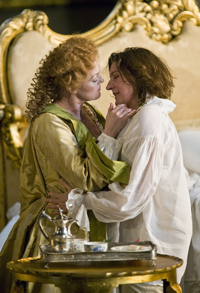 Janice Watson (The Marschallin) / Sarah Connolly (Octavian)
This should be a good thing, and indeed it is, on its own terms. The
downside is that Tomlinson plays his colleagues off the stage, and the
impression that is left on the memory a couple of hours after curtain-down is
of a brilliant, riotous Act 2. The erotic tumult of the opera’s opening,
Octavian and Sophie’s mutual falling in love, and the Marschallin’s
gracious sacrifice... all were wonderful at the time, but were all but
obliterated by the memory of this extraordinary Ochs.
That is not to say that there was much evidence of weakness in the rest of the cast. Janice Watson’s Marschallin was not the glacial grande dame we often see, and let her mask slip at times — for a mere moment in the confrontation with Ochs in Act 3, her grace and poise yielded to a flash of unrefined hot-blooded fury. Here we saw a rare glimpse of the fiery spirit which surely attracted Octavian in the first place. Later, when she observed him with Sophie, the façade slipped in quite another direction.
Sarah Connolly’s Octavian was expansive of voice and full of youthful vigour, loose-limbed and confident in his unofficial temporary role as lord of the manor in the Feldmarschall’s absence. I had been doubtful about Connolly’s ability to play a youth, after the succession of Handelian warrior-heroes on which her career is founded, but she captured ideally the petulance and over-sensitivity of the selfish teenager behind this young aristocrat’s aristocratic pomp and chivalry.
It is good to hear the accomplished soubrette Sarah Tynan in a proper lyrical role such as Sophie; she looks lovely, is able to play the right age, and is a feisty little madam with or without Octavian’s assistance. Her silvery soprano sits ideally with the musical character of the scenes in which she sings, and is rightly as far the vocal opposite of Ochs as it is possible to be.
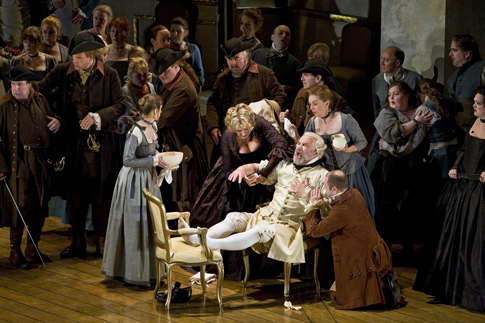 John Tomlinson (Baron Ochs) centre group
Rosenkavalier was, of course, Strauss’s answer to Figaro, and director David McVicar’s 2005 staging of Mozart’s work for the Royal Opera clearly took much inspiration from this production which originated at Scottish Opera in 1999. At times this Rosenkavalier seems full of McVicar clichés, but as it predates most of the work for which he’s now renowned, it should rightly be seen as an original. One such ‘cliché’ was the deconstructed rococo set, a single one used (with contrasting embellishments) for all three acts. Another, repeated in Figaro, was the attention to detail in the direction of a multitude of minor roles, servants, and non-singing characters. Harry Ward’s idiotic, mugging Leopold stood out, but from the Singer (Alfie Boe, replacing an indisposed Dwayne Jones) to the Milliner, all were clearly defined and full of personality. Stuart Kale’s Valzacchi was partnered by an exceptional Annina in Madeleine Shaw, currently on ENO’s Young Singers programme.
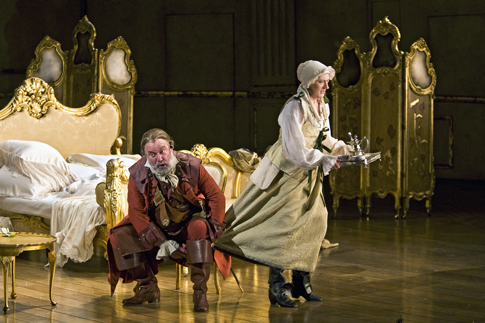 John Tomlinson (Baron Ochs) / Sarah Connolly (Octavian as ‘Mariandel’)
Sometimes, the concentration on detail is to the detriment of the bigger moments. The Marschallin’s exit after the trio is unsympathetically staged, with Janice Watson forced to edge her way clumsily through a side doorway that is too small for her immense dress, and lacks impact. Ed Gardner’s conducting, though sumptuous when required, is fairly conservative and supports rather than adds to the intricate character of the performance. But McVicar’s ability to make this lengthy and variably-paced opera flow so well — even with standard musical cuts opened out — is a credit to his dramatic intelligence.
Ruth Elleson © 2008