09 Jun 2008
Opera with a human heart
When the Ringling Brothers folded their tents, opera took over. Aïda with elephants, and Walküre with real horses.
English Touring Opera are delighted to announce a season of lyric monodramas to tour nationally from October to December. The season features music for solo singer and piano by Argento, Britten, Tippett and Shostakovich with a bold and inventive approach to making opera during social distancing.
This tenth of ten Live from London concerts was in fact a recorded live performance from California. It was no less enjoyable for that, and it was also uplifting to learn that this wasn’t in fact the ‘last’ LfL event that we will be able to enjoy, courtesy of VOCES8 and their fellow vocal ensembles (more below …).
Ever since Wigmore Hall announced their superb series of autumn concerts, all streamed live and available free of charge, I’d been looking forward to this song recital by Ian Bostridge and Imogen Cooper.
Although Stile Antico’s programme article for their Live from London recital introduced their selection from the many treasures of the English Renaissance in the context of the theological debates and upheavals of the Tudor and Elizabethan years, their performance was more evocative of private chamber music than of public liturgy.
Evidently, face masks don’t stifle appreciative “Bravo!”s. And, reducing audience numbers doesn’t lower the volume of such acclamations. For, the audience at Wigmore Hall gave soprano Elizabeth Llewellyn and pianist Simon Lepper a greatly deserved warm reception and hearty response following this lunchtime recital of late-Romantic song.
For this week’s Live from London vocal recital we moved from the home of VOCES8, St Anne and St Agnes in the City of London, to Kings Place, where The Sixteen - who have been associate artists at the venue for some time - presented a programme of music and words bound together by the theme of ‘reflection’.
'Such is your divine Disposation that both you excellently understand, and royally entertaine the Exercise of Musicke.’
‘And there was war in heaven: Michael and his angels fought against the dragon; and the dragon fought and his angels, And prevailed not; neither was their place found any more in heaven … that old serpent … Satan, which deceiveth the whole world: he was cast out into the earth, and his angels were cast out with him.’
There was never any doubt that the fifth of the twelve Met Stars Live in Concert broadcasts was going to be a palpably intense and vivid event, as well as a musically stunning and theatrically enervating experience.
‘Love’ was the theme for this Live from London performance by Apollo5. Given the complexity and diversity of that human emotion, and Apollo5’s reputation for versatility and diverse repertoire, ranging from Renaissance choral music to jazz, from contemporary classical works to popular song, it was no surprise that their programme spanned 500 years and several musical styles.
The Academy of St Martin in the Fields have titled their autumn series of eight concerts - which are taking place at 5pm and 7.30pm on two Saturdays each month at their home venue in Trafalgar Square, and being filmed for streaming the following Thursday - ‘re:connect’.
The London Symphony Orchestra opened their Autumn 2020 season with a homage to Oliver Knussen, who died at the age of 66 in July 2018. The programme traced a national musical lineage through the twentieth century, from Britten to Knussen, on to Mark-Anthony Turnage, and entwining the LSO and Rattle too.
With the Live from London digital vocal festival entering the second half of the series, the festival’s host, VOCES8, returned to their home at St Annes and St Agnes in the City of London to present a sequence of ‘Choral Dances’ - vocal music inspired by dance, embracing diverse genres from the Renaissance madrigal to swing jazz.
Just a few unison string wriggles from the opening of Mozart’s overture to Le nozze di Figaro are enough to make any opera-lover perch on the edge of their seat, in excited anticipation of the drama in music to come, so there could be no other curtain-raiser for this Gala Concert at the Royal Opera House, the latest instalment from ‘their House’ to ‘our houses’.
"Before the ending of the day, creator of all things, we pray that, with your accustomed mercy, you may watch over us."
The doors at The Metropolitan Opera will not open to live audiences until 2021 at the earliest, and the likelihood of normal operatic life resuming in cities around the world looks but a distant dream at present. But, while we may not be invited from our homes into the opera house for some time yet, with its free daily screenings of past productions and its pay-per-view Met Stars Live in Concert series, the Met continues to bring opera into our homes.
Music-making at this year’s Grange Festival Opera may have fallen silent in June and July, but the country house and extensive grounds of The Grange provided an ideal setting for a weekend of twelve specially conceived ‘promenade’ performances encompassing music and dance.
There’s a “slide of harmony” and “all the bones leave your body at that moment and you collapse to the floor, it’s so extraordinary.”
“Music for a while, shall all your cares beguile.”
The hum of bees rising from myriad scented blooms; gentle strains of birdsong; the cheerful chatter of picnickers beside a still lake; decorous thwacks of leather on willow; song and music floating through the warm evening air.
When the Ringling Brothers folded their tents, opera took over. Aïda with elephants, and Walküre with real horses.
Supernumeraries infiltrated the chorus, and sets and costumes went beyond the most extravagant excesses of Hollywood. Eat your heart out, Cecil B. DeMille! Opera — growing in popularity by the season — became the opium of the masses, and directors vied with each other in productions that took the breath away. Forget the plot and the music written for it; the show was the thing!
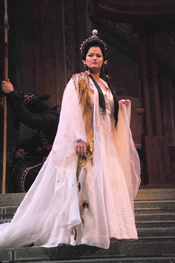
Texas’ 62-year-old Fort Worth Opera — it’s a senior among American companies — is out to restore a proper balance, and the four productions currently on stage there in the FWO’s second summer festival stress that this is no longer just another regional company, but an enterprise that has defined for itself a special identity through its commitment to fidelity, to composers’ intentions, to perceptive direction and a finely honed sense of what it is that makes opera both grand and great. The Turandot that opened the festival on May 24 made all this clear. For those who wanted awe, it was there in the staging designed by Peter Graves and Allen Charles Klein for Opera Cleveland. However, it was Daniel Pelzig’s sensitive direction that made this refreshingly fascinating Puccini.
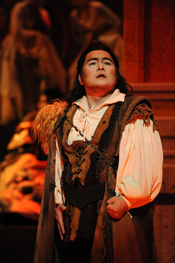 Dongwon Shin as Calaf
Turandot is a troubling tale. The eponymous heroine isn’t the
girl next door; she’s downright nasty, a trait of character underscored by
the ease with which she condones the murder of sweet and innocent Liú, the
one genuinely good character in the story. In most productions Turandot is a
simplified study in frigidity — an ice sculpture imperially above the
masses on stage with half of Beijing’s Imperial City on her head and
shoulders. Pelzig made her mobile and an agitated presence in her own story.
The prehistory of abuse to a female ancestor became a document of modern
feminism as she stood next to Liu’ in the younger woman’s hour of
sacrifice. And Carter Scott, who stepped in for an ailing Elizabeth Bennett,
has the power, passion and agility of voice to make Turandot a portrait of
deeply internalized suffering. (The goodness of Liú, sung with youthful
devotion by Sandra Lopez, even lost some of its appeal through this
meaningful feminization of the Princess.)
Given the paucity of tremendous tenors today it is astonishing that one has to go to Fort Worth to discover Korean-born Dongwon Shin, whose throbbing “Nessun dorma” would leave the citizens of any city willing to surrender a night of sleep to hear the greatest hit in the opera sung with his ardor. Stephen Dubberly had the massive FWO Chorus making music — not merely noise, and FWO music director Joseph Illick extracted playing from the Fort Worth Symphony that added to the impact of a Turandot that one had hoped one day to hear.
Anthony Dean Griffey, a major success of the season at the Met as Britten’s Peter Grimes, has made Lennie, the retarded central figure of Carlisle Floyd’s Of Mice and Men a signature role, and it’s wonderful that audiences can expect the young American tenor to sing this role for decades to come.
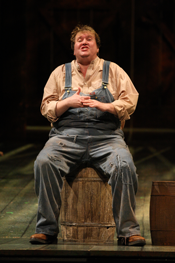 Anthony Dean Griffey as Lennie
Even Griffey’s considerable bulk contributes
to his success as Lennie, for he seems at first blush just another overweight
kid. But watch his fingers as he seeks solace in “something soft.” Keep
an eye on his smile and the little skip that he executes from time to time
and you’ll swear that you have a genuine case of arrested mental
development in front of you. Griffey makes Lennie loveable and he makes his
relationship with his companion George — both migrant workers from the
Great Depression — meaningful and beautiful.
George could hardly be better sung than he was by Canadian baritone George Addis, another of astonishing FWO artists to watch for elsewhere. Brandi Icard, true, was one dimensional as Curley’s love-starved wife, while Matt Morgan made Curley the quintessential American macho male, recalling Annie Proulx’ pronouncement that “men are the major victims of American masculinity.”
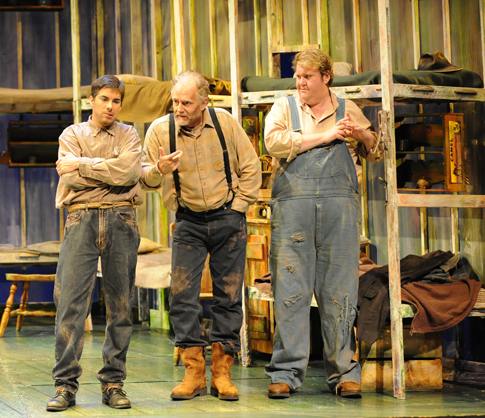 Phillip Addis as George, Stephen West as Candy, and Anthony Dean Griffey as Lennie
The Utah Opera production — sets and costumes by, respectively, Vicki Davis and Susan Memmott-Allred — recalled Grant Wood, and Richard Kagey’s direction upheld the view that this 1971 score is Floyd’s finest work. Illick was again an impressive conductor, especially in the orchestral interludes that put Floyd on a level with the Anton Webern of Wozzeck.
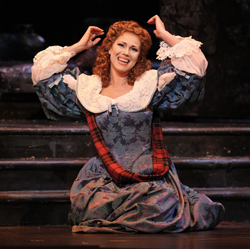 Elizabeth Futral as Lucia
Despite it’s greatest “hits” — the sextet and the Mad Scene —
the bel canto melodrama of Donizetti’s Lucia di Lammemoor is not
everyone’s tankard of ale. A less-than-great performance is uncomfortably
close to parody, and its glaring rejection of traditional family values is
wasted on those interested only in coloratura acrobatics. How different,
however, the FWO Lucia directed by David Gately and conducted by
Steven White!
Lucia has rarely had a better interpreter than Elizabeth Futral, cast by the FWO in the title role. She is one of the loveliest singers of her generation, and she makes bel canto seem her mother tongue. She is wonderfully vulnerable — even when one wishes she would take a knife to Brother Enrico. Futral sang the Mad Scene with delicate sensitivity, never reveling that that’s only catsup and not blood on her hands and gown, Yet this show was almost stolen from her by youthful and up-coming tenor Stephen Costello as losing lover Edgardo, a role he has already sung at the Met. In his cemetery lament in the final scene of the opera Costello, lean and handsome at a mere 28, sang his way into this music with a richness of tone, accuracy and articulation that had the audience on its feet, suggesting that the next great tenor is now — and in Fort Worth.
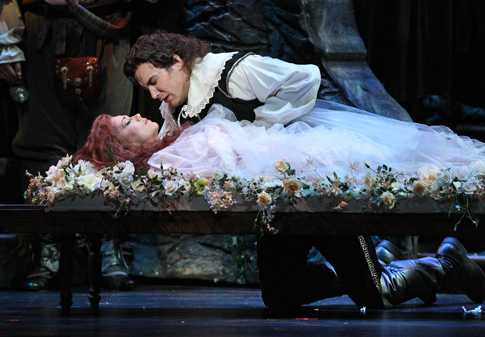 Elizabeth Futral as Lucia and Stephen Costello as Edgardo
The Cincinnati Opera production is traditional and true to the period and it gained color through lavish costumes from near-by Dallas. The chorus seemed to have had one — or two — too many in the orgiastic post-wedding revelry.
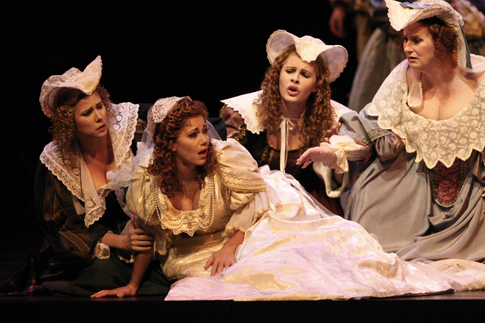 Alissa Anderson, Elizabeth Futral, Allison Whetsel and Pamela Grayson
Homosexuality might have come a long way since the day that it was — said Oscar Wilde — “the love that dare not speak its name” to — as someone quipped in the 70s — the love that won’t shut up. Nonetheless, the composition of an AIDS opera is a task far removed from dashing off another Bohème or Butterfly.
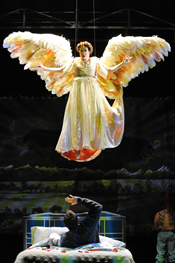 Prior’s (David Adam Moore) prophetic visions culminate in the appearance of an imposing and beautiful Angel (Ava Pine) who crashes through the roof of his apartment and proclaims, “The Great Work begins.”
That alone, however, makes
Peter Eötvös’ opera based on Tony Kushner’s Angels in America
all the more remarkable — and admirable, and the choice of the work to
round out the FWO’s second festival season is to be praised as an act of
bravery and bravura. This obviously begs the question about the quality of
the opera, which received its first full staging during the festival in Fort
Worth’s 500-seat Scott Theater in the city’s museum district. (The other
three operas were staged in the city’s still new downtown Bass Performance
Hall.) In shaving Angels down from a seven-hour stage work to an
opera of a mere two hours Mari Mezei has made a noble attempt to transfer the
drama — and its discomforting subject matter — to another medium.
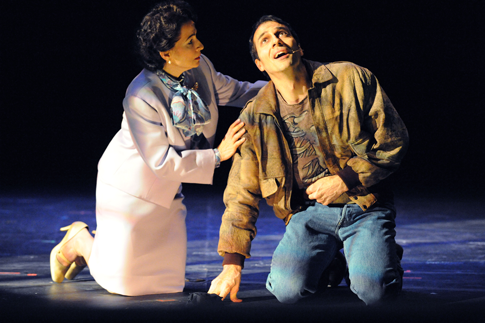 Hannah (Janice Hall) helps Prior (David Adam Moore) who is sick with AIDS
Hungarian-born Eötvös, a major European modernist in the wake of the Second Viennese School, has written much music for the opera that is of ethereal beauty and impressive in technique. (Much of it is delivered by musicians screened on either side of the stage.) Yet the result seems a work in which less is much less; too much has been lost in transition. An immense amount of detail obscures the major issues of Kushner’s play.
With the efforts of a brilliant creative team — conductor Christopher Larkin, director David Gately, designers Peter Nigrini and Claudia Stephens — made Angels a work decidedly worth seeing. And the cast, headed by veteran soprano Janice Hall and Erin Elizabeth Smith, delivered lines ranging from speaking to Sprechstimme to singing with amazing aplomb.
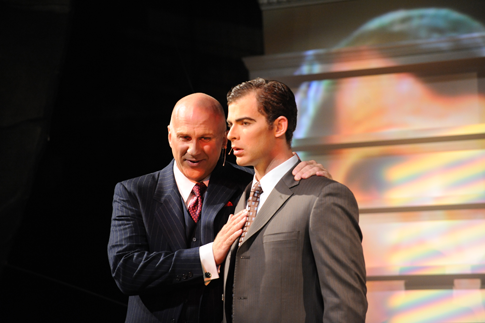 Left to Right: Roy Cohn (Kelly Anderson) and Joe Pitt (Craig Verm) talk politics
Kelly Anderson was a brilliantly butch Roy Cohn (but who remembers today who that was?), and studio artist Ave Pine was vocally stunning as the major angel who flew about on wires while singing famously. In all probability Angels will not be done again in this country in a long, long time, and one is grateful to FWO general director Darren K. Woods for his courage in bringing it to the festival.
A bonus of the ’08 season was the inclusion in the season of Ricky Ian Gordon’s Orpheus and Euridice, his song cycle for soprano, clarinet and piano. The performance by Gina Browning, virtuoso clarinetist Jonathan Jones and Illick at the piano was part of More Life: The Art & Science of AIDS, a series of concurrent events involving a multitude of Fort Worth community organizations designed to focus attention on the AIDS epidemic.
On stage in Fort Worth in 2009 are Carmen, Cinderella and Dead Man Walking. The season from 25 April through June 10 is followed immediately by the 2009 Van Cliburn International Piano Festival. Visit www.fwopera.org.