Recently in Performances
English Touring Opera are delighted to announce a season of lyric monodramas to tour nationally from October to December. The season features music for solo singer and piano by Argento, Britten, Tippett and Shostakovich with a bold and inventive approach to making opera during social distancing.
This tenth of ten Live from London concerts was in fact a recorded live performance from California. It was no less enjoyable for that, and it was also uplifting to learn that this wasn’t in fact the ‘last’ LfL event that we will be able to enjoy, courtesy of VOCES8 and their fellow vocal ensembles (more below …).
Ever since Wigmore Hall announced their superb series of autumn concerts, all streamed live and available free of charge, I’d been looking forward to this song recital by Ian Bostridge and Imogen Cooper.
Although Stile Antico’s programme article for their Live from London recital introduced their selection from the many treasures of the English Renaissance in the context of the theological debates and upheavals of the Tudor and Elizabethan years, their performance was more evocative of private chamber music than of public liturgy.
Evidently, face masks don’t stifle appreciative “Bravo!”s. And, reducing audience numbers doesn’t lower the volume of such acclamations. For, the audience at Wigmore Hall gave soprano Elizabeth Llewellyn and pianist Simon Lepper a greatly deserved warm reception and hearty response following this lunchtime recital of late-Romantic song.
For this week’s Live from London vocal recital we moved from the home of VOCES8, St Anne and St Agnes in the City of London, to Kings Place, where The Sixteen - who have been associate artists at the venue for some time - presented a programme of music and words bound together by the theme of ‘reflection’.
'Such is your divine Disposation that both you excellently understand, and royally entertaine the Exercise of Musicke.’
‘And there was war in heaven: Michael and his angels fought against the dragon; and the dragon fought and his angels, And prevailed not; neither was their place found any more in heaven … that old serpent … Satan, which deceiveth the whole world: he was cast out into the earth, and his angels were cast out with him.’
There was never any doubt that the fifth of the twelve Met Stars Live in Concert broadcasts was going to be a palpably intense and vivid event, as well as a musically stunning and theatrically enervating experience.
‘Love’ was the theme for this Live from London performance by Apollo5. Given the complexity and diversity of that human emotion, and Apollo5’s reputation for versatility and diverse repertoire, ranging from Renaissance choral music to jazz, from contemporary classical works to popular song, it was no surprise that their programme spanned 500 years and several musical styles.
The Academy of St Martin in the Fields have titled their autumn series of eight concerts - which are taking place at 5pm and 7.30pm on two Saturdays each month at their home venue in Trafalgar Square, and being filmed for streaming the following Thursday - ‘re:connect’.
The London Symphony Orchestra opened their Autumn 2020 season with a homage to Oliver Knussen, who died at the age of 66 in July 2018. The programme traced a national musical lineage through the twentieth century, from Britten to Knussen, on to Mark-Anthony Turnage, and entwining the LSO and Rattle too.
With the Live from London digital vocal festival entering the second half of the series, the festival’s host, VOCES8, returned to their home at St Annes and St Agnes in the City of London to present a sequence of ‘Choral Dances’ - vocal music inspired by dance, embracing diverse genres from the Renaissance madrigal to swing jazz.
Just a few unison string wriggles from the opening of Mozart’s overture to Le nozze di Figaro are enough to make any opera-lover perch on the edge of their seat, in excited anticipation of the drama in music to come, so there could be no other curtain-raiser for this Gala Concert at the Royal Opera House, the latest instalment from ‘their House’ to ‘our houses’.
"Before the ending of the day, creator of all things, we pray that, with your accustomed mercy, you may watch over us."
The doors at The Metropolitan Opera will not open to live audiences until 2021 at the earliest, and the likelihood of normal operatic life resuming in cities around the world looks but a distant dream at present. But, while we may not be invited from our homes into the opera house for some time yet, with its free daily screenings of past productions and its pay-per-view Met Stars Live in Concert series, the Met continues to bring opera into our homes.
Music-making at this year’s Grange Festival Opera may have fallen silent in June and July, but the country house and extensive grounds of The Grange provided an ideal setting for a weekend of twelve specially conceived ‘promenade’ performances encompassing music and dance.
There’s a “slide of harmony” and “all the bones leave your body at that moment and you collapse to the floor, it’s so extraordinary.”
“Music for a while, shall all your cares beguile.”
The hum of bees rising from myriad scented blooms; gentle strains of birdsong; the cheerful chatter of picnickers beside a still lake; decorous thwacks of leather on willow; song and music floating through the warm evening air.
Performances
13 Jul 2008
CANDIDE – English National Opera, London Coliseum
Originating at the Châtelet, where the narration was given in French, Robert Carsen's staging of Bernstein's unique satire worked rather well in its television broadcast from the Parisian house late in 2006.
It is set inside a giant television in America at some unspecified point in the 1950s or 1960s (though there are references to events spanning the past sixty years), one conceit of the production is that Candide's childhood home is the White House, and his adoptive parents the President and First Lady. Voltaire's imaginary land of Westphalia becomes 'West Failure', an overt joke at the expense of the US, and Pangloss's unfailingly 'optimistic' philosophical teachings become an all-too-recognisable depiction of a country whose administration prefers to brainwash its younger generation into acceptance and support of its professed moral and religious values while employing questionable (and often downright hypocritical) ethical practices both at home and in its foreign policy.
The overture is accompanied by a film depicting various aspects of American life, principally the ‘American Dream’. It was an inventive compilation with each new musical theme coinciding with a new theme in the film: the fast tune from ‘Glitter and be Gay’, for example, took us to the glamour of Monroe-era Hollywood, and the splash of the final cadence became an exploding Coca-Cola sponsorship logo. We are then introduced to Act 1 by a cartoon Voltaire giving a wink and a one-fingered salute in the manner of a Monty Python animation vignette.
The deeply cynical operetta juxtaposes sunny innocence and the worst excesses of human darkness right from the start, with Pangloss and 'Voltaire' (both roles played by the singing actor Alex Jennings) blithely recounting the young protagonists' encounters with military brutality, massacre and rape as though it were a natural progression from the privileged idyll of the opening scene. The characters hop from country to country, meeting appalling fate after appalling fate and somehow always coming out the other side. Almost all the characters have a surreal habit of surviving their own deaths on multiple occasions; all in all nothing much ever changes in the world, no matter how great the growth in wisdom and self-knowledge of its individual citizens.
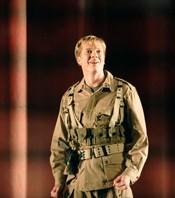
Rumon Gamba's conducting was often rather pedestrian, but the cast was reasonably strong. In the title role, Toby Spence was soulful and likeable, his boyish blond looks and clear tenor ideal for the gullible hero. In appearance and character he was well-matched by Anna Christy's Cunégonde, though the amplification system was unkind to her very focussed glassy soprano and she was often shrill (though at least her American accent is natural; the rest of the cast had varying degrees of success with theirs.) Mairéad Buicke's Paquette was lively, and Mark Stone's Maximilian was the most attractive voice on offer. Beverly Klein supplied the best all-round value as the Old Lady; her tango number 'I am easily assimilated' was the most successful set-piece of the evening, more so even than the more obviously showy 'Glitter and be Gay'.
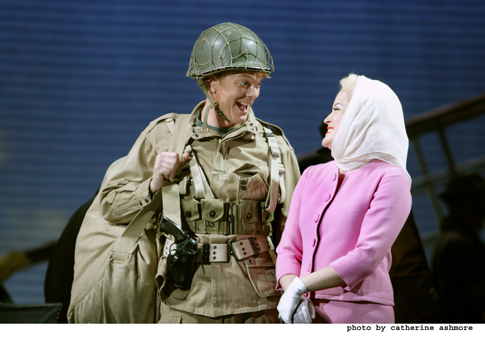 Toby Spence as Candide & Anna Christy as Cunegonde
The main problem with the staging is that the concept – while supplying good value in terms of funny situations and surreal humour – rides roughshod over the wit and satire in the piece itself. A stab at 21st-century topical comedy – with a parade of five contemporary politicians lazing on inflatable mattresses atop an oil slick – fell absolutely flat, and should be consigned to the cutting-room floor before the production travels any further. Furthermore, the characters remained cartoonish and two-dimensional, and I never felt much sympathy for any of them – the plot relies upon each person being a blend of the positives and negatives of humanity. There were certainly a few real belly-laughs over the course of the evening, but ultimately it was a superficial affair.
Ruth Elleson © 2008