13 Jul 2008
Die Soldaten
Bernd Alois Zimmermann was a sensitive, none too healthy 21-year-old music prodigy in 1939, when he was drafted into the German army.
English Touring Opera are delighted to announce a season of lyric monodramas to tour nationally from October to December. The season features music for solo singer and piano by Argento, Britten, Tippett and Shostakovich with a bold and inventive approach to making opera during social distancing.
This tenth of ten Live from London concerts was in fact a recorded live performance from California. It was no less enjoyable for that, and it was also uplifting to learn that this wasn’t in fact the ‘last’ LfL event that we will be able to enjoy, courtesy of VOCES8 and their fellow vocal ensembles (more below …).
Ever since Wigmore Hall announced their superb series of autumn concerts, all streamed live and available free of charge, I’d been looking forward to this song recital by Ian Bostridge and Imogen Cooper.
Although Stile Antico’s programme article for their Live from London recital introduced their selection from the many treasures of the English Renaissance in the context of the theological debates and upheavals of the Tudor and Elizabethan years, their performance was more evocative of private chamber music than of public liturgy.
Evidently, face masks don’t stifle appreciative “Bravo!”s. And, reducing audience numbers doesn’t lower the volume of such acclamations. For, the audience at Wigmore Hall gave soprano Elizabeth Llewellyn and pianist Simon Lepper a greatly deserved warm reception and hearty response following this lunchtime recital of late-Romantic song.
For this week’s Live from London vocal recital we moved from the home of VOCES8, St Anne and St Agnes in the City of London, to Kings Place, where The Sixteen - who have been associate artists at the venue for some time - presented a programme of music and words bound together by the theme of ‘reflection’.
'Such is your divine Disposation that both you excellently understand, and royally entertaine the Exercise of Musicke.’
‘And there was war in heaven: Michael and his angels fought against the dragon; and the dragon fought and his angels, And prevailed not; neither was their place found any more in heaven … that old serpent … Satan, which deceiveth the whole world: he was cast out into the earth, and his angels were cast out with him.’
There was never any doubt that the fifth of the twelve Met Stars Live in Concert broadcasts was going to be a palpably intense and vivid event, as well as a musically stunning and theatrically enervating experience.
‘Love’ was the theme for this Live from London performance by Apollo5. Given the complexity and diversity of that human emotion, and Apollo5’s reputation for versatility and diverse repertoire, ranging from Renaissance choral music to jazz, from contemporary classical works to popular song, it was no surprise that their programme spanned 500 years and several musical styles.
The Academy of St Martin in the Fields have titled their autumn series of eight concerts - which are taking place at 5pm and 7.30pm on two Saturdays each month at their home venue in Trafalgar Square, and being filmed for streaming the following Thursday - ‘re:connect’.
The London Symphony Orchestra opened their Autumn 2020 season with a homage to Oliver Knussen, who died at the age of 66 in July 2018. The programme traced a national musical lineage through the twentieth century, from Britten to Knussen, on to Mark-Anthony Turnage, and entwining the LSO and Rattle too.
With the Live from London digital vocal festival entering the second half of the series, the festival’s host, VOCES8, returned to their home at St Annes and St Agnes in the City of London to present a sequence of ‘Choral Dances’ - vocal music inspired by dance, embracing diverse genres from the Renaissance madrigal to swing jazz.
Just a few unison string wriggles from the opening of Mozart’s overture to Le nozze di Figaro are enough to make any opera-lover perch on the edge of their seat, in excited anticipation of the drama in music to come, so there could be no other curtain-raiser for this Gala Concert at the Royal Opera House, the latest instalment from ‘their House’ to ‘our houses’.
"Before the ending of the day, creator of all things, we pray that, with your accustomed mercy, you may watch over us."
The doors at The Metropolitan Opera will not open to live audiences until 2021 at the earliest, and the likelihood of normal operatic life resuming in cities around the world looks but a distant dream at present. But, while we may not be invited from our homes into the opera house for some time yet, with its free daily screenings of past productions and its pay-per-view Met Stars Live in Concert series, the Met continues to bring opera into our homes.
Music-making at this year’s Grange Festival Opera may have fallen silent in June and July, but the country house and extensive grounds of The Grange provided an ideal setting for a weekend of twelve specially conceived ‘promenade’ performances encompassing music and dance.
There’s a “slide of harmony” and “all the bones leave your body at that moment and you collapse to the floor, it’s so extraordinary.”
“Music for a while, shall all your cares beguile.”
The hum of bees rising from myriad scented blooms; gentle strains of birdsong; the cheerful chatter of picnickers beside a still lake; decorous thwacks of leather on willow; song and music floating through the warm evening air.
Bernd Alois Zimmermann was a sensitive, none too healthy 21-year-old music prodigy in 1939, when he was drafted into the German army.
He was invalided out in 1942, but that was quite enough to give him a lifetime’s horror of the brutalities of war and what militarism does to society (especially German society). This was not a new idea, though the Nazi Era saw the worst, the apotheosis, of it, and there had been protests before — one of them, The Soldiers, an eighteenth-century play by J.M.R. Lenz, is a didactic fable that shows the notion of military glamour corrupting young people, relations between the sexes and between the classes, and politics.
Zimmerman turned the play into an opera according to twelve-tone principles but with many additional threads from other arts, intending, it seems, to outdo Wagner in its melding of different arts into “total theater,” with opera, a 110-piece orchestra with special percussion and jazz units, spoken theater, ballet, film, television, circus, electronic music, tape and sound techniques to tell a tight, unpleasant, unglamorous little story. Comparisons to Wozzeck are obvious — let’s just say Wozzeck is a whole lot shorter and more focused. (Wozzeck is also based on a far earlier play.) Die Soldaten premiered in Cologne in 1965. Having said what he had to say, Zimmerman killed himself in 1970.
Stagings of Die Soldaten must always be special events — the work is not for small companies or repertory productions. The singers have to be first-rate musicians and first-rate actors, the orchestra huge and expert, the special effects cannot easily be fudged. For this year’s Lincoln Center Festival, the Ruhr Triennial brought their 2007 staging to the Park Avenue Armory, home base when it was built in the 1880s of the most fashionable regiment in town and thus an ideal space for the purpose, both in terms of its block-long size and the military trappings, which have recently been spectacularly refurbished and will keep you agog for the intermissions of any event you attend there. (The City Opera hopes to use it for the New York premiere of Messiaen’s St. François d’Assise in 2010.)
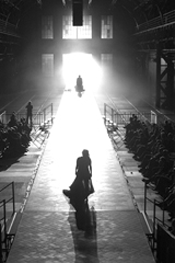
As an event — as a theatrical experience — there can hardly be two opinions of Die Soldaten’s success: It is overwhelming, fascinating theater, a live performance designed with cinematic technique. The impossibly huge room (stretching from near Park Avenue to Lexington) was given a T-shaped stage — the crossbar at the Lexington end, the narrow centerpiece down the center to the seats. The orchestra played on one side, the percussion ensemble on the other. The audience, a thousand of us, sat on rising seats at the Park Avenue end, but our seats were on rollers on six train tracks. For close-ups on the crossbar, we were silently brought east to it; then we were silently moved backwards as scene after scene unfolded on the central stage, where characters were sang while walking, sometimes through each other’s “rooms” on a stage set with sparse evocative furnishings. A Turkish bath for the soldiers, a countess’s salon, a snowy street, the steppes of Russia’s battlefields were thus evoked. There was no interruption between scenes; the continuity made the swiftness of the sordid story of a young girl’s descent from innocently accepting presents from an officer, to his kept woman, to everybody’s whore, to freezing beggar all the more devastating and, at least in this version, inevitable.
No doubt the horrors of war (between men and women, as well as between armies) can be affectingly presented in melodious ways — Prokofiev’s War and Peace comes to mind, and few operas end with more quietly devastating effect than Tchaikowsky’s Mazeppa, as the heroine, having gone mad, lullabies a dying man she believes to be her lost baby. But war in the mid-twentieth century has been savage beyond the stretch of melody, and seemed to Zimmermann to call for unhummable music. Yet he did not make the mistake of many of his atonal contemporaries — his singers do not simply screech at the top of their lungs to express intense feeling, but use the full range of their voices so that subtler shades of meaning can get across. Conversations in this opera do not turn into set pieces — lovers sing at cross purposes, a trio for three arguing women never blends but leaves each of them in her separate world. This is naturalistic and appropriate, but leaves one sometimes wondering if opera is really the medium for Zimmermann’s vision — certainly not traditional opera, but then Die Soldaten is hardly a traditional opera.
It would be amusing to consider what a composer a hundred or two hundred years earlier would have done when setting Lenz’s play: Charlotte’s folk song of broken hearts in the opening scene would have a recognizable melody so that it could return as her sister’s life descended step by step on the social scale, from girlfriend to mistress to whore to beggar. The loutish soldiers’ reflections on the honor of women (or lack of it) would be a merry chorus instead of a collection of brutal shards of tone. Desportes, the “noble” lout who seduces Marie and gives her to his gamekeeper for rape when she becomes too importunate, would have time for a drinking song before Marie’s old boyfriend poisoned him (as, brutally, melodramatically, he does). The trio of three arguing women who never listen to each other would be sublime in the hands of a Mozart.
We can be touched by such methods, but Zimmerman didn’t want to touch us — he wanted to batter us, to shove our faces in it, to eliminate the distance that art necessarily allows for, to make us feel war. He wanted big faces on movie screens to demonstrate the horrors he’d scene at the Front. David Pountney’s production, though the lighting effects (by Wolfgang Göbbel) are subtly brilliant (wavering spirals over the action of a drunken party; shadows that swallow characters when the story has no further use for them), shoves us into, and among, its lurid story by having us zoom across the theater into the girls’ bedroom and the soldier’s mess, then pulling us back for scenes of perspective or of long walks or a nightmare “ballet” sequence in which the ever less clothed, less conscious Marie is tossed from one pig-masked black-tied brute to another. This cinematic variety of perspective makes it easier to notice, for instance, that Marie’s clumsy, childish walk in Act I has become a kept woman’s flounce by Act III, and for a devastating final image to have her — rejected in the snow by her father, who does not recognize her — staggering down endless, featureless streets into a steppe laden with snow-covered dead bodies, recalling Germany’s Russian campaign of World War II.
But what would Zimmermann have done with his brittle, savage, shocking style of composition if, by chance, any of his characters had agreed with each other? If two people had shared love, for example (all the yearning is one-sided here)? It’s difficult to see how that would work in his system, and one admires his cleverness in designing a libretto where it never happens: this is all confrontation, cross-purposes, asides and social cruelties. Verdi and Mozart and Wagner could set confrontation beguilingly, but that is not Zimmermann’s intention. The tonal texture did not outrage (some people left at the intermission — a pity, as the second half was the more exciting) but it did not please, soothe, appeal — it is not meant to. This is art designed to explicate brutality. I enjoyed the intrusive off-kilter atonal jazz band in the banquet scene; another effect of some charm was a percussive rumble like distant freight trains that turned out to be an uncomposed thunderstorm breaking on the Armory roof.
The singers sang with microphones (necessary in the Armory, and suggested by the composer). Microphones can cover lack of volume but not disguise other sins. Let it be said that none of them sounded as if this fantastically difficult music put them out unduly, and I’d be very interested to hear what they can do unamplified and with more gracious sounds to produce. Their acting was superb across the board, and went as far as the manner of movement, the stance adopted in different social situations (a countess alone does not move like a countess in front of social inferiors; a bourgeois boy stands differently when he has enlisted as an officer’s orderly).
Claudia Barainsky was Marie, whose descent is the trajectory of the opera, and her changeable, corruptible moods — innocent flirtatiousness, hauteur when criticized, wracked with jealousy, despair, numbness — guided every phrase as well as every step. As the opera opens, she is bursting with life; as it ends she is empty — and every step, every sound, is part of that picture. Claudia Mahnke sang her sister in a way to contrast at each step — echoing but adjusting her sister’s flightiness with caution, as if to show us that safety could have been an option. Helen Field was splendid as the countess willing to save Marie — as long as Marie agrees not to seduce the countess’s son.
Among the men, the most striking picture and the most interesting sounds, ingratiating, contemptuous, amorous, disgusting, came from Peter Hoare as the officer who corrupts Marie and — in the opera’s stagiest, most satisfying but unrealistic moment — is murdered by her old fiancé. Kay Stiefermann was almost sympathetic as a less amoral but less intelligent officer.
Steven Sloane, aided by a dozen close-circuit televisions, kept musicians and singers and machinery in step through a grueling night to the final shattering tableau.
Is this sort of multiple-effect total-art-work the wave of some budget-unconscious future? Is it necessary to abandon melody and the art of unamplified singing to achieve it? Such questions arise but do not interrupt the presentation of one of the world’s great theatrical and moral messages.
John Yohalem