13 Jul 2008
Troilus triumphant in Saint Louis …..
For Sir William Walton, the protracted genesis of Troilus and Cressida must have seemed more akin to the agonies of Sisyphus than to the composition of an opera.
English Touring Opera are delighted to announce a season of lyric monodramas to tour nationally from October to December. The season features music for solo singer and piano by Argento, Britten, Tippett and Shostakovich with a bold and inventive approach to making opera during social distancing.
This tenth of ten Live from London concerts was in fact a recorded live performance from California. It was no less enjoyable for that, and it was also uplifting to learn that this wasn’t in fact the ‘last’ LfL event that we will be able to enjoy, courtesy of VOCES8 and their fellow vocal ensembles (more below …).
Ever since Wigmore Hall announced their superb series of autumn concerts, all streamed live and available free of charge, I’d been looking forward to this song recital by Ian Bostridge and Imogen Cooper.
Although Stile Antico’s programme article for their Live from London recital introduced their selection from the many treasures of the English Renaissance in the context of the theological debates and upheavals of the Tudor and Elizabethan years, their performance was more evocative of private chamber music than of public liturgy.
Evidently, face masks don’t stifle appreciative “Bravo!”s. And, reducing audience numbers doesn’t lower the volume of such acclamations. For, the audience at Wigmore Hall gave soprano Elizabeth Llewellyn and pianist Simon Lepper a greatly deserved warm reception and hearty response following this lunchtime recital of late-Romantic song.
For this week’s Live from London vocal recital we moved from the home of VOCES8, St Anne and St Agnes in the City of London, to Kings Place, where The Sixteen - who have been associate artists at the venue for some time - presented a programme of music and words bound together by the theme of ‘reflection’.
'Such is your divine Disposation that both you excellently understand, and royally entertaine the Exercise of Musicke.’
‘And there was war in heaven: Michael and his angels fought against the dragon; and the dragon fought and his angels, And prevailed not; neither was their place found any more in heaven … that old serpent … Satan, which deceiveth the whole world: he was cast out into the earth, and his angels were cast out with him.’
There was never any doubt that the fifth of the twelve Met Stars Live in Concert broadcasts was going to be a palpably intense and vivid event, as well as a musically stunning and theatrically enervating experience.
‘Love’ was the theme for this Live from London performance by Apollo5. Given the complexity and diversity of that human emotion, and Apollo5’s reputation for versatility and diverse repertoire, ranging from Renaissance choral music to jazz, from contemporary classical works to popular song, it was no surprise that their programme spanned 500 years and several musical styles.
The Academy of St Martin in the Fields have titled their autumn series of eight concerts - which are taking place at 5pm and 7.30pm on two Saturdays each month at their home venue in Trafalgar Square, and being filmed for streaming the following Thursday - ‘re:connect’.
The London Symphony Orchestra opened their Autumn 2020 season with a homage to Oliver Knussen, who died at the age of 66 in July 2018. The programme traced a national musical lineage through the twentieth century, from Britten to Knussen, on to Mark-Anthony Turnage, and entwining the LSO and Rattle too.
With the Live from London digital vocal festival entering the second half of the series, the festival’s host, VOCES8, returned to their home at St Annes and St Agnes in the City of London to present a sequence of ‘Choral Dances’ - vocal music inspired by dance, embracing diverse genres from the Renaissance madrigal to swing jazz.
Just a few unison string wriggles from the opening of Mozart’s overture to Le nozze di Figaro are enough to make any opera-lover perch on the edge of their seat, in excited anticipation of the drama in music to come, so there could be no other curtain-raiser for this Gala Concert at the Royal Opera House, the latest instalment from ‘their House’ to ‘our houses’.
"Before the ending of the day, creator of all things, we pray that, with your accustomed mercy, you may watch over us."
The doors at The Metropolitan Opera will not open to live audiences until 2021 at the earliest, and the likelihood of normal operatic life resuming in cities around the world looks but a distant dream at present. But, while we may not be invited from our homes into the opera house for some time yet, with its free daily screenings of past productions and its pay-per-view Met Stars Live in Concert series, the Met continues to bring opera into our homes.
Music-making at this year’s Grange Festival Opera may have fallen silent in June and July, but the country house and extensive grounds of The Grange provided an ideal setting for a weekend of twelve specially conceived ‘promenade’ performances encompassing music and dance.
There’s a “slide of harmony” and “all the bones leave your body at that moment and you collapse to the floor, it’s so extraordinary.”
“Music for a while, shall all your cares beguile.”
The hum of bees rising from myriad scented blooms; gentle strains of birdsong; the cheerful chatter of picnickers beside a still lake; decorous thwacks of leather on willow; song and music floating through the warm evening air.
For Sir William Walton, the protracted genesis of Troilus and Cressida must have seemed more akin to the agonies of Sisyphus than to the composition of an opera.
Walton and Christopher Hassall spent over six years laboriously crafting the libretto from nuggets of Chaucer, Boccaccio, and C.S. Lewis’s The Allegory of Love. The musical idiom likewise troubled Walton. He envisioned the opera as an heir to the bel canto tradition, but worried about strains of Wagner, Verdi, and Strauss always “popping their heads round the corner.” Casting problems dogged the 1954 Covent Garden premiere, and Troilus was ill-received at La Scala in 1956. Disheartened, Walton undertook major revisions for the 1963 Covent Garden revival. More revisions followed in 1976, including the alteration of Cressida’s original soprano tessitura into a mezzo-soprano vehicle for Dame Janet Baker. Despite these efforts, today Troilus and Cressida remains a relative rarity. Opera Theatre of Saint Louis’s glorious new production is the first since Opera North in 1995, and the first American performance since the 1950s. Opera Theatre likewise premiered a new performing edition of the opera, which incorporates a revised orchestration and the original soprano tessitura. Beautifully sung and strikingly staged, hopefully this Troilus will encourage more frequent American performances.
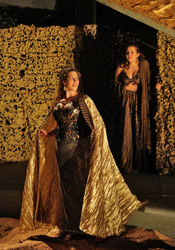
In Behind the Façade, Susana Walton recalled her husband’s lament that he never found the right voices to sing Troilus. The role of Cressida particularly tormented him; Walton had written it for Elisabeth Schwarzkopf, who never sang it onstage. Constantly trolling for the perfect Cressida, Walton even briefly tried to interest Callas in the role. Opera Theatre turned to gorgeous soprano Ellie Dehn, who truly dazzled as the Trojan priestess. Her Act II aria “At the haunted end of the day,” shimmered with mournful longing and finished with a gloriously resonant high C. Cressida’s music has some creatively creepy moments, such as Act III’s “O Tranquil Goddess.” Here Dehn’s excellent breath control helped delicately shape the piano high notes. The only vocal flaw lay in her diction, which was sometimes seemed a little lazy. Dehn’s greatest coup was her magnetic stage presence, proving Walton’s dictum that Cressida is the crux of the opera.
The role of Troilus was well served by Roger Honeywell’s puissant tenor voice, save a few oversung high notes. The quality of Troilus’s music, however, seems less consistent than Cressida’s. For Troilus’s main Act I aria, “Child of the wine-dark wave,” Walton composed a soaring vocal line with the standard love song signifiers of G-flat major and throbbing triple-time. Yet for all its obvious charms, this aria falls flat, through no fault of Honeywell’s. Dramatically, Honeywell and Dehn were a compelling couple, though Honeywell might tone down his occasionally histrionic gestures.
Tenor Robert Breault was stellar as Cressida’s pandering uncle Pandarus. His musical style famously parodies Benjamin Britten’s, with lots of falsetto, melismas, and odd repetitions. Pandarus is hard to judge; on one hand, he offers the only comic relief in Troilus and Cressida, and Breault certainly deserved enthusiastic applause for his fussily cheeky interpretation. On the other hand, I find a little of Pandarus’s music goes a very long way. By Act II, Breault’s well-executed melismas, such as the one on the words “embroidered satin,” just seemed annoying.
Walton noted in 1953 that Cressida’s servant Evadne “should be as good as we can find.” Opera Theatre seemed to follow his directive, given Elizabeth Batton’s beautifully creamy mezzo-soprano voice. Batton had terrific low notes, and her voice blended wonderfully with Dehn’s at the beginning of Act III. Bass-baritone Mark S. Doss imposingly interpreted Cressida’s rival suitor, the Grecian Prince Diomede. Doss’s voice is lusciously rich, with great diction. As High Priest Calkas, bass-baritone Darren K. Stokes was an amazing stage presence, but the voice didn’t carry particularly well.
The orchestra did a fine job negotiating Walton’s complicated score, and the revised orchestration certainly seemed both sufficient and transparent in a hall this size. Many of the short string solos were lovely, particularly Daniel Lee’s cello solos in Acts I and III. Act II’s famous interlude was properly full of yearning.
The sets and costumes were striking in their mix of austerity and sumptuousness. Director Stephen Lawless turned to wartime London for inspiration, particularly the claustrophobic “bunkers” of the Underground. Yet the stage looked less like the London underground than a mix of Downfall and Desert Storm. To some extent, the mixing of the modern and the antique is built into this opera, since Troilus’s original medieval story was transplanted to ancient Greece. The costume designer followed this bi-temporal impulse, with Trojan soldiers in modern metal helmets and the plumes of legionnaires. Cressida and Evadne’s beautiful Grecian dresses were covered with camouflage capes, and spears freely intermingled with contemporary military netting.
At times extraneous stage busyness detracted from the otherwise outstanding production. Walton consummated Troilus and Cressida’s union with an extended “pornographic interlude,” complete with action implied behind a scrim. Opera Theatre staged this beautifully, with Troilus and Cressida wrapping themselves in an enormous sheet and moving in suggestive poses. Paired with Mark McCullough’s splendid lighting and the crashing orchestral interlude, the onstage image was striking. Yet the directors added random “sidebar” interests during the interlude, such as someone being tortured stage right, Pandarus milling about, and finally soldiers crawling in to drag Troilus and Cressida offstage.
I was also mystified by changes to Troilus and Cressida’s dénouement. It took Walton and Hassall years of furious debate to decide the exact sequence of events, particularly concerning the deaths of Troilus and Cressida. Eventually they settled that Cressida’s father Calkas would traitorously stab Troilus in the back, causing the disgusted Diomede to banish him to Troy. Left alone onstage, Cressida seizes Troilus’s sword and stabs herself to end the opera. In Opera Theatre’s version, Calkas shot Troilus in the back. More bizarrely, Cressida ran offstage in the opera’s final bars. At the final drumbeat, an upstage door opened to reveal “Cressida” hanging in effigy from the walls of Troy, strangled by her red scarf. Not only did this significantly alter Walton and Hassall’s vision, the choice ultimately seemed to confuse the audience for no good reason.
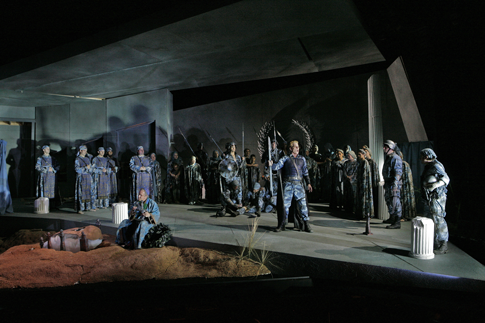 Roger Honeywell as Troilus (center) with Robert Breault (seated) in William Walton's Troilus and Cressida.
These performances of Troilus were particularly poignant for Opera Theatre, given longtime Artistic Director Colin Graham’s passionate advocacy of Walton’s opera. Graham directed Troilus’s 1976 revival on a shoestring budget, and relished the idea of staging Troilus in Saint Louis. Due to his passing last year, Opera Theatre dedicated Troilus’s run to Graham’s memory. Let us hope Graham’s long-desired Saint Louis Troilus is only the first of many new productions.
Erin Brooks