18 Aug 2008
Lucky star over the Arena
“Stage direction should not follow fashion, for fashion is the sister of death”.
English Touring Opera are delighted to announce a season of lyric monodramas to tour nationally from October to December. The season features music for solo singer and piano by Argento, Britten, Tippett and Shostakovich with a bold and inventive approach to making opera during social distancing.
This tenth of ten Live from London concerts was in fact a recorded live performance from California. It was no less enjoyable for that, and it was also uplifting to learn that this wasn’t in fact the ‘last’ LfL event that we will be able to enjoy, courtesy of VOCES8 and their fellow vocal ensembles (more below …).
Ever since Wigmore Hall announced their superb series of autumn concerts, all streamed live and available free of charge, I’d been looking forward to this song recital by Ian Bostridge and Imogen Cooper.
Although Stile Antico’s programme article for their Live from London recital introduced their selection from the many treasures of the English Renaissance in the context of the theological debates and upheavals of the Tudor and Elizabethan years, their performance was more evocative of private chamber music than of public liturgy.
Evidently, face masks don’t stifle appreciative “Bravo!”s. And, reducing audience numbers doesn’t lower the volume of such acclamations. For, the audience at Wigmore Hall gave soprano Elizabeth Llewellyn and pianist Simon Lepper a greatly deserved warm reception and hearty response following this lunchtime recital of late-Romantic song.
For this week’s Live from London vocal recital we moved from the home of VOCES8, St Anne and St Agnes in the City of London, to Kings Place, where The Sixteen - who have been associate artists at the venue for some time - presented a programme of music and words bound together by the theme of ‘reflection’.
'Such is your divine Disposation that both you excellently understand, and royally entertaine the Exercise of Musicke.’
‘And there was war in heaven: Michael and his angels fought against the dragon; and the dragon fought and his angels, And prevailed not; neither was their place found any more in heaven … that old serpent … Satan, which deceiveth the whole world: he was cast out into the earth, and his angels were cast out with him.’
There was never any doubt that the fifth of the twelve Met Stars Live in Concert broadcasts was going to be a palpably intense and vivid event, as well as a musically stunning and theatrically enervating experience.
‘Love’ was the theme for this Live from London performance by Apollo5. Given the complexity and diversity of that human emotion, and Apollo5’s reputation for versatility and diverse repertoire, ranging from Renaissance choral music to jazz, from contemporary classical works to popular song, it was no surprise that their programme spanned 500 years and several musical styles.
The Academy of St Martin in the Fields have titled their autumn series of eight concerts - which are taking place at 5pm and 7.30pm on two Saturdays each month at their home venue in Trafalgar Square, and being filmed for streaming the following Thursday - ‘re:connect’.
The London Symphony Orchestra opened their Autumn 2020 season with a homage to Oliver Knussen, who died at the age of 66 in July 2018. The programme traced a national musical lineage through the twentieth century, from Britten to Knussen, on to Mark-Anthony Turnage, and entwining the LSO and Rattle too.
With the Live from London digital vocal festival entering the second half of the series, the festival’s host, VOCES8, returned to their home at St Annes and St Agnes in the City of London to present a sequence of ‘Choral Dances’ - vocal music inspired by dance, embracing diverse genres from the Renaissance madrigal to swing jazz.
Just a few unison string wriggles from the opening of Mozart’s overture to Le nozze di Figaro are enough to make any opera-lover perch on the edge of their seat, in excited anticipation of the drama in music to come, so there could be no other curtain-raiser for this Gala Concert at the Royal Opera House, the latest instalment from ‘their House’ to ‘our houses’.
"Before the ending of the day, creator of all things, we pray that, with your accustomed mercy, you may watch over us."
The doors at The Metropolitan Opera will not open to live audiences until 2021 at the earliest, and the likelihood of normal operatic life resuming in cities around the world looks but a distant dream at present. But, while we may not be invited from our homes into the opera house for some time yet, with its free daily screenings of past productions and its pay-per-view Met Stars Live in Concert series, the Met continues to bring opera into our homes.
Music-making at this year’s Grange Festival Opera may have fallen silent in June and July, but the country house and extensive grounds of The Grange provided an ideal setting for a weekend of twelve specially conceived ‘promenade’ performances encompassing music and dance.
There’s a “slide of harmony” and “all the bones leave your body at that moment and you collapse to the floor, it’s so extraordinary.”
“Music for a while, shall all your cares beguile.”
The hum of bees rising from myriad scented blooms; gentle strains of birdsong; the cheerful chatter of picnickers beside a still lake; decorous thwacks of leather on willow; song and music floating through the warm evening air.
“Stage direction should not follow fashion, for fashion is the sister of death”.
This solemn statement, drawing from Italy’s poet laureate Giacomo Leopardi, is ostensibly the key to Denis Krief’s vision of Nabucco, unveiled last year as the inaugural show for the 85th opera season at L’Arena di Verona and now being revived from late June to late August. By signing all alone direction, scenery, costumes and light design, the French-Italian polymath provided a consistent, almost austere, staging; one relying more on the clash of ideas than on traditional melodramatic gestures. Jerusalem and Babylon, two hostile worlds, are summarized by means of abstract symbols facing each other from opposite sides of the stage. On the left, huge pentagons in white metal resembling a library: Jehovah’s Word incorporated in long rows of books. On the right, gilded cylinder slices boldly pointing towards the sky: the tower of Babylon, obviously. As the conquering Assyrian king storms the Temple on horseback — a real horse, Arena-style, and a pretty skittish one at that — all the books abruptly fall from the shelves and tumble down to the ground with an ominous roar. The Temple is then plunged into the dark, with the Jews singing as if behind the bars of a multi-storied penitentiary. No less destitute in their ankle-length grayish overcoats, Assyrian troopers march to and fro along a steep platform stretching between both monuments. Their queer parade-step, an operette-ish caricature of the German Wehrmacht or the Soviet Red Army, conveys a touch of (unintentional?) humor, though.
After a first controversial reception from the popular outdoor audience, this production is now being paid growing success. Pity that, right on the first sold-out night on July 27, a meeting of stagehands called for a strike in support to a fired colleague and pitch-black clouds were amassing over the beautiful town on the green Adige river. “A stormy night at the Arena — past GM Claudio Orazi once told me — amounts to a thrilling experience. Challenging occasional downpours is part of the excitement, as long as they don’t wholly disrupt the performance. A much seldom occurrence, inasmuch we believe that a lucky star shines over the Arena”. Yet at 9.15 p.m., when Daniel Oren raised his baton for the overture, few among the 14,000-odd patrons filling the stone crater to the brink would bet on a happy end. True, this particular production could not suffer much from the desertion of stagehands. The books were not there, and that was nearly all the damage.
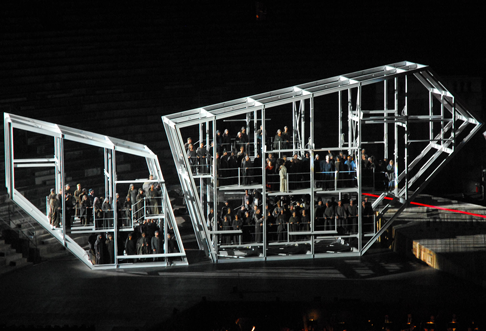 Scene from Act III of Nabucco
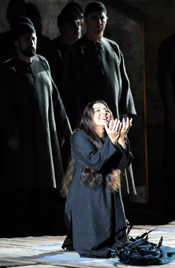
To make up for it, the acid colors and the gloomy atmosphere of Krief’s lighting, that plunged most of the rear-stage into darkness, were stirred by a continuous battery of natural flashes and rumbles from above. Whether accompanying Nabucco’s acts of blasphemy, the Jews’ hymn to “Immenso Jehovah”, or the fall of the idol of Belo, such serendipitous effects conveyed a grandeur that no human director could afford. Eight minutes past midnight, with the company still bowing in return of applause, a gentle drizzle started falling, turning into a flood as soon as the last opera tourists had climbed their coaches heading to Switzerland, Austria and Germany — an amazingly tactful timing. As to the music itself, a credible title-role was provided by Ambrogio Maestri, equally royal in bodily appearance and breath consumption. His main opponent Zaccaria (Paata Burchuladze) did not yield an inch and triumphed with beautiful legato singing in “Dio di Giuda”. Maria Guleghina, still an awe-inspiring Abigaille, was at her most affecting in her lyrical and repentant moments, particularly in her final “Su me morente, esanime”, while suffering from occasional strain at high-pitched cabalettas, such as “Salgo già sul trono aurato”. Ismaele (Giorgio Casciarri) and Fenena (Eufemia Tufano) sketched an elegant couple of lovers, with uncommon bel canto potential and enough power to be heard above the thunderbolts. The house’s chorus reaped wild applause for its rendering of “Va’ pensiero”, once a battle anthem during Italy’s independence wars against the Austrian empire. That 19th-century tradition lives on, as shown in the customary calls for encore, this time full-heartedly granted by Oren. The mercurial Israeli maestro is a welcome guest here. His nuanced touch is even more praiseworthy given the dimensions of this unique venue; if only he could restrain from humming and roaring into his microphone during the climactic orchestral tutti…
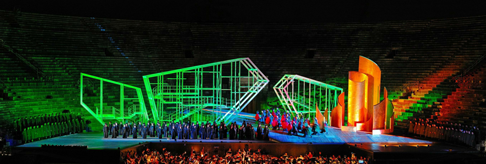 A panoramic view of Nabucco.
Carlo Vitali