08 Sep 2008
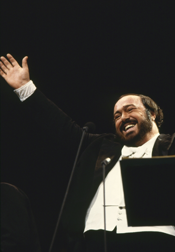
“Great Performances” remembers Pavarotti — What remains is the voice.
Luciano Pavoritti died on September 6, 2007. The all-too-ample figure and the fables associated with him are already retreating from memory.
English Touring Opera are delighted to announce a season of lyric monodramas to tour nationally from October to December. The season features music for solo singer and piano by Argento, Britten, Tippett and Shostakovich with a bold and inventive approach to making opera during social distancing.
Conductor Oliver Zeffman has commissioned the very first opera for a socially distanced world, which is now available to watch exclusively on Apple Music. Eight Songs From Isolation has been written by eight leading composers, specifically for streaming - rather than live performance - and is the first opera written for a time when the performers were unable to meet in person.
Leading freelance musicians unite in Parliament Square to call for targeted support for colleagues in the arts and entertainment sector.
Duo Lewis Murphy (composer) and Laura Attridge (writer) have launched a charitable song project entitled Notes From Isolation. The resulting songs, featuring some of the UK's top singing talent, are being released online between August and October 2020 and can be enjoyed free of charge.
The Royal Opera House is thrilled to announce an exciting, wide-ranging new line-up for its autumn programme. For the first time, extraordinary performances will be accessible online for a global audience through livestreams and for socially distanced live audiences at our home in Covent Garden. In a global first, we present a new opera in hyper-reality, alongside repertory favourites from both artistic companies.
Some of the most famous and outstanding stars from the opera world are to take part in a very special evening from Wexford Festival Opera, including Aigul Akhmetshina, Joseph Calleja, Daniela Barcellona, Juan Diego Flórez, Igor Golovatenko, Ermonela Jaho, Sergey Romanovsky, and many more.
Following its successful launch in 2019, OperaStreaming streams nine operas on YouTube from the historic opera houses of Emilia-Romagna during the 2020-21 season, with fully-staged productions of Verdi's La traviata in October from Modena and Verdi'sOtello from Bologna in...
‘A brief history of song’ is the subtitle of the 2020 Oxford Lieder Festival (10th-17th October), which will present an ambitious, diverse and imaginative programme of 40 performances and events.
Bampton Classical Opera returns to the Baroque splendour of London’s St John’s Smith Square on November 6 with a concert performance of Gluck’s one-act opera The Crown, the first in the UK since 1987. The performance will also be filmed and available to watch on demand on the Bampton website from 9 November.
While many of us spent lockdown at home taking it a little easier, composer Andrew Synnott wrote an opera.
Owen Wingrave is part of the new Interim Season of 19 brand new events, all free to view online between September and December 2020.
The Arts Council has awarded innovative UK charity Music and Theatre For All (MTFA) a major new grant to develop three ambitious new projects in the wake of Covid 19.
English National Opera (ENO) will reopen the London Coliseum to socially distanced audiences on 6 and 7 November for special performances of Mozart’s Requiem. These will provide audiences with an opportunity to reflect upon and to commemorate the difficulties the nation has faced during the pandemic.
The Royal Opera House is proud to continue its curated #OurHouseToYourHouse programme into the autumn, bringing audiences the best of the ROH through a new series of Friday Premieres and cultural highlights.
After six months of closure, the Royal Opera House is thrilled to be opening its doors to the public as part of Open House London weekend, giving visitors a taste of one of the world’s most famous theatres for free.
The Academy of St Martin in the Fields is thrilled to announce re:connect - an eight concert series with live socially distanced audiences at its namesake church, St. Martin-in-the-Fields. The autumn concerts will take place at 5pm & 7:30pm on two Saturdays per month with guest artists including baritone Roderick Williams, soprano Carolyn Sampson and composer-conductor-pianist Ryan Wigglesworth performing a wide range of repertoire.
Music and poetry unite and collide across centuries, from the Medieval to the Enlightenment to the present day. This year, the Oxford Lieder Festival will present a thrilling and innovative programme comprising more than forty events streamed over eight days.
The English Concert with artistic director Harry Bicket is delighted to announce a series of concerts from 1-15 October 2020. The concerts take place in historic London venues with star soloists and will be performed and streamed live to a paying audience at 7pm GMT on each performance date. The programmes include first-class vocal and instrumental works from the two pillars of the English Baroque, covering different aspects of the repertoire.
Glyndebourne has announced plans for a ‘staycation’ series of socially-distanced indoor performances, starting on 10 October 2020.
The Royal Opera House is delighted to announce two packed evenings of opera and ballet, live from our stage in Covent Garden and available to view wherever you are in the world online.
Luciano Pavoritti died on September 6, 2007. The all-too-ample figure and the fables associated with him are already retreating from memory.
But the voice remains, and it’s documented — and celebrated — in “Pavarotti; A Life in Seven Arias,” a “Great Performances” presentation slated for broadcast by PBS on Wednesday (10 September).
“In a career that spanned four decades he defined what a tenor is,” says David Thompson, mastermind of the project that originated at the BBC. “And that’s why I decided to focus on the voice, for it’s the voice that is his legacy.” Thompson points out, moreover, it is extremely fortunate that these four decades, beginning with his first Bohème in Modena, his Italian hometown, are so richly documented in high-quality recordings and on film.
Thompson looks back on a long career in TV documentaries that embraces a wide variety of people and subjects. Music has been a central concern, and his bibliography includes programs on Aaron Copland, Gian Carlo Menotti and Francis Poulenc. “When the BBC approached me, they wanted this program to mark the first anniversary of Pavarotti’s death,’ he says. “And that meant that we didn’t have much time.”
To structure the 90-minute program the director decided to offer a retrospective of Pavarotti’s career by focusing on seven arias closely associated with his fame. “I thought this was the best way to make sense of his career,” Thompson says, recalling his 1979 tribute to Pavarotti “King of the High C’s,” also made for the BBC. “They trace his development and put it all together — and the performances present Pavarotti when his voice was at its best.”
The program opens with “Che gelida manina” from Bohème. The 1965 Modena performance features an equally youthful Mirella Freni as Mimi. Twelve years later Pavarotti sang Rodolfo opposite Renata Scotto in the first-ever live TV broadcast from New York’s Met.
“Pour mon âme” from Donizetti’s Daughter of the Regiment marked a double turning point in the tenor’s career, for this challenging aria with nine high C’s and the Covent Garden performance brought him together for the first time with Joan Sutherland and conductor-husband Richard Bonynge. Pavarotti identifies the Australian soprano as a major influence upon his development. “She taught me how to breathe and how to control my voice,” he says.
A sequence heavy in sentiment takes Pavarotti back to Modena to sing César Franck’s haunting Panis Angelicus with his baker father.
It was manager Herbert Breslin who launched the media blitz that moved Pavarotti beyond the opera house and designed the “Three Tenors” concerts that made Pavarotti’s name a household concept around the world. Clips from the first “Three Tenors” performance at the Rome 1990 World Cup document this collaboration with Placido Domingo and José Carreras.
“Questa o quella,” the Duke’s aria from Verdi’s Rigoletto recalls a further favorite role. It was, however, “Nessun dorma” from Puccini’s Turandot that became Pavarotti’s signature aria — especially after the recording of it made at the World Cup.
From the tenor’s late years, when Tosca became his undoing, Thompson chose “E Lucian le stelle.” It was in this opera that Pavarotti made his final appearance at the Met in 2004. It was his last complete opera performance. The series ends — appropriately — with the “Ingemisco” from Verdi’s Requiem.
Thompson counterpoints the music with recollections by fellow tenor Kim Begley, Bonynge and Sutherland, director John Coply, critic Noman Lebrecht and Covent Garden wig and makeup artist Ron Freeman.
Surviving fellow tenors José Carreras and Plácido Domingo also pay tribute to Pavarotti’s greatness. Especially touching are comments by Juan Diego Flórez, a major Pavarotti fan. “Pavarotti had happiness in the voice,” the Peru-born tenor says. “His technique was based on clarity, on the words, on the vowels. “It is important — especially in a tenor — that the words come across and that you can understand them.”
Tracking down these singers was not easy for Thompson. “It was hard to find them and to find a time when they were available,” he says. “Monserrat Caballé was available in Munich for only one day, and Carreras could be interviewed only in China. For Domingo we had to arrange an interview in New York.”
Like millions for whom Pavarotti was a synonym for opera — if not for serious music per se — Thompson never heard Pavarotti live. “I was always busy with other things when he sang in London,” he says. “But I knew the voice well. It was a powerful voice, very even and lyrical. That’s what this program is about — his voice, not his personal life.”
“Pavarotti: A Life in Seven Arias,” a “Great Performances” presentation, airs on public television on September 10. Check local stations for local broadcast times.
Wes Blomster