29 Sep 2008
Les Pêcheurs de perles at the Washington National Opera
The second offering of the current WNO season is a San Diego Opera production of Georges Bizet’s Pearl Fishers (1863).
English Touring Opera are delighted to announce a season of lyric monodramas to tour nationally from October to December. The season features music for solo singer and piano by Argento, Britten, Tippett and Shostakovich with a bold and inventive approach to making opera during social distancing.
This tenth of ten Live from London concerts was in fact a recorded live performance from California. It was no less enjoyable for that, and it was also uplifting to learn that this wasn’t in fact the ‘last’ LfL event that we will be able to enjoy, courtesy of VOCES8 and their fellow vocal ensembles (more below …).
Ever since Wigmore Hall announced their superb series of autumn concerts, all streamed live and available free of charge, I’d been looking forward to this song recital by Ian Bostridge and Imogen Cooper.
Although Stile Antico’s programme article for their Live from London recital introduced their selection from the many treasures of the English Renaissance in the context of the theological debates and upheavals of the Tudor and Elizabethan years, their performance was more evocative of private chamber music than of public liturgy.
Evidently, face masks don’t stifle appreciative “Bravo!”s. And, reducing audience numbers doesn’t lower the volume of such acclamations. For, the audience at Wigmore Hall gave soprano Elizabeth Llewellyn and pianist Simon Lepper a greatly deserved warm reception and hearty response following this lunchtime recital of late-Romantic song.
For this week’s Live from London vocal recital we moved from the home of VOCES8, St Anne and St Agnes in the City of London, to Kings Place, where The Sixteen - who have been associate artists at the venue for some time - presented a programme of music and words bound together by the theme of ‘reflection’.
'Such is your divine Disposation that both you excellently understand, and royally entertaine the Exercise of Musicke.’
‘And there was war in heaven: Michael and his angels fought against the dragon; and the dragon fought and his angels, And prevailed not; neither was their place found any more in heaven … that old serpent … Satan, which deceiveth the whole world: he was cast out into the earth, and his angels were cast out with him.’
There was never any doubt that the fifth of the twelve Met Stars Live in Concert broadcasts was going to be a palpably intense and vivid event, as well as a musically stunning and theatrically enervating experience.
‘Love’ was the theme for this Live from London performance by Apollo5. Given the complexity and diversity of that human emotion, and Apollo5’s reputation for versatility and diverse repertoire, ranging from Renaissance choral music to jazz, from contemporary classical works to popular song, it was no surprise that their programme spanned 500 years and several musical styles.
The Academy of St Martin in the Fields have titled their autumn series of eight concerts - which are taking place at 5pm and 7.30pm on two Saturdays each month at their home venue in Trafalgar Square, and being filmed for streaming the following Thursday - ‘re:connect’.
The London Symphony Orchestra opened their Autumn 2020 season with a homage to Oliver Knussen, who died at the age of 66 in July 2018. The programme traced a national musical lineage through the twentieth century, from Britten to Knussen, on to Mark-Anthony Turnage, and entwining the LSO and Rattle too.
With the Live from London digital vocal festival entering the second half of the series, the festival’s host, VOCES8, returned to their home at St Annes and St Agnes in the City of London to present a sequence of ‘Choral Dances’ - vocal music inspired by dance, embracing diverse genres from the Renaissance madrigal to swing jazz.
Just a few unison string wriggles from the opening of Mozart’s overture to Le nozze di Figaro are enough to make any opera-lover perch on the edge of their seat, in excited anticipation of the drama in music to come, so there could be no other curtain-raiser for this Gala Concert at the Royal Opera House, the latest instalment from ‘their House’ to ‘our houses’.
"Before the ending of the day, creator of all things, we pray that, with your accustomed mercy, you may watch over us."
The doors at The Metropolitan Opera will not open to live audiences until 2021 at the earliest, and the likelihood of normal operatic life resuming in cities around the world looks but a distant dream at present. But, while we may not be invited from our homes into the opera house for some time yet, with its free daily screenings of past productions and its pay-per-view Met Stars Live in Concert series, the Met continues to bring opera into our homes.
Music-making at this year’s Grange Festival Opera may have fallen silent in June and July, but the country house and extensive grounds of The Grange provided an ideal setting for a weekend of twelve specially conceived ‘promenade’ performances encompassing music and dance.
There’s a “slide of harmony” and “all the bones leave your body at that moment and you collapse to the floor, it’s so extraordinary.”
“Music for a while, shall all your cares beguile.”
The hum of bees rising from myriad scented blooms; gentle strains of birdsong; the cheerful chatter of picnickers beside a still lake; decorous thwacks of leather on willow; song and music floating through the warm evening air.
The second offering of the current WNO season is a San Diego Opera production of Georges Bizet’s Pearl Fishers (1863).
The 24-year old composer’s sixth and his second to be staged, this opera is a relatively little-known example of 19th-century French opera’s obsession with exotica. Its mostly Oriental stories are populated by savage primitives, and sexy virgin priestesses who in the course of the plot would invariably fall victim to forbidden love. In The Pearl Fishers, Bizet and his librettists were evidently feeling charitable: the guilty passion for once does not prove fatal for the soprano. Instead, she is saved by the villainous baritone, who belatedly discovers his inner hero, and of course gets himself shot for his trouble.
The 25 September performance was generally of good quality. The orchestra did well under the baton of Ciuseppe Grazioli. So did the chorus— when it was on stage and was able to watch the maestro’s baton, that is; the timing in the off-stage numbers was sometimes shaky.
Among the soloists, tenor Charles Castronovo as Nadir definitely stood out from the ensemble. His popular Act 1 romance “Je crois entendre encore” showcased the singer’s strong metallic timbre with excellent projection in all registers. His softly beautiful high notes might perhaps be criticized as too thin; I personally liked the pianos and thought they were stylistically appropriate for a French opéra lyrique, which really should sound different from middle-period Verdi, although it rarely does.
Baritone Trevor Scheunemann as Zurga offered a rich vocal timbre and good blending in the ensembles, of which the famous Act 1 duet “Au fond du temple saint” was a particular highlight of the evening. Scheunemann’s solos were solid, but not particularly memorable. It seemed to me that his concentration on the dramatic aspects of his part— specifically, his character’s inability to decide whether to play a village Count di Luna or Marquis di Poza of Ceylon— sometimes got in the way of sound production.
French soprano Norah Amsellem as Leila was another solid choice in casting. Despite her vocal excellence, however, the singer, like her colleague Mr. Scheunemann, also seemed trapped in the inner contradictions of her character. This time, the issue is not young Bizet’s inexperience as a dramatist, but rather the ideological “baggage” attached to the female lead in French Orientalist opera. Is she a virginal victim or an exotic seductress? One of these two favored clichés demands pure, crystalline high register and “floating” timbre with not much support; the other calls for a throaty, rich low and middle range, with rare but powerful highs. Although Ms Amsellem herself seemed to try charting some sort of middle ground, the casting of this singer, a dramatic soprano, indicates the director’s preference for the seductress image. As a result, in my opinion, this Leila often sounded much too heavy for Bizet’s delicate creation who, after all, is more Michaela than Carmen.
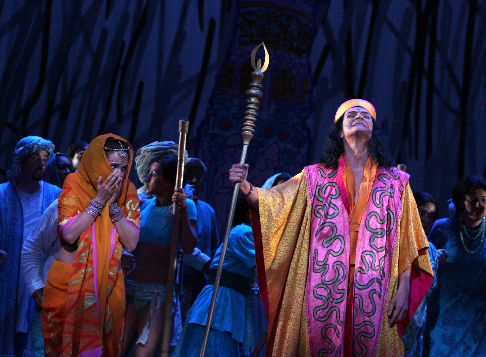 Norah Amsellem as Leila and Denis Sedov as Nourabad
Bass Denis Sedov as high priest Nouraband cut an imposing figure, but despite occasionally powerful sound did not impress with either diction or articulation. In this production, however, the very tall singer’s towering physique was evidently more in demand than his vocal prowess. The stage director, Australian Andrew Sinclair, has attempted to both dramatize and modernize the story by superimposing a political intrigue à la Boris Godunov onto Bizet’s unsuspecting characters, with Mr Sedov’s Nouraband serving as the evil “old order” genius who masterminds the collapse of “liberal” Zurga’s rule. Since no one told the composer about this particular plot twist, there was little in the score to support it. Instead, it was delivered entirely via stage business, which required a lot of “extra-curricular” wandering about the stage from Mr Sedov who did manage to look suitably menacing most of the time.
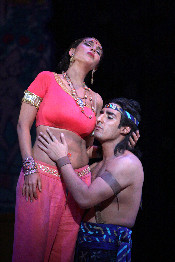
Another directorial attempt to make Bizet’s dramatically challenging early work more palatable to modern audiences included the revamping of Act 3. It used neither the original love duet nor its common trio substitute, but did entail Leila partially disrobing, then getting assaulted during her duet with Zurga. Alas, the tedious scene was not at all improved by that spectacle. It did, however, allow Ms. Amsellem to showcase once again Leila’s fanciful costume of an orange sari wrapped around a classic “Oriental” ensemble of a skimpy pink top with bare midriff and the see-through harem pants.
The bright palette of reds, oranges, pinks, and turquoise greens dominated the vibrant décor by celebrated British fashion designer Zandra Rhodes. Among the often striking visual effects she created, enhanced by the excellent lighting by Ron Vodicka, particularly notable was the scene of Leila’s first appearance— carried on a live chariot by six men, immobile like a Buddha statue, her orange and gold veil spotlighted against deep purple backdrop. Rhodes’ design ideas were always vivid and always intriguing. What bothered me in her vision was the stylistic discontinuity between the sets and costumes. The latter were colorful, with a nod to geographic authenticity, and in tune with the production’s realist acting and staging. The former— deliberately perspective-less, two-dimensional, with fauvist-leaning color palette and a neo-primitivism-inspired images— were anything but “real.”
The designer’s closest stylistic ally in this production was John Malashock’s choreography, on display so much that it became almost as ubiquitous as Ms Rhodes’ sets. Indeed, even by dance-crazy French standards, ballet was often entirely superfluous, such as the number for what was evidently the “spirits of fire” that provided the background for the introduction to Leila’s Act 1 prayer. When staging The Pearl Fishers, Mr. Sinclair outlawed “proper” ballet as unsuitable for the subject; thus, there was not a pointed shoe in sight (or any kind of shoe, for that matter, as all the dancers performed barefoot). Rare nods to “Oriental” choreography were confined to women’s numbers, which unfortunately suffered from weak execution (this specifically refers to the quartet of Leila’s attendants). The male dances, in a counterpart to Bizet’s imaginary Ceylon, offered a picture of the “imaginary primitives” brandishing fighting pikes: their movements were athletic, aggressive, and purposefully inelegant, with ground stomping, angular hand and feet positions; pirouettes replaced by cartwheels. The Act 3 finale opened with a pas de trois in The Lion King-size animal masks— which was perhaps a little much, but it did save the director a major headache of having to come up with stage business for the endless choruses of this scene.
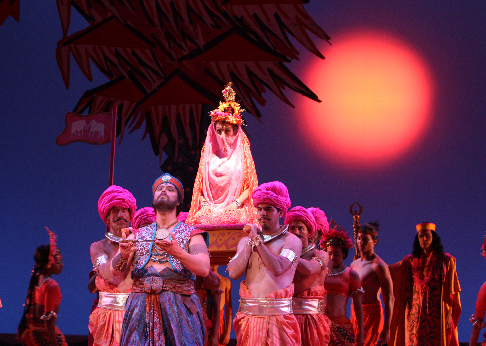 Norah Amsellem (top, veiled) as Leila, Trevor Scheunemann (foreground) as Zurga
Overall, the Washington audiences were presented with a solid, colorful, mostly traditional Les Pêcheurs de perles, well performed (despite some misgivings on my part) by a consistently good cast. The production, which runs through 7 October, offers few vocal fireworks; nor can it boast a truly new word in staging. Yet, for an old-fashioned opera lover, after last season’s symbolist Dutchman and Nazi-fied Tamerlano, these realistic and suitably “Oriental” Pearl Fishers might be a welcome relief.
Olga Haldey