Recently in Performances
English Touring Opera are delighted to announce a season of lyric monodramas to tour nationally from October to December. The season features music for solo singer and piano by Argento, Britten, Tippett and Shostakovich with a bold and inventive approach to making opera during social distancing.
This tenth of ten Live from London concerts was in fact a recorded live performance from California. It was no less enjoyable for that, and it was also uplifting to learn that this wasn’t in fact the ‘last’ LfL event that we will be able to enjoy, courtesy of VOCES8 and their fellow vocal ensembles (more below …).
Ever since Wigmore Hall announced their superb series of autumn concerts, all streamed live and available free of charge, I’d been looking forward to this song recital by Ian Bostridge and Imogen Cooper.
Although Stile Antico’s programme article for their Live from London recital introduced their selection from the many treasures of the English Renaissance in the context of the theological debates and upheavals of the Tudor and Elizabethan years, their performance was more evocative of private chamber music than of public liturgy.
Evidently, face masks don’t stifle appreciative “Bravo!”s. And, reducing audience numbers doesn’t lower the volume of such acclamations. For, the audience at Wigmore Hall gave soprano Elizabeth Llewellyn and pianist Simon Lepper a greatly deserved warm reception and hearty response following this lunchtime recital of late-Romantic song.
For this week’s Live from London vocal recital we moved from the home of VOCES8, St Anne and St Agnes in the City of London, to Kings Place, where The Sixteen - who have been associate artists at the venue for some time - presented a programme of music and words bound together by the theme of ‘reflection’.
'Such is your divine Disposation that both you excellently understand, and royally entertaine the Exercise of Musicke.’
‘And there was war in heaven: Michael and his angels fought against the dragon; and the dragon fought and his angels, And prevailed not; neither was their place found any more in heaven … that old serpent … Satan, which deceiveth the whole world: he was cast out into the earth, and his angels were cast out with him.’
There was never any doubt that the fifth of the twelve Met Stars Live in Concert broadcasts was going to be a palpably intense and vivid event, as well as a musically stunning and theatrically enervating experience.
‘Love’ was the theme for this Live from London performance by Apollo5. Given the complexity and diversity of that human emotion, and Apollo5’s reputation for versatility and diverse repertoire, ranging from Renaissance choral music to jazz, from contemporary classical works to popular song, it was no surprise that their programme spanned 500 years and several musical styles.
The Academy of St Martin in the Fields have titled their autumn series of eight concerts - which are taking place at 5pm and 7.30pm on two Saturdays each month at their home venue in Trafalgar Square, and being filmed for streaming the following Thursday - ‘re:connect’.
The London Symphony Orchestra opened their Autumn 2020 season with a homage to Oliver Knussen, who died at the age of 66 in July 2018. The programme traced a national musical lineage through the twentieth century, from Britten to Knussen, on to Mark-Anthony Turnage, and entwining the LSO and Rattle too.
With the Live from London digital vocal festival entering the second half of the series, the festival’s host, VOCES8, returned to their home at St Annes and St Agnes in the City of London to present a sequence of ‘Choral Dances’ - vocal music inspired by dance, embracing diverse genres from the Renaissance madrigal to swing jazz.
Just a few unison string wriggles from the opening of Mozart’s overture to Le nozze di Figaro are enough to make any opera-lover perch on the edge of their seat, in excited anticipation of the drama in music to come, so there could be no other curtain-raiser for this Gala Concert at the Royal Opera House, the latest instalment from ‘their House’ to ‘our houses’.
"Before the ending of the day, creator of all things, we pray that, with your accustomed mercy, you may watch over us."
The doors at The Metropolitan Opera will not open to live audiences until 2021 at the earliest, and the likelihood of normal operatic life resuming in cities around the world looks but a distant dream at present. But, while we may not be invited from our homes into the opera house for some time yet, with its free daily screenings of past productions and its pay-per-view Met Stars Live in Concert series, the Met continues to bring opera into our homes.
Music-making at this year’s Grange Festival Opera may have fallen silent in June and July, but the country house and extensive grounds of The Grange provided an ideal setting for a weekend of twelve specially conceived ‘promenade’ performances encompassing music and dance.
There’s a “slide of harmony” and “all the bones leave your body at that moment and you collapse to the floor, it’s so extraordinary.”
“Music for a while, shall all your cares beguile.”
The hum of bees rising from myriad scented blooms; gentle strains of birdsong; the cheerful chatter of picnickers beside a still lake; decorous thwacks of leather on willow; song and music floating through the warm evening air.
Performances
![Jane Dutton as Santuzza [Photo by Robert Workman]](http://www.operatoday.com/Dutton_Santuzza_ENO.png)
08 Oct 2008
Cavalleria rusticana/Pagliacci — English National Opera, London Coliseum
For the opening of the 2008/09 season at ENO, Richard Jones has teamed up with two separate theatrical writers, Sean O'Brien and Lee Hall, to create unique new versions of the repertoire's most famous double bill.
Cavalleria rusticana, or 'Sicilian Revenge' in Sean O'Brien's
translation, was psychologically insightful and dramatically compelling. The
whole piece took place sometime in the 1940s inside a tiny village hall, with
murky walls and an oppressive low ceiling, an uncomfortably intimate
microcosm of a community in which everybody knows each other's business. All
human life was here, from the illicit out-of-hours assignation between
Turiddu (Peter Auty) and Lola (Fiona Murphy) to the village women preparing
an Easter dinner. The importance of this central space was underlined by the
centre-stage presentation of the Siciliana at the start and Turiddu's
graphically brutal murder at the end, both of which Mascagni envisaged
occuring in the distance. Only Jane Dutton's rejected Santuzza, fidgety and
obsessive, remained on the periphery, coming into the central space for her
pivotal scene with Roland Wood's threateningly masculine Alfio.
Ed Gardner's punchy conducting complemented Auty's red-blooded ardent
tenor especially well, and brought out the opera's almost constant sense of
raw heightened emotion which the piety of the Easter Hymn and the calm
respite of the Intermezzo serve only to accentuate.
The addition of a mentally-disabled brother for Turiddu could so easily
have come across as a cheap theatrical cliché, but his one line announcing
Turiddu's murder, normally reserved for an offstage woman's voice, had
devastating impact.
The English translation was somewhat hit-and-miss, but the only real
problem — and it was a big one — was the incongruity of the drab
indoor setting with Mascagni's lush Mediterranean score. Jones's production
was a riveting piece of theatre in its own right, but the music seemed almost
incidental to it.
After the interval, a surreal repeat of the 'Cav' curtain call heralded
the descent of a new, bright orange curtain. We were thrown into the environs
of a British provincial theatre sometime in the 1970s, about to welcome the
stars of a TV sitcom for a week-long run of a cheesy bedroom farce.
This ingenious production was The Comedians, a genuine and
coherent contemporary take on Leoncavallo's opera, a behind-the-scenes
portrait of a clutch of outdated entertainers whose popularity is based on a
façade of cheap laughs and in-jokes. With the exception of the bird aria,
which didn't make a lot of sense out of its natural context, the whole affair
worked extremely well and was in a completely different class from your
average half-hearted opera 'modernisation' which tends to be riddled with
inconsistencies. Lee Hall's English-language version was again more a
reinvention than a translation, designed specifically in conjunction with
this staging, renaming the characters to suit the context. These were
recognisable characters, in equally recognisable sordid liaisons and public
breakdowns against the backdrop of an impeccably-realised backstage
environment by the set designer Ultz.
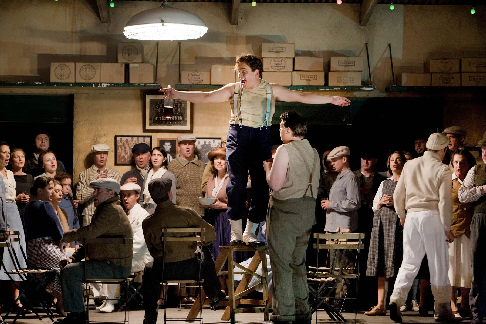 Peter Auty as Turiddu
Although the characterisation was uniformly excellent, the singing, it has
to be said, was variable; Geraint Dodd's Kenny (Canio) had a softer-grained,
less focused tenor than is ideal in this role, while Christopher Purves's
Tony (Tonio) was put under some vocal strain in the Prologue. Mary Plazas's
Nelly (Nedda) and Mark Stone's Woody (Silvio) were far more vocally
consistent, with strong support from Christopher Turner as Brian (Beppe).
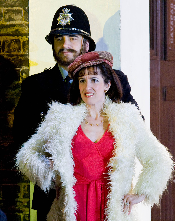 Trevor Goldstein as policeman, Mary Plazas as Nelly
In a stroke of genius the final scene was given on a split stage, as if
the on-stage theatre had been spliced at the proscenium arch and opened out
like a book. Thus we got to focus on the audience's reactions as much as the
on-stage action. The sense of unease and horror was expertly ratcheted up,
and when Kenny had killed Woody and Nelly and turned his gun towards the
audience, the onstage audience's collective dive for cover kept much of the
real audience laughing right up to the last moment, until Kenny delivered his
devastating closing line and turned the gun on himself. Suddenly, nobody was
laughing any more. Absolutely brilliant.
Ruth Elleson © 2008
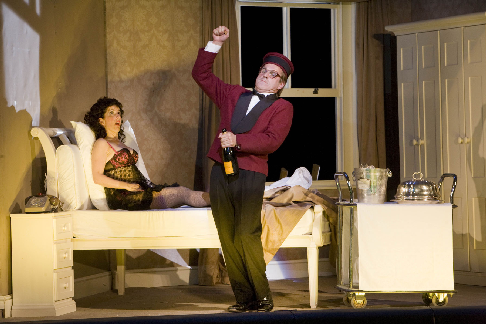 Mary Plazas as Nelly, Christopher Purves as Tony