Recently in Performances
English Touring Opera are delighted to announce a season of lyric monodramas to tour nationally from October to December. The season features music for solo singer and piano by Argento, Britten, Tippett and Shostakovich with a bold and inventive approach to making opera during social distancing.
This tenth of ten Live from London concerts was in fact a recorded live performance from California. It was no less enjoyable for that, and it was also uplifting to learn that this wasn’t in fact the ‘last’ LfL event that we will be able to enjoy, courtesy of VOCES8 and their fellow vocal ensembles (more below …).
Ever since Wigmore Hall announced their superb series of autumn concerts, all streamed live and available free of charge, I’d been looking forward to this song recital by Ian Bostridge and Imogen Cooper.
Although Stile Antico’s programme article for their Live from London recital introduced their selection from the many treasures of the English Renaissance in the context of the theological debates and upheavals of the Tudor and Elizabethan years, their performance was more evocative of private chamber music than of public liturgy.
Evidently, face masks don’t stifle appreciative “Bravo!”s. And, reducing audience numbers doesn’t lower the volume of such acclamations. For, the audience at Wigmore Hall gave soprano Elizabeth Llewellyn and pianist Simon Lepper a greatly deserved warm reception and hearty response following this lunchtime recital of late-Romantic song.
For this week’s Live from London vocal recital we moved from the home of VOCES8, St Anne and St Agnes in the City of London, to Kings Place, where The Sixteen - who have been associate artists at the venue for some time - presented a programme of music and words bound together by the theme of ‘reflection’.
'Such is your divine Disposation that both you excellently understand, and royally entertaine the Exercise of Musicke.’
‘And there was war in heaven: Michael and his angels fought against the dragon; and the dragon fought and his angels, And prevailed not; neither was their place found any more in heaven … that old serpent … Satan, which deceiveth the whole world: he was cast out into the earth, and his angels were cast out with him.’
There was never any doubt that the fifth of the twelve Met Stars Live in Concert broadcasts was going to be a palpably intense and vivid event, as well as a musically stunning and theatrically enervating experience.
‘Love’ was the theme for this Live from London performance by Apollo5. Given the complexity and diversity of that human emotion, and Apollo5’s reputation for versatility and diverse repertoire, ranging from Renaissance choral music to jazz, from contemporary classical works to popular song, it was no surprise that their programme spanned 500 years and several musical styles.
The Academy of St Martin in the Fields have titled their autumn series of eight concerts - which are taking place at 5pm and 7.30pm on two Saturdays each month at their home venue in Trafalgar Square, and being filmed for streaming the following Thursday - ‘re:connect’.
The London Symphony Orchestra opened their Autumn 2020 season with a homage to Oliver Knussen, who died at the age of 66 in July 2018. The programme traced a national musical lineage through the twentieth century, from Britten to Knussen, on to Mark-Anthony Turnage, and entwining the LSO and Rattle too.
With the Live from London digital vocal festival entering the second half of the series, the festival’s host, VOCES8, returned to their home at St Annes and St Agnes in the City of London to present a sequence of ‘Choral Dances’ - vocal music inspired by dance, embracing diverse genres from the Renaissance madrigal to swing jazz.
Just a few unison string wriggles from the opening of Mozart’s overture to Le nozze di Figaro are enough to make any opera-lover perch on the edge of their seat, in excited anticipation of the drama in music to come, so there could be no other curtain-raiser for this Gala Concert at the Royal Opera House, the latest instalment from ‘their House’ to ‘our houses’.
"Before the ending of the day, creator of all things, we pray that, with your accustomed mercy, you may watch over us."
The doors at The Metropolitan Opera will not open to live audiences until 2021 at the earliest, and the likelihood of normal operatic life resuming in cities around the world looks but a distant dream at present. But, while we may not be invited from our homes into the opera house for some time yet, with its free daily screenings of past productions and its pay-per-view Met Stars Live in Concert series, the Met continues to bring opera into our homes.
Music-making at this year’s Grange Festival Opera may have fallen silent in June and July, but the country house and extensive grounds of The Grange provided an ideal setting for a weekend of twelve specially conceived ‘promenade’ performances encompassing music and dance.
There’s a “slide of harmony” and “all the bones leave your body at that moment and you collapse to the floor, it’s so extraordinary.”
“Music for a while, shall all your cares beguile.”
The hum of bees rising from myriad scented blooms; gentle strains of birdsong; the cheerful chatter of picnickers beside a still lake; decorous thwacks of leather on willow; song and music floating through the warm evening air.
Performances
![Torsten Kerl (Paul) [Photo by Terrence McCarthy]](http://www.operatoday.com/Paul.png)
03 Oct 2008
Die tote Stadt at San Francisco Opera
Korngold’s third opera Die tote Stadt premiered in 1920 in Cologne, the composer a mere 23 years old. Back then, opera remained a living art form, with the likes of Strauss and Puccini keeping the public excited about new works.
Korngold’s third opera Die tote Stadt premiered in 1920 in
Cologne, the composer a mere 23 years old. Back then, opera remained a living
art form, with the likes of Strauss and Puccini keeping the public excited
about new works. The Met, not wanting to miss out on any of the excitement,
immediately grabbed this odd piece for its American premiere only a year
later. Korngold’s next opera Das Wunder der Heliane premiered
in Hamburg in 1927 but its generic musicality and moralistic satire failed to
ignite enthusiasm on either side of the Atlantic. Never mind though, it was
time to write movie music.
After its initial Met performances, Die tote Stadt had to wait
more than fifty years to again seduce American audiences with the heavy
nostalgia that permeates Korngold’s score. This time it was a brave
excursion into rare but revered repertory by America’s only adventurous
company of the time, the New York City Opera, where the 1975 Frank Corsaro
staging remained in its repertory until 2006. San Franciscans had to wait
even longer for Korngold’s enigmatic work.
Die tote Stadt is a masterpiece, at least in the hands of a stage
director able to superimpose the real and the imaginary, of an indulgent
conductor able to sustain its unending waltzes and revivals of a single tune,
of a tenor able to sing loud and long and high, and of a soprano able to do
the same as well as impersonate a cabaret dancer. All this the San Francisco
Opera brought over to us from the Salzburg Festival where it originated in
2004, with a brief stop in Vienna to pick up soprano Emily Magee.
Die tote Stadt is a tour de force for everyone involved.
The formidable role of Paul, the bereaved husband of the dead Marie, belongs
these days to Torsten Kerl, who continues on to London with this superb Willy
Decker production. Frank, Paul’s friend and finally rival for the
attentions of the dancer Marietta, is the third of the opera’s
formidable roles, particularly as it is tied to the Pierrot song and antics
of Fritz who taunts Paul in Marietta’s cruel commedia
dell’arte improvisation on death and resurrection. The staging of
this complicated scene (as well with the entire opera) was entrusted to and
effectively realized by Meisje Hummel, an assistant for the Salzburg
premiere.
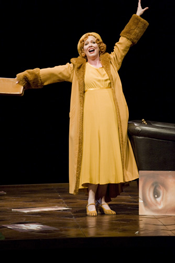 Emily Magee (Marietta)
There is no doubt that the piece casts its spell from the first note. The
San Francisco audience gave its immediate and full attention to
Korngold’s rich sound, conductor Donald Runnicles lovingly pulling
forth its thick and weighty sonorities from San Francisco Opera orchestra.
The big tune from the opera, “Marietta’s Lied” comes fairly
early but it is really a duet for Paul and Marietta (though it is far better
known as a stand alone concert aria for soprano), and this tune comes back
many, many times, finally as Paul’s wrenching farewell to his dead
wife.
The message of Die tote Stadt is simple – there is no
resurrection. It is a plain statement, unadorned with philosophic and
religious implications, forcefully presented with the full resources of the
post Romantic orchestra with expanded percussion. The Willy Decker production
assumes equal proportion in a conception that sometimes juxtaposes and other
times superimposes Paul’s present upon Paul’s past, resulting in
a confusion of life with dream that brings a whirling corporealness to what
is cold and dead. These are the brilliant designs of Wolfgang Gussmann whose
black boxes and shadowy abysses inhabited by Decker’s real people and
by their shadows. The production means are both enormous and delicately
expended.
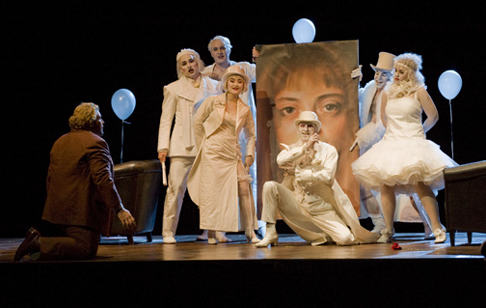 Paul and troupe
Donald Runncles resonated mightily with Korngold’s over-the-top
sonorities. Torsten Kerl is justifiably famous for the role of Paul. Emily
Magee brought impeccable musical taste and character dimensionality as the
nemesis of the dead wife. San Francisco Opera’s particular
contributions to its performances of the Decker production were adequate. The
Frank of Lucas Meachem fulfilled the formidable needs of this role, though it
lacked the weight as antagonist to counter balance the musical and dramatic
personalities of the production’s protagonists. The Brigitta of
Katharine Tier was similarly out of balance. The well-performed
commedia scene added enormously to the many pleasures of this
production.
Michael Milenski