31 Oct 2008
Lucia di Lammermoor at the MET
Mary Zimmerman’s unmusical production of Lucia certainly improves if you give it a cast of singers who know what Donizetti is about.
English Touring Opera are delighted to announce a season of lyric monodramas to tour nationally from October to December. The season features music for solo singer and piano by Argento, Britten, Tippett and Shostakovich with a bold and inventive approach to making opera during social distancing.
This tenth of ten Live from London concerts was in fact a recorded live performance from California. It was no less enjoyable for that, and it was also uplifting to learn that this wasn’t in fact the ‘last’ LfL event that we will be able to enjoy, courtesy of VOCES8 and their fellow vocal ensembles (more below …).
Ever since Wigmore Hall announced their superb series of autumn concerts, all streamed live and available free of charge, I’d been looking forward to this song recital by Ian Bostridge and Imogen Cooper.
The Sixteen continues its exploration of Henry Purcell’s Welcome Songs for Charles II. As with Robert King’s pioneering Purcell series begun over thirty years ago for Hyperion, Harry Christophers is recording two Welcome Songs per disc.
Although Stile Antico’s programme article for their Live from London recital introduced their selection from the many treasures of the English Renaissance in the context of the theological debates and upheavals of the Tudor and Elizabethan years, their performance was more evocative of private chamber music than of public liturgy.
In February this year, Albanian soprano Ermonela Jaho made a highly lauded debut recital at Wigmore Hall - a concert which both celebrated Opera Rara’s 50th anniversary and honoured the career of the Italian soprano Rosina Storchio (1872-1945), the star of verismo who created the title roles in Leoncavallo’s La bohème and Zazà, Mascagni’s Lodoletta and Puccini’s Madama Butterfly.
Evidently, face masks don’t stifle appreciative “Bravo!”s. And, reducing audience numbers doesn’t lower the volume of such acclamations. For, the audience at Wigmore Hall gave soprano Elizabeth Llewellyn and pianist Simon Lepper a greatly deserved warm reception and hearty response following this lunchtime recital of late-Romantic song.
Collapsology. Or, perhaps we should use the French word ‘Collapsologie’ because this is a transdisciplinary idea pretty much advocated by a series of French theorists - and apparently, mostly French theorists. It in essence focuses on the imminent collapse of modern society and all its layers - a series of escalating crises on a global scale: environmental, economic, geopolitical, governmental; the list is extensive.
For this week’s Live from London vocal recital we moved from the home of VOCES8, St Anne and St Agnes in the City of London, to Kings Place, where The Sixteen - who have been associate artists at the venue for some time - presented a programme of music and words bound together by the theme of ‘reflection’.
'Such is your divine Disposation that both you excellently understand, and royally entertaine the Exercise of Musicke.’
Amongst an avalanche of new Mahler recordings appearing at the moment (Das Lied von der Erde seems to be the most favoured, with three) this 1991 Mahler Second from the 2nd Kassel MahlerFest is one of the more interesting releases.
‘And there was war in heaven: Michael and his angels fought against the dragon; and the dragon fought and his angels, And prevailed not; neither was their place found any more in heaven … that old serpent … Satan, which deceiveth the whole world: he was cast out into the earth, and his angels were cast out with him.’
If there is one myth, it seems believed by some people today, that probably needs shattering it is that post-war recordings or performances of Wagner operas were always of exceptional quality. This 1949 Hamburg Tristan und Isolde is one of those recordings - though quite who is to blame for its many problems takes quite some unearthing.
There was never any doubt that the fifth of the twelve Met Stars Live in Concert broadcasts was going to be a palpably intense and vivid event, as well as a musically stunning and theatrically enervating experience.
‘Love’ was the theme for this Live from London performance by Apollo5. Given the complexity and diversity of that human emotion, and Apollo5’s reputation for versatility and diverse repertoire, ranging from Renaissance choral music to jazz, from contemporary classical works to popular song, it was no surprise that their programme spanned 500 years and several musical styles.
The Academy of St Martin in the Fields have titled their autumn series of eight concerts - which are taking place at 5pm and 7.30pm on two Saturdays each month at their home venue in Trafalgar Square, and being filmed for streaming the following Thursday - ‘re:connect’.
The London Symphony Orchestra opened their Autumn 2020 season with a homage to Oliver Knussen, who died at the age of 66 in July 2018. The programme traced a national musical lineage through the twentieth century, from Britten to Knussen, on to Mark-Anthony Turnage, and entwining the LSO and Rattle too.
With the Live from London digital vocal festival entering the second half of the series, the festival’s host, VOCES8, returned to their home at St Annes and St Agnes in the City of London to present a sequence of ‘Choral Dances’ - vocal music inspired by dance, embracing diverse genres from the Renaissance madrigal to swing jazz.
Just a few unison string wriggles from the opening of Mozart’s overture to Le nozze di Figaro are enough to make any opera-lover perch on the edge of their seat, in excited anticipation of the drama in music to come, so there could be no other curtain-raiser for this Gala Concert at the Royal Opera House, the latest instalment from ‘their House’ to ‘our houses’.
"Before the ending of the day, creator of all things, we pray that, with your accustomed mercy, you may watch over us."
Mary Zimmerman’s unmusical production of Lucia certainly improves if you give it a cast of singers who know what Donizetti is about.
This was true in the autumn revival (the cast will change again come spring), but some of the dopier director’s touches have been toned down a bit, and to top it off, there was a major set malfunction at the Saturday performance: the great spiral staircase that is the center of the action in Act III was a no-show, and the chorus and soloists were obliged to invent new business on a bare stage on the spur of the moment – which they did, improving markedly on last year’s skit.
The stars of the night – who brought the audience to its feet, and kept them cheering, though it was already half an hour past midnight – were Diana Damrau and Piotr Beczala. Damrau is a full-voiced dramatic coloratura, a type we haven’t heard much of late (who was the last one? June Anderson, perhaps), and her cool, beautifully straightforward soprano is carved from golden ore not unlike Joan Sutherland’s. She imitated that lady in several Mad Scene touches, and though lacking a genuine trill and a perfectly secure top, gave a credible version of her style of Lucia, adding many dramatic touches, perhaps just because she was feeling the part and the occasion. She can certainly improvise on stage, never one of La Stupenda’s skills.
Item: During her first cabaletta, “Quando rapito in estasi,” when her luscious high legato was being amusingly shushed by Michaela Martens’s Alisa, Damrau occasionally sacrificed flawless phrasing to cute little jokes. This gave us an idea of Lucia as a person, a Scottish girl with a sense of humor – but as that is not the Lucia she played in later acts (or that Donizetti wrote), I couldn’t quite see the point of it, and would have preferred more of that easy, purling legato.
Item: Damrau showed rather more fire in confronting brother Enrico – Dessay played a feather in the wind, with no fight at all – but the music says “fire,” and Damrau played fire. But I think it an error to have her palm a dagger at the end of the scene – she is not planning bloodshed; she will do it on the spur of the moment.
Item: She did not seem oblivious to everything around her during the sextet, as Dessay did. That never made any sense. (Wouldn’t Arturo notice?) Damrau tried to keep an eye on the violence while posing for the photographer. She sang it beautifully, too. The photographer was not so obtrusive as last year, but still unnecessary – Zimmerman put him in because she thinks there is nothing happening when people are merely standing about singing. That is fundamentally not the case in bel canto opera, or we wouldn’t be at the opera – in bel canto, singing is the action, is the point. Zimmerman was the person who shouldn’t be here. Neither should the photographer. Or the ghost. Or the doctor in the Mad Scene. Or the distracting servants changing the scenery when Raimondo sings his cabaletta. But mostly Mary Zimmerman.
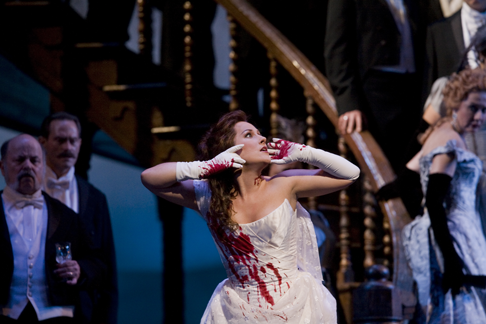 Diana Damrau in the title role of Donizetti’s “Lucia di Lammermoor.”
Item: The shocked turn of the head when the flute solo intrudes in the Mad Scene, Sutherland’s signature, was well achieved, and the craziness was lower key, more integral, than Dessay’s, but what really thrilled in this long stretch of bravura singing was the dramatic variety and color Damrau brought to Lucia’s mad changes of mood: elegiac (with a truly ghostly glass harmonica accompaniment) during the wedding hallucination, cries of grief defending herself to the imaginary Edgardo, and then, after (in this production) the doctor has injected her with a sedative, singing the second verse of the cabaletta in an ever more woozy, weavy way, like an exhausted bird spiraling down to the floor. It was a complete characterization.
Damrau’s voice, large, suave, cool, lovely, after a few wooden phrases in the lower ranges in her opening scene, filled the house with no trouble at all, and turned into glittering silver cascades at Lucia’s dreamy moments. It was the prettiest Lucia at the Met since the heyday of Ruth Ann Swenson, and first-rate bravura acting as well.
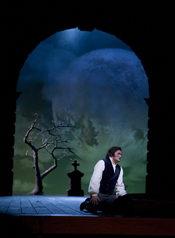 Piotr Beczala as Edgardo in Donizetti’s “Lucia di Lammermoor.”
The evening’s second star – by a hair (and because Donizetti
designed the opera for prima donna) – was the Polish tenor, Piotr
Beczala. He has a rich, liquid tenor of exceptional quality, top to bottom,
with a never overstated sob when necessary, and urgency when the dramatic
moment demands. Too, he fills the house with it, without pushing or barking.
Edgardo is a plum for the tenor who knows how to seize it, and Beczala did
not waste anything. Withal, he cuts a slim, handsome figure, is a good actor,
and his Italian diction is impeccable. It was easy (if a pity) to shut
one’s eyes and enjoy oneself whenever the direction demanded he do
something stupid. The one thing I might have wanted that was not here,
vocally, was a bit more maddened forza during the famous Curse after
the Sextet, a moment that can make or break a tenor’s reputation.
Vladimir Stoyanov’s baritone sounded a bit hollow in the opening scene, but he sang it, not screamed it, and that is a good thing. He warmed up by Act II, but (aided by a plain face and an unattractive pre-Raphaelite haircut) he always remembered he was the nasty in this opera. Ildar Abdrazakov used his height and sturdiness to enhance the impression his singing gave that Raimondo is the still, sane center of this damnfool family. Sean Panikkar – much too tall and strapping for a fellow who is knocked over and dispatched by a slip of a girl in thirty seconds flat – sang a promising Arturo, matching the impression he made as Edmondo in Manon Lescaut last year. (Don’t blame Donizetti for the folly of this: it was Zimmerman’s idea to cut the murder to thirty seconds by having bride and groom climb the staircase at the scene’s opening. Donizetti and his librettis, Romani, would never have been so dumb.)
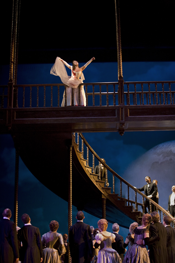 A scene from Donizett’s “Lucia di Lammermoor” with Diana Damrau in the title role.
Damrau seemed especially delighted to run off stage during the curtain
calls to bring on conductor Marco Armiliato; she hugged him, and he waved a
bit of bloody veil at us. Doing a staircase Mad Scene impromptu, with no
staircase, calls for reliability in the pit, and he was happy to stand in for
the rickety stairs. Certainly he propelled things capably, kept cool while
those on stage invented, and the ghostly orchestral effects that can fade for
lack of attention were on this occasion exceptionally noteworthy, moody and
striking.
The crowd, rather small for a Saturday night, stuck it out, and responded with enthusiasm. You have to wonder what the effect on the audience would have been with such a first-rate cast if they had been performing in a decent, old-fashioned staging of an opera that, after 175 years of success, really doesn’t need a tyro director’s helping hand.
John Yohalem