![Anna Grevelius ( Rosina ) John Tessier ( Almaviva ) [Photo by Alastair Muir]](http://www.operatoday.com/The_Barber_of_Seville_013.png)
06 Oct 2008
The Barber of Seville — English National Opera, London Coliseum
It can be difficult to inject life into a production which has been a staple of a company’s repertoire for over twenty years.
English Touring Opera are delighted to announce a season of lyric monodramas to tour nationally from October to December. The season features music for solo singer and piano by Argento, Britten, Tippett and Shostakovich with a bold and inventive approach to making opera during social distancing.
This tenth of ten Live from London concerts was in fact a recorded live performance from California. It was no less enjoyable for that, and it was also uplifting to learn that this wasn’t in fact the ‘last’ LfL event that we will be able to enjoy, courtesy of VOCES8 and their fellow vocal ensembles (more below …).
Ever since Wigmore Hall announced their superb series of autumn concerts, all streamed live and available free of charge, I’d been looking forward to this song recital by Ian Bostridge and Imogen Cooper.
Although Stile Antico’s programme article for their Live from London recital introduced their selection from the many treasures of the English Renaissance in the context of the theological debates and upheavals of the Tudor and Elizabethan years, their performance was more evocative of private chamber music than of public liturgy.
Evidently, face masks don’t stifle appreciative “Bravo!”s. And, reducing audience numbers doesn’t lower the volume of such acclamations. For, the audience at Wigmore Hall gave soprano Elizabeth Llewellyn and pianist Simon Lepper a greatly deserved warm reception and hearty response following this lunchtime recital of late-Romantic song.
For this week’s Live from London vocal recital we moved from the home of VOCES8, St Anne and St Agnes in the City of London, to Kings Place, where The Sixteen - who have been associate artists at the venue for some time - presented a programme of music and words bound together by the theme of ‘reflection’.
'Such is your divine Disposation that both you excellently understand, and royally entertaine the Exercise of Musicke.’
‘And there was war in heaven: Michael and his angels fought against the dragon; and the dragon fought and his angels, And prevailed not; neither was their place found any more in heaven … that old serpent … Satan, which deceiveth the whole world: he was cast out into the earth, and his angels were cast out with him.’
There was never any doubt that the fifth of the twelve Met Stars Live in Concert broadcasts was going to be a palpably intense and vivid event, as well as a musically stunning and theatrically enervating experience.
‘Love’ was the theme for this Live from London performance by Apollo5. Given the complexity and diversity of that human emotion, and Apollo5’s reputation for versatility and diverse repertoire, ranging from Renaissance choral music to jazz, from contemporary classical works to popular song, it was no surprise that their programme spanned 500 years and several musical styles.
The Academy of St Martin in the Fields have titled their autumn series of eight concerts - which are taking place at 5pm and 7.30pm on two Saturdays each month at their home venue in Trafalgar Square, and being filmed for streaming the following Thursday - ‘re:connect’.
The London Symphony Orchestra opened their Autumn 2020 season with a homage to Oliver Knussen, who died at the age of 66 in July 2018. The programme traced a national musical lineage through the twentieth century, from Britten to Knussen, on to Mark-Anthony Turnage, and entwining the LSO and Rattle too.
With the Live from London digital vocal festival entering the second half of the series, the festival’s host, VOCES8, returned to their home at St Annes and St Agnes in the City of London to present a sequence of ‘Choral Dances’ - vocal music inspired by dance, embracing diverse genres from the Renaissance madrigal to swing jazz.
Just a few unison string wriggles from the opening of Mozart’s overture to Le nozze di Figaro are enough to make any opera-lover perch on the edge of their seat, in excited anticipation of the drama in music to come, so there could be no other curtain-raiser for this Gala Concert at the Royal Opera House, the latest instalment from ‘their House’ to ‘our houses’.
"Before the ending of the day, creator of all things, we pray that, with your accustomed mercy, you may watch over us."
The doors at The Metropolitan Opera will not open to live audiences until 2021 at the earliest, and the likelihood of normal operatic life resuming in cities around the world looks but a distant dream at present. But, while we may not be invited from our homes into the opera house for some time yet, with its free daily screenings of past productions and its pay-per-view Met Stars Live in Concert series, the Met continues to bring opera into our homes.
Music-making at this year’s Grange Festival Opera may have fallen silent in June and July, but the country house and extensive grounds of The Grange provided an ideal setting for a weekend of twelve specially conceived ‘promenade’ performances encompassing music and dance.
There’s a “slide of harmony” and “all the bones leave your body at that moment and you collapse to the floor, it’s so extraordinary.”
“Music for a while, shall all your cares beguile.”
The hum of bees rising from myriad scented blooms; gentle strains of birdsong; the cheerful chatter of picnickers beside a still lake; decorous thwacks of leather on willow; song and music floating through the warm evening air.
It can be difficult to inject life into a production which has been a staple of a company’s repertoire for over twenty years.
Jonathan Miller’s durable production of Rossini’s most popular opera has returned almost every second season since its 1987 première, and though it has its longueurs (as does the opera itself) the thing that has kept it fresh is its straightforward attractiveness and humour. The company’s casting department has a large part to play in its enduring success, too – Tanya McCallin’s straightforwardly functional period set is normally populated by a combination of company veterans and fresh and promising young artists, with the result that it always feels like a successful ensemble piece with an eternal spark of life.
One thing which wasn’t new was Andrew Shore’s Bartolo; he has become a fixture in this production, to the extent that on the advertisement posters scattered around London’s transport system it is his name alone that is emblazoned next to the title of the opera. His gift for delivering words when singing in English is quite unequalled, and he plays the staging’s physical comedy to maximum effect. Sometimes in the past this has resulted in an imbalance, because with Shore as Bartolo it takes a particularly strong and characterful Rosina to convince the audience that she could credibly get the better of him. Fortunately the young Swedish mezzo Anna Grevelius was his ideal foil; a beautiful girl who always had a glint in her eye, and whose warm and rounded tone and lovely sense of bel canto line were combined with pinpoint accuracy of pitch and diction.
The Canadian tenor John Tessier, making his house début, made an extremely personable and youthful Almaviva. If he was rather superficial, this was the production’s idea rather than his own; Rosina is seduced more by the idea of being swept off her feet by a romantic young man than the reality of what life might actually be like afterwards. He showed off his lovely light, easy and secure tone with some stratospheric ornamentation, though conductor Rory Macdonald would have done well to give him a little more space to prevent an occasional stridency and unevenness which crept into some of his fastest runs. He demonstrated a gift for comedy and character acting with both his disguises, and served equally well as an ardent romantic hero when required.
Of the major principals, only Garry Magee’s Figaro disappointed; the eponymous barber needs charisma and charm, and his entrance aria should be filled with unshakeable masculine confidence and panache, but often it felt as though he was just singing the notes.
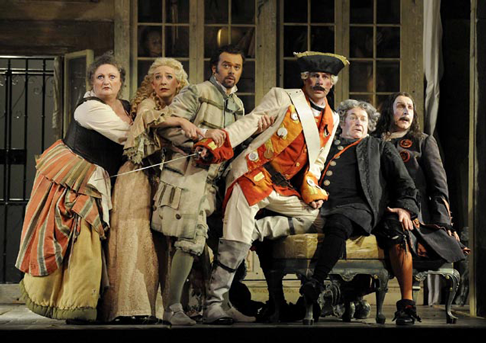 Jennifer Rhys-Davies (Berta) Anna Grevelius (Rosina) Garry Magee (Figaro) John Tessier (Almaviva) Andrew Shore (Doctor Bartolo) Brindley Sherratt (Don Basilio)
Brindley Sherratt’s oleaginous Don Basilio was a sinister delight, Julian Hubbard’s Fiorello was superbly sung, while Jennifer Rhys-Davies and Peter Kerr offered solid if slightly nondescript support as Berta and Ambrogio.
Two factors put this into a class above what could have been a run-of-the-mill revival of an ENO warhorse. Firstly it would appear that the original director, Jonathan Miller, might have had more of a hand in this revival of his than in any earlier run I can remember; various long-absent details have been restored, while much of the sillier business which the staging has acquired over the years, such as Ambrogio’s constant yawning and Berta’s incurable sneezing, has been mercifully consigned to the dustbin. More to the point, the cast had a real chemistry together, filled the stage with life, and looked and sounded as though they were really enjoying themselves.
Ruth Elleson © 2008