02 Nov 2008
Blond Leading the Blond: Scandinavia Times Three
I was just itching to experience the new Oslo Opera House ever since I saw the pictures of its grand opening (ahead of schedule, thank-you-very-much) last April.
English Touring Opera are delighted to announce a season of lyric monodramas to tour nationally from October to December. The season features music for solo singer and piano by Argento, Britten, Tippett and Shostakovich with a bold and inventive approach to making opera during social distancing.
This tenth of ten Live from London concerts was in fact a recorded live performance from California. It was no less enjoyable for that, and it was also uplifting to learn that this wasn’t in fact the ‘last’ LfL event that we will be able to enjoy, courtesy of VOCES8 and their fellow vocal ensembles (more below …).
Ever since Wigmore Hall announced their superb series of autumn concerts, all streamed live and available free of charge, I’d been looking forward to this song recital by Ian Bostridge and Imogen Cooper.
The Sixteen continues its exploration of Henry Purcell’s Welcome Songs for Charles II. As with Robert King’s pioneering Purcell series begun over thirty years ago for Hyperion, Harry Christophers is recording two Welcome Songs per disc.
Although Stile Antico’s programme article for their Live from London recital introduced their selection from the many treasures of the English Renaissance in the context of the theological debates and upheavals of the Tudor and Elizabethan years, their performance was more evocative of private chamber music than of public liturgy.
In February this year, Albanian soprano Ermonela Jaho made a highly lauded debut recital at Wigmore Hall - a concert which both celebrated Opera Rara’s 50th anniversary and honoured the career of the Italian soprano Rosina Storchio (1872-1945), the star of verismo who created the title roles in Leoncavallo’s La bohème and Zazà, Mascagni’s Lodoletta and Puccini’s Madama Butterfly.
Evidently, face masks don’t stifle appreciative “Bravo!”s. And, reducing audience numbers doesn’t lower the volume of such acclamations. For, the audience at Wigmore Hall gave soprano Elizabeth Llewellyn and pianist Simon Lepper a greatly deserved warm reception and hearty response following this lunchtime recital of late-Romantic song.
Collapsology. Or, perhaps we should use the French word ‘Collapsologie’ because this is a transdisciplinary idea pretty much advocated by a series of French theorists - and apparently, mostly French theorists. It in essence focuses on the imminent collapse of modern society and all its layers - a series of escalating crises on a global scale: environmental, economic, geopolitical, governmental; the list is extensive.
For this week’s Live from London vocal recital we moved from the home of VOCES8, St Anne and St Agnes in the City of London, to Kings Place, where The Sixteen - who have been associate artists at the venue for some time - presented a programme of music and words bound together by the theme of ‘reflection’.
'Such is your divine Disposation that both you excellently understand, and royally entertaine the Exercise of Musicke.’
Amongst an avalanche of new Mahler recordings appearing at the moment (Das Lied von der Erde seems to be the most favoured, with three) this 1991 Mahler Second from the 2nd Kassel MahlerFest is one of the more interesting releases.
‘And there was war in heaven: Michael and his angels fought against the dragon; and the dragon fought and his angels, And prevailed not; neither was their place found any more in heaven … that old serpent … Satan, which deceiveth the whole world: he was cast out into the earth, and his angels were cast out with him.’
If there is one myth, it seems believed by some people today, that probably needs shattering it is that post-war recordings or performances of Wagner operas were always of exceptional quality. This 1949 Hamburg Tristan und Isolde is one of those recordings - though quite who is to blame for its many problems takes quite some unearthing.
There was never any doubt that the fifth of the twelve Met Stars Live in Concert broadcasts was going to be a palpably intense and vivid event, as well as a musically stunning and theatrically enervating experience.
‘Love’ was the theme for this Live from London performance by Apollo5. Given the complexity and diversity of that human emotion, and Apollo5’s reputation for versatility and diverse repertoire, ranging from Renaissance choral music to jazz, from contemporary classical works to popular song, it was no surprise that their programme spanned 500 years and several musical styles.
The Academy of St Martin in the Fields have titled their autumn series of eight concerts - which are taking place at 5pm and 7.30pm on two Saturdays each month at their home venue in Trafalgar Square, and being filmed for streaming the following Thursday - ‘re:connect’.
The London Symphony Orchestra opened their Autumn 2020 season with a homage to Oliver Knussen, who died at the age of 66 in July 2018. The programme traced a national musical lineage through the twentieth century, from Britten to Knussen, on to Mark-Anthony Turnage, and entwining the LSO and Rattle too.
With the Live from London digital vocal festival entering the second half of the series, the festival’s host, VOCES8, returned to their home at St Annes and St Agnes in the City of London to present a sequence of ‘Choral Dances’ - vocal music inspired by dance, embracing diverse genres from the Renaissance madrigal to swing jazz.
Just a few unison string wriggles from the opening of Mozart’s overture to Le nozze di Figaro are enough to make any opera-lover perch on the edge of their seat, in excited anticipation of the drama in music to come, so there could be no other curtain-raiser for this Gala Concert at the Royal Opera House, the latest instalment from ‘their House’ to ‘our houses’.
"Before the ending of the day, creator of all things, we pray that, with your accustomed mercy, you may watch over us."
I was just itching to experience the new Oslo Opera House ever since I saw the pictures of its grand opening (ahead of schedule, thank-you-very-much) last April.
My only previous experience with the Norwegian National Opera had been a number of years ago for a perfectly competent L’Italiana in Algeria (or was it La Cenerentola?).
While the exact Rossini may be forgettable, what is still vividly implanted from that visit was that the company was housed, make that “tucked away” inside a depressingly non-descript shopping arcade, poorly signed, and with an auditorium of a garden variety 60’s high school multi-function room. Lo these many intervening years, I always told myself I would wait to return until they had the long-talked about new home.
Well, the wait is over, and Godot is here. The brilliant new house is nothing short of stunning with an imposing, glacier-like facade right on the water (you can walk up two sloping roofs outside to the top of the lobby!), sporting exceedingly handsome and spacious public areas (the men’s plumbing fixtures appear like fountains framed by indirect lighting almost too pretty to soil!), and a gorgeous and rich dark-wood auditorium with excellent acoustics. It reminded me of a silhouette of a Viking ship with its coloring and curving lines.
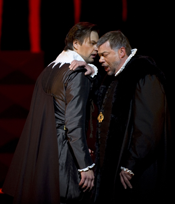
And they have happily inhabited these auspicious surroundings with a festival quality production of Don Carlo, being shared with Covent Garden and the Metropolitan Opera.
The opening forest scene of Bob Crowley’s handsome design looks like a very elegant, very expensive Hallmark card, with raised white silhouettes of trees, and a central winding path nestled in perspective between snow carpets (which might have benefited from a little more tape applied to the edges). Within this lovely setting director Nicholas Hytner created detailed staging with the soloists, devising interaction and stage business that not only conveyed their youthfulness, but also the playfulness of their courtship.
That directorial inventiveness was in ample supply is witnessed by such touches at act’s end as having the courtiers laying cloaks in the snow for the (now) “queen” to cross to a waiting sedan chair to be lifted high and carried through the crowd with a heart-rending clear sight line to the devastated Carlo.
This (and subsequent scenes) was framed by a box of walls that were evenly dotted with small square holes. These openings allowed for terrific lighting effects from designer Mark Henderson, such as the tomb scene where shafts of white light spookily slashed through the copious chemical fog on stage. The ostentatious black marble tomb down left with the lone word “Carlos” engraved large on it, was tracked to move diagonally upstage and be separated by walls to create an alcove, allowing the vacated space for hero and heroine to play out their important confrontation scene.
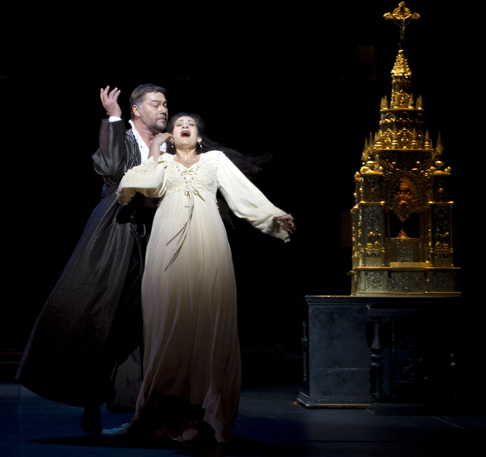 Anja Harteros as Elisabeth and René Pape as Filip II (Photo courtesy of Den Norske Opera & Ballett)
The subsequent garden scene was so playful it looked like it could have come from Crowley’s sketchbook for Elton John’s Broadway Aida. An expansive field chockful of red flowers was fronted by a dominating triangular piece of wall made up of large red, well, bricks. . .sort of. A cut out of a cross frames a dangling crucifix (did I say “playful”?) and church bell. A long continuous diagonal bench completed the setting which allowed for an especially animated “Veil Song” with ladies dancing front, behind, and on the bench thanks to the choreography of Scarlett Mackmin.
What the setting may have lacked for atmosphere for the love duet, was more than compensated by superlative blocking that was alternately impassioned, despairing and sensual. Should the duo be prone on the ground, as I have never seen before? It sure worked dramatically. And hey, maybe that is why the King never wants her to be alone! Powerful stuff.
The “other garden” scene of mistaken identities was given a great assist by layers of scrim panels of trees center and left, and a large rounded ivied wall right. For once the confusion of shadows and light worked, with Eboli ducking between scrim and full view, rendering Carlo’s gullibility of her identity believable. This rounded wall remained (sans ivy) for the auto-da-fe, with a large ornate alter-piece-as-church-facade filling the upstage.
This was the best staging of this problematic section that I have yet seen. The usual dumb show of processing sinners as the (sorry, Giuseppe) rather indifferent dirge of a march churns along, was here devised as a last-chance-before-you-fry scenario in which a priest challenges each of six convicts in turn by name to repent their heresy. Purists may chide me for enjoying the made up chatter that competes with the music, but damn if it didn’t make the proceedings come alive.
The rounded wall turned out to be a scrim panel revealing the naked sinners burning at the stake and, in a brilliant touch, the Heavenly Voice came from high above the back of auditorium. Doink! What a great solution! It should never be done any other way! (Especially if you have the silvery tones of Eli Kristin Hanssveen at your disposal.)
The home stretch was increasingly more spare with the study simple and sparsely furnished and the cell completely vacant, until we returned to the tomb. My appreciation for Mr. Hytner continued to grow as he drew motivated movement, detailed acting, and emotionally varied performances from his principals. Posa’s death scene, with the anguished Carlo cradling his cherished friend made me weep for the first time ever. The sometimes ungrateful final duet scene found Elisabetta and Carlo with ever fresh and imaginative interaction, at one point sitting together on the steps of the tomb.
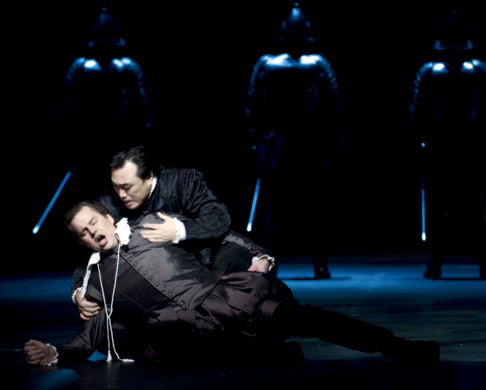 Keith Ikaia-Purdy as Don Carlo and Peter Mattei as Posa (Photo courtesy of Den Norske Opera & Ballett)
Of course, no one (except perhaps a handful of German Regie-Theater eccentrics) goes to Don Carlo for the scenery. And on the musical side, this performance could scarcely have been bettered. Conductor Marco Guidarini drew idiomatic, nuanced playing from the pit, and had a secure command over the pace and sweep of the masterpiece. While he could sometimes dawdle and indulge a bit, such as the bridge in “O Don Fatale,” in general the rhythmic drive was right on the money. While the great duet for Fillipo and the Inquisitor was as brisk as I have heard, what it lost in gravity it gained in evil menace.
Rene Pape made a fine Filippo and he voiced a compelling “Ella giammai m’amo,” although it must be said that he was initially a little muted, since he usually serves notice with his first utterances that he is a force to be reckoned with. Local girl Ingebjorg Kosmo made a wholly successful Eboli. What she may lack in pin-your-ears-back power in the lower middle, she more than makes up for with a healthily-produced sound and intelligent artistry. True, she broke up a few climactic phrases so as to give the most kick possible at the end of “Fatale” but then so do other successful practitioners. Silvia Moi’s light-voiced Tebaldo contributed all that was required, and she had a committed and graceful stage presence.
I would think that Anja Harteros must be rapidly on a track to become the Elisabetta of choice for the world’s leading houses. She deploys her dark-hued voice with technical mastery and deeply personalized phrasing, laden with meaning and gorgeous tone. She can handle the dramatic outbursts with common sense pacing, and can float a secure pianissimo at will. And it is no stretch to imagine this beautiful woman as both a queen, and the object of someone’s romantic attention.
Peter Mattei deployed his mellifluous kavalierbariton to tremendous effect with a beautifully sung Posa. His tall and lanky presence literally towered over the rest of the cast, and his acting was simple and affecting. His emotion-laden prison scene was all that could be wished.
The title role has been a calling card for tenor Keith Ikaia-Purdy all over the continent (several continents, in fact) and it is easy to see why. This wonderful artist serves up a richly detailed and nuanced performance, as capable of full-throated outpourings of pointed sound, as he is at scaling back to well-crafted mezzo-piano and sotto voce phrases laden with subtext. His subtlety impresses as much as does his capacity for clarion top notes.
Of course, our hero does get pushed aside in the final act as soloist after soloist regale us with some of the top four arias/pieces Verdi ever produced. (After he reappears in the prison scene with Rodrigo, I always sort of summon up a paraphrased echo of Anna Russell: “Remember Don Carlo?”). However, Mr. Ikaia-Purdy’s presence and committed acting immediately recaptured our attention, and Posa’s death was the most affecting I have ever experienced, not just because Mr. Mattei sang it uperlatively, but because our Don Carlo cradled the baritone in such inexpressible grief.
While this Oslo experience was first class and the performance top drawer, it was to prove to be only the first of three wonderful Scandinavian evenings.
Somehow, over the years, I have never been in Stockholm during the regular opera season, having made it to the Drottningholm and Dalhalla festivals, but not to the lovely and venerable Belle Epoque-style home of the Swedish Royal Opera. The occasion of this first visit was the premiere of a handsome new mounting of Samson et Dalila, cast from strength with (as far as I can tell) regular company members.
 Richard Decker sang the title role as well as anyone probably does these
days. Think of a more suave and musically refined Cura, and you’ll get
the idea. Mr. Decker’s muscular, baritonal tenor served Samson very
well and he certainly had the requisite beefy high notes, although sometimes
achieved by fudging of the French (the exposed “Je t’aime”
came out “zhah-tah-mah”.) Too, he cuts a handsome enough figure
and his acting was sincere and appropriate.
Richard Decker sang the title role as well as anyone probably does these
days. Think of a more suave and musically refined Cura, and you’ll get
the idea. Mr. Decker’s muscular, baritonal tenor served Samson very
well and he certainly had the requisite beefy high notes, although sometimes
achieved by fudging of the French (the exposed “Je t’aime”
came out “zhah-tah-mah”.) Too, he cuts a handsome enough figure
and his acting was sincere and appropriate.
David Bizic turned in a world-class star performance as the “High Priest,” his rich bass ringing out with pointed declamation and astonishing vocal presence. It’s not often this role gets the lion’s share of applause. The disappointing and woolly Albimelich was taken by Sten Wahlund, who (although no announcement was made) had to have been indisposed.
Dalila was engagingly sung by Anna Larsson, who paired her plummy and rich mezzo with committed acting to great effect. The famous arias were sumptuously rendered, and the self-righteous pronouncements were filled with dramatic fire. If her rapid melismas sounded a bit effortful here and there, this was overall a notable success. A handsome woman,Ms. Larsson was somewhat hindered by a costume that was too drab, albeit wholly in keeping with the “concept.”
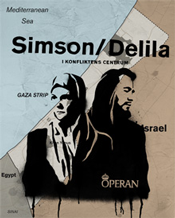
Director/choreographer Renaud Doucet boldly chose to frame the piece in modern day Gaza. This allowed for some brilliant opportunities, as well as some vexing problems. Not least of which is that while Yitzhak Rabin is lionized, and the Jewish plight is sympathetically heightened, the necessities of the opera’s plot assignments make the Palestinians come off very badly. Very very badly. So, while short on diplomacy and balance, just how did it come off as theatre?
Well. Indeed, very very well. The handsome design by Andre Barbe was meticulously lit by Guy Simard. The settings were rather like modern sculpture for people who don’t think they like modern sculpture. We first see imposingly large, burnished silver metal security walls with bright (and I mean bright) red rope threaded through it high above the action. Is the huge knot meant to be the Gordian knot? Is it the rope of fate waiting to be woven? No matter, it is beautiful as can be, and…it allows us to theorize.
These walls are re-configured for act two creating a “room” of sorts down left, and a huge coil of the red rope is fashioned into a couch (with culminating tassel laid to rest beside it), upon which our lovers consummate their passion before it becomes a barber-chair-by- default. The walls tighten to create a narrow space center stage in which “Samson at the mill” is really turning a giant spindle on which a length of red rope is being wound. Finally, the great hall is framed by pieces of these walls creating a forced perspective, with a greatly truncated rope is strung between the upstage receding walls. The set pieces shuddered, bent and tumbled very effectively in the Climactic Pillar Pull.
The modern dress costumes (also by Mr. Barbe) were appropriate, with exception of our heroine. Although she had to be in Muslim dress, complete with head scarf, it did not allow her to be physically alluring, and indeed her dress entirely argued against that which hampered the obvious sexual dynamic considerably.
However, most of the stage pictures were gripping, and the visceral connection with some of the visual imagery was brilliant. The opera started with a shallow playing space, backed by a scrim. Children are playing with a soccer ball stage left, a white limo is parked stage right. A couple of worried mothers hasten their children away when several evil looking goons approach the car. The thugs leave, the kids return, and then the car “explodes,” with pieces of it carried through the air in stylized fashion by the white suited terrorists. We audibly gasped at the horrific simplicity of this stagecraft.
The Bacchanal was another master stroke. Instead of the usual DeMille kitsch, Doucet realized it as the occasion for production of a suicide bomber recruiting film, that got more and more abhorrent as first a woman begs to be included in the mission (and is allowed), and then a young couple with a very small child. Compelling theatre. This same film is later shown as video footage on Dagon News with Dalila and the Priest as fanatical commentators.
And things were on the same high level in the pit. Conductor Gregor Buehl led a beautifully judged and stylistically convincing account of this most atmospheric of scores. He was not only accommodating of his fine soloists, but elicited clean and dramatically convincing singing from the well-trained chorus.
It will be a long time before I encounter as gripping and musically satisfying a Samson et Dalila as this at the Swedish Royal Opera. I changed gears entirely the following night, encountering a delightful new production of Handel’s Partenope in Copenhagen at the Danish Royal Opera. Although this company also has a gorgeous new house for the larger-scale pieces in the repertoire, they still use the handsome “old” house for Baroque and chamber operas.
Pride of place for this Partenope has to go to conductor Lars Ulrik Mortensen and his exceptional instrumentalists. This was without a doubt the best period instrument performance (and perhaps Handel performance) I have yet heard. To me, this music can sometimes just churn on and on, albeit very pleasantly. But here was a reading with a consistent dramatic tension, an electrifying propulsion, a flawless sense of melodic line, and creatively varied dramatic accents, not least of which were the oft magical “buttons” at the end of set pieces. Magical, that is indeed the word.
The Royal Opera assembled uncommonly fine soloists all, with the star hype being reserved for counter-tenor Andreas Scholl. This debut performance as Arsace was only his third opera role. To get the bad news out of the way, Mr. Scholl was announced as “greatly indisposed” but, in the interest of the premiere, he was going to go on and do his best. And his considerable “best” was, well, quite good enough.
Although he vocally marked his recitatives, he did not stint one whit in his acting and physical business. From photos, I had expected him to be short, bespectacled, and bookish, but sans glasses, he was tall, dark, and handsome. And like Juan Diego Florez, he has excellent comic acting abilities. He was highly affecting in his famous plaintive arias. A total professional, his committed and brave performance was not only enjoyable, it made me want to hear him again when he is well. It was quite evident that Mr. Scholl is a special artist.
The rest of the company was not only healthy, but fabulous. French counter-tenor Christophe Dumaux (Armindo) showed off an unusually bright and focused tone, and was wholly impressive in his solid technique, pleasing demeanor, and fearless physical acting. At opera’s start, I though that Inger Dam-Jensen’s “Partenope” might be a little diffuse in tone for the role’s demands, but in a matter minutes — wow — she sounded like Renee at her most ravishing, with awesome rapid-fire coloratura and superb musicianship. Her spoiled sex kitten approach slowly matured to create the evening’s most detailed and fully realized character.
Company member Tuva Semmingsen’s securely voiced Rosmira was solidly on a quality level of many of the world’s better known (and probably, paid) mezzos. On the basis of this assured outing, Ms. Semmingsen emphatically has the agility, burnished tone, stylistic command, and star presence to join their ranks. She is short, wiry, fiery, and delectable.
In the smaller role (vocally, if not in stage time) of Ormonte, Palle Knudsen first appeared scampering on stage from the prompter’s box, and proceeded to surprise and delight us the whole night, at one point rappelling to the stage from a spectator box. Mr. Knudsen’s rolling and refined baritone also possesses good agility, and he proved a perfect narrator/facilitator to move along the convoluted story and plot twists. As the less sympathetic Emilio, Bo Kristian Jensen had an energetic presence that was matched by some dynamic singing.
Director Francisco Negrin staged the improbable and long-winded story with a light comic touch, illuminating character relationships, deploying wholly successful physicality (not above the use of pratfalls!), lovingly crafted poignancy, and sparingly evoked sentimentality. His love of the piece and the genre was infectious and his cast (And audience) responded in kind.
The sets and costumes by Louis Desire, well-lit by Bruno Poet (great lightning effects), offered many delights. The plot’s requisite imposing walls look to be made of rocks like in some of those Neptune grottos you’ve seen around Europe. Patterns of vegetation in earth tones give way to a reveal of some nautical creatures and flora and fauna. Two massive perpendicular arches start on the sidelines, then roll in and out as the drama requires. A long table and chairs are imaginatively used as platform, dining table, runway, etc, and economically offer any number of creative blocking possibilities.
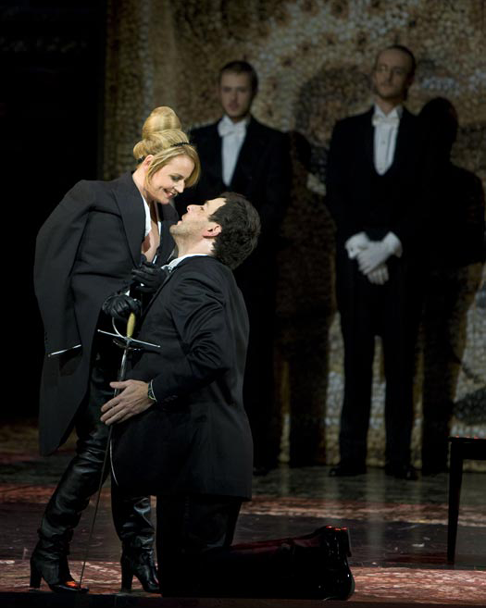 Inger Dam-Jensen as Partenope and Andreas Scholl as Arsace (Photo by Thomas Petri courtesy of The Royal Danish Opera)
A long heavy staircase fronts the rear wall, from which wall a large oval piece just falls out during the thunder storm, to great effect. The turntable revolves to reveal a secondary platform behind that hole-y wall, which serves as a sort of rocky ledge upon which the rain-drenched and blanket-covered principles begin the next act.
Mr. Desire’s well-tailored and elegant costumes flatter and inform all of the characters. However, Partenope herself was especially lovingly attired, first in a lustrous rust strapless gown; then in a fetching black number that is shed to put on a tuxedo jacket stripped from a hunky extra; and last a gorgeous,spangly, stately gold sleeveless gown, the progression of all reflecting her growing maturity.
Danish Royal Opera should be justifiably proud of their new Partenope, a musically resplendent and theatrically rich entertainment that meets the highest standards of any international company.
James Sohre