Subscribe to
Opera Today

Receive articles and news via RSS feeds or email subscription.


twitter_logo[1].gif


9780521746472.png

Recently in Reviews

The Importance of Being Earnest, Covent Garden

The Importance of Being Earnest , Gerald Barry’s fifth opera, was commissioned by the Los Angeles Philharmonic Orchestra and the Barbican, and was first performed in concert, Thomas Adès conducting the London premiere.

Death in Venice by ENO

‘Beauty is the one form of spirituality that we experience through the senses.’ In Thomas Mann’s, Death in Venice, Plato’s axiom stirs the hopes of the aging, intellectually stale poet, Gustav von Aschenbach, that he may rekindle his creativity.

Adding Movie Magic to The Magic Flute

What better way for Masonic brothers, Wolfgang Amadeus Mozart and Emmanuel Shikaneder to disseminate Masonic virtues, than through the most popular musical entertainment of their age, a happy ending folktale that features a dragon, enchanting flutes and bells, mixed-up parentage, and a beautiful young princess in distress?

Madama Butterfly, Opera Holland Park

There is a sense in which it all began in London, Puccini having been seized in 1900 with the idea of an opera on this subject after watching David Belasco’s play here.

An Evening of Zarzuela and Latin American Music at Los Angeles Opera

The tenor that the audience most wanted to hear, Plácido Domingo, opened the vocal program with “Junto al puente de la peña” (Next to the rock bridge) from La Canción del Olvido (The song of Oblivion) by José Serrano. He sounded rested and his voice soared majestically over the orchestra.

Così fan tutte in San Francisco

Tucked away somewhere in the San Francisco Opera warehouse was an old John Cox production of Così fan tutte from Monte Carlo. Well, not that old by current standards at San Francisco Opera.

Rossini Maometto Secondo Garsington Opera at Wormsley

Rossini's Maometto Secondo is a major coup for Garsington Opera at Wormsley, confirming its status as the leading specialist Rossini house in Britain. Maometto Secondo is a masterpiece, yet rarely performed because it's formidably difficult to sing. It's a saga with some of the most intense music Rossini ever wrote, expressing a drama so powerful that one can understand why early audiences needed "happy endings" to water down its impact

Peter Grimes in Concert

I suppose it was inevitable that, in this Britten Centenary year, the 66th Aldeburgh Festival would open with Peter Grimes.

Die Entführung aus dem Serail, Garsington Opera at Wormsley

Die Entführung aus dem Serail at Garsington Opera at Wormsley isn’t Mozart as you’d expect but it’s true to the spirit of Mozart who loved witty, madcap japes.

Le nozze di Figaro, Glyndebourne

What a pity! On a glorious — well, by recent English standards — summer’s day, there can be few more beautiful English countryside settings than Glyndebourne, with the added bonus, as alas much of the audience appears to understand it, of an opera house attached.

Queens, Heroines and Ladykillers

Described by one critic as “cosmically gifted”, during her tragically short career, American mezzo-soprano Lorraine Hunt Lieberson amazed and delighted audiences with the spellbinding beauty of her singing and the astonishing honesty of her performances.

L’Incoronazione di Poppea from Virgin Classics

Since its first performance at the Teatro Santi Giovanni e Paolo during Venice’s 1643 Carnevale, Monteverdi’s L’Incoronazione di Poppea has been one of the most important milestones in the genesis of modern opera despite its 250 years of unmerited obscurity. 

Alzira by Chelsea Opera Group

“I wrote it almost without noticing.” So Verdi declared when reminded of his eighth — and perhaps least frequently performed, opera, Alzira. One might say that, since he composed the work, no-one else has much noticed either.

Les Contes d’Hoffmann in San Francisco

Just when you thought the protagonist was Hoffmann! Who, rather what stole the show?

La Tosca in Los Angeles

When is verismo verily veristic? Or what is a virginal girl dressed in communion white doing in the two murderous acts of the Los Angeles Opera’s current production of Tosca? And why does she sing the shepherd's song?

Saverio Mercadante: I due Figaro

Though 2013 is the bicentennial of the births of Giuseppe Verdi and Richard Wagner, the releases of Cecilia Bartoli’s recording of Bellini’s Norma on DECCA, a new studio recording of Donizetti’s Caterina Cornaro from Opera Rara, and this première recording of Saverio Mercadante’s forgotten I due Figaro, suggest that this is the start of a summer of bel canto.

Lohengrin, Welsh National Opera

Wagner’s Lohengrin is not an unfamiliar visitor to the UK thanks, in the main, to Elijah Moshinsky’s perennial production at Covent Garden.

Philip Glass: The Perfect American

Philip Glass's The Perfect American at the ENO in London is a visual treat, but the libretto is mind-numbingly anodyne.

Christian Thielemann’s Der Ring des Nibelungen

Recording Richard Wagner’s Der Ring des Nibelungen is for a record label equivalent to a climber reaching the summit of Mount Everest: it is the zenith from which a label surveys its position among its rivals and appreciates an achievement that can define its reputation for a generation. 

Cecilia Bartoli as Norma

Few people who love opera in general and bel canto in particular have never heard the comment made by Lilli Lehmann, veteran of the inaugural Ring at Bayreuth in 1876, that singing all three of Wagner’s Brünnhildes—in Die Walküre, Siegfried, and Götterdämmerung, respectively, all of which she sang to great acclaim—pales in comparison with singing the title rôle in Bellini’s Norma

OPERA TODAY ARCHIVES »

Reviews

Renée Fleming as Lucrezia Borgia [Photo by Karin Cooper]
16 Nov 2008

Lucrezia Borgia at the Washington National Opera

After a somewhat shaky start to the season, as my recently posted review of La traviata attests, Washington National Opera has added considerable luster to its roster this November with the infusion of spectacle and star power in two new productions.

G. Donizetti: Lucrezia Borgia

Lucrezia Borgia (Renée Fleming), Gennaro (Vittorio Grigolo), Duke Alfonso (Ruggero Raimondi), Maffio Orsini (Kate Aldrich), Rustighello (Yingxi Zhang), Jeppo Liverotto (Jesus Hernandez), Apostolo Gazella (Grigory Soloviov), Ascanio Patrucci (Oleksandr Pushniak), Astolfo (David B. Morris), Gubetta (Robert Cantrell), Oloferno (Jose Ortega). Washington National Opera. Conductor: Plácido Domingo. Director: John Pascoe.

Above: Renée Fleming as Lucrezia Borgia

All photos by Karin Cooper courtesy of Washington National Opera.


My subject today is the first of these, Donizetti’s perpetually underperformed 1833 masterpiece Lucrezia Borgia. The next installment, to appear in a few days, will comment on the second – Bizet’s perennial favorite, the 1875 Carmen.

Lucrezia is a fiendishly difficult work for all involved. Spectacular settings of Renaissance Venice and Ferrara require the expensive kind of luxury in staging – luxury without ostentation. The director must create a sympathetic figure out of a legendary mass murderess, whose grit Donizetti evidently admired enough to make her a soprano, a victim, a mother, and a girl with a heart – most of the time… Meanwhile, the lead singer has to survive the endless bel canto lines and the head-spinning coloratura of her dramatic role written for a lyrical voice, all the while staying “in character” – and a character that psychologically is barely comprehensible to most of us. This was a tall order, and the result was worth the price of admission, which at the Washington National is always memorable in and of itself.
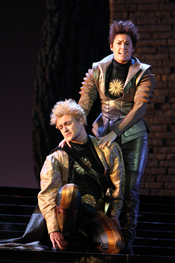
Grigolo,-Aldrich_Lucrezia-B.pngVittorio Grigolo as Gennaro, Kate Aldrich as Maffio Orsini.
A major ingredient in the production’s success was the fact that it was a Gesamtkunstwerk of sorts, with both stage direction and visual design in the excellent hands of the admirable John Pascoe. The stunning visuals, a fusion of old-world luxury with edgy and abstract modern lines, were sophisticated yet not overbearing. Central to the design were gigantic stone walls, first parting in welcome to the carnival atmosphere of Venice, the endless party town, then closing ominously to lock the characters and the audience in. Together with the fabulous lighting, a persistently excellent WNO feature (designer Jeff Bruckerhoff), these sets enhanced the complex psychological drama woven by Mr Pascoe the stage director. His reading of the libretto explained (if not entirely justified) Lucrezia’s bloodthirsty nature and reputation for promiscuity by casting her as a victim of incest and sexual abuse – an interpretation for which there is a valid historical precedent, as well as some veiled hints in the Donizetti score. Just to top it off, the historical heroine’s fictional son, Gennaro, is torn between an oedipal passion for his mother and a homoerotic one for his best friend Orsini – it is almost hard to believe Lucrezia has not yet joined The Tudors as a prime-time show on Cinemax!

Renée Fleming was billed as the star attraction of the show, and so she was. The singer’s famously buttery voice was on full display, even in Donizetti’s inhumane coloratura passages, which not only seemed easy, but were – a rare treat indeed – musical. Ms Fleming’s formidable acting skills served her best through the sections of the drama in which Lucrezia comes across as a sympathetic victim, fighting desperately for survival and the remaining shreds of her feminine dignity. It was harder to appear sympathetic in her Act 3 Scene 2 entrance, clad in male warrior attire (an unfortunate costume choice, in my opinion) and rejoicing in having just poisoned a group of admittedly foolish but basically harmless young men.
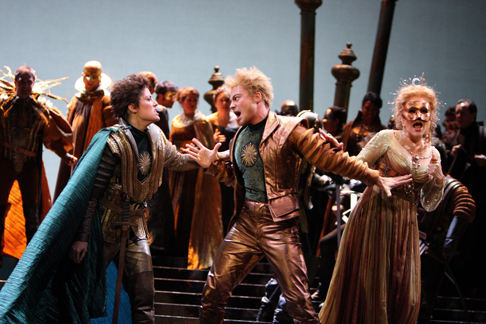
2_Aldrich,-Grigolo,-Fleming.pngKate Aldrich as Maffio Orsini, Vittorio Grigolo as Gennaro, Renée Fleming as Lucrezia Borgia

Vittorio Grigolo as Gennaro had an easier task. His character’s sexual ambiguity is defined situationally, in relation to others throughout the opera, while Gennaro himself essentially remains unchanged – a young, passionate, straightforward (if not totally straight) macho warrior. Mostly what is required to strike the right tenor here is, forgive the obvious pun, the right tenor. Mr Grigolo is in a possession of a fantastic one: sonorous, yet crisp and metallic, a highly appropriate timbre for Donizetti’s character. Despite his youth, the singer was a worthy partner to Ms Fleming. Then again, he started performing professionally at age thirteen, and his first solo gig was at the Sistine Chapel – not your average résumé!

Vittorio Grigolo was not the only young singer in the cast. He was partnered with mezzo-soprano Kate Aldrich in the travesti role of Maffio Orsini. One of the least experienced members of the ensemble, Miss Aldrich did an admirable job, which under normal circumstances would have garnered her well-deserved accolades. However, she was cursed by proximity. She simply could not quite hold her own in this all-star production and came across, undeservedly perhaps, as only adequate. On the other hand, the performance of the most venerable member of the line-up, the legendary Verdian bass-baritone Ruggero Raimondi, demonstrated both the advantages and pitfalls of experience. The 67-year-old singer appeared in a role with a significantly lower tessitura than those he performed in his early years. The part was shorn of most of its coloratura in an effort to accommodate the lack of flexibility in the voice, particularly conspicuous against Ms Fleming’s nonchalant virtuosity. Yet, unencumbered by the customary technical fireworks, Mr Raimondi was free to unleash his impressive dramatic talent, arguably more important than vocal prowess in the role of villainous Duke Alfonso. It was an honor to watch the old master at work.

Another master, Raimondi’s old partner Placido Domingo, was also involved in the production as the conductor of the performance. Unfortunately, on that front I have few laurel wreaths to award. Just as visual spectacle has consistently been one of the strongest elements of WNO’s productions, the company’s orchestra is almost always the weakest link. Donizetti’s score for Lucrezia Borgia is quite difficult for its time and genre; it contains, for instance, an unusual amount of brass writing, both in the pit and off-stage. Mr Domingo did a good job as a conductor, and the orchestra sounded better than the last time I heard it (in La traviata), but that is a very low bar to hurdle. In comparison with the level of artistry displayed by the singers and the director-designer in this production, the orchestral performance was barely passable, and I wish Mr Domingo, as the artistic director as well as conductor of the Washington National Opera could do something to improve a situation that surely cannot satisfy him. Other than that, Lucrezia is a world-class production, and the company is to be congratulated on its well-deserved success.

Olga Haldey

Send to a friend

Send a link to this article to a friend with an optional message.

Friend's Email Address: (required)

Your Email Address: (required)

Message (optional):