25 Nov 2008
Lulu-Palooza in the Windy City
Marlis Petersen, the much lauded "Lulu-du-jour," brought her well-traveled portrayal of Berg's complex heroine to Chicago Lyric Opera and she alone was almost worth the price of admission.
English Touring Opera are delighted to announce a season of lyric monodramas to tour nationally from October to December. The season features music for solo singer and piano by Argento, Britten, Tippett and Shostakovich with a bold and inventive approach to making opera during social distancing.
This tenth of ten Live from London concerts was in fact a recorded live performance from California. It was no less enjoyable for that, and it was also uplifting to learn that this wasn’t in fact the ‘last’ LfL event that we will be able to enjoy, courtesy of VOCES8 and their fellow vocal ensembles (more below …).
Ever since Wigmore Hall announced their superb series of autumn concerts, all streamed live and available free of charge, I’d been looking forward to this song recital by Ian Bostridge and Imogen Cooper.
The Sixteen continues its exploration of Henry Purcell’s Welcome Songs for Charles II. As with Robert King’s pioneering Purcell series begun over thirty years ago for Hyperion, Harry Christophers is recording two Welcome Songs per disc.
Although Stile Antico’s programme article for their Live from London recital introduced their selection from the many treasures of the English Renaissance in the context of the theological debates and upheavals of the Tudor and Elizabethan years, their performance was more evocative of private chamber music than of public liturgy.
In February this year, Albanian soprano Ermonela Jaho made a highly lauded debut recital at Wigmore Hall - a concert which both celebrated Opera Rara’s 50th anniversary and honoured the career of the Italian soprano Rosina Storchio (1872-1945), the star of verismo who created the title roles in Leoncavallo’s La bohème and Zazà, Mascagni’s Lodoletta and Puccini’s Madama Butterfly.
Evidently, face masks don’t stifle appreciative “Bravo!”s. And, reducing audience numbers doesn’t lower the volume of such acclamations. For, the audience at Wigmore Hall gave soprano Elizabeth Llewellyn and pianist Simon Lepper a greatly deserved warm reception and hearty response following this lunchtime recital of late-Romantic song.
Collapsology. Or, perhaps we should use the French word ‘Collapsologie’ because this is a transdisciplinary idea pretty much advocated by a series of French theorists - and apparently, mostly French theorists. It in essence focuses on the imminent collapse of modern society and all its layers - a series of escalating crises on a global scale: environmental, economic, geopolitical, governmental; the list is extensive.
For this week’s Live from London vocal recital we moved from the home of VOCES8, St Anne and St Agnes in the City of London, to Kings Place, where The Sixteen - who have been associate artists at the venue for some time - presented a programme of music and words bound together by the theme of ‘reflection’.
'Such is your divine Disposation that both you excellently understand, and royally entertaine the Exercise of Musicke.’
Amongst an avalanche of new Mahler recordings appearing at the moment (Das Lied von der Erde seems to be the most favoured, with three) this 1991 Mahler Second from the 2nd Kassel MahlerFest is one of the more interesting releases.
‘And there was war in heaven: Michael and his angels fought against the dragon; and the dragon fought and his angels, And prevailed not; neither was their place found any more in heaven … that old serpent … Satan, which deceiveth the whole world: he was cast out into the earth, and his angels were cast out with him.’
If there is one myth, it seems believed by some people today, that probably needs shattering it is that post-war recordings or performances of Wagner operas were always of exceptional quality. This 1949 Hamburg Tristan und Isolde is one of those recordings - though quite who is to blame for its many problems takes quite some unearthing.
There was never any doubt that the fifth of the twelve Met Stars Live in Concert broadcasts was going to be a palpably intense and vivid event, as well as a musically stunning and theatrically enervating experience.
‘Love’ was the theme for this Live from London performance by Apollo5. Given the complexity and diversity of that human emotion, and Apollo5’s reputation for versatility and diverse repertoire, ranging from Renaissance choral music to jazz, from contemporary classical works to popular song, it was no surprise that their programme spanned 500 years and several musical styles.
The Academy of St Martin in the Fields have titled their autumn series of eight concerts - which are taking place at 5pm and 7.30pm on two Saturdays each month at their home venue in Trafalgar Square, and being filmed for streaming the following Thursday - ‘re:connect’.
The London Symphony Orchestra opened their Autumn 2020 season with a homage to Oliver Knussen, who died at the age of 66 in July 2018. The programme traced a national musical lineage through the twentieth century, from Britten to Knussen, on to Mark-Anthony Turnage, and entwining the LSO and Rattle too.
With the Live from London digital vocal festival entering the second half of the series, the festival’s host, VOCES8, returned to their home at St Annes and St Agnes in the City of London to present a sequence of ‘Choral Dances’ - vocal music inspired by dance, embracing diverse genres from the Renaissance madrigal to swing jazz.
Just a few unison string wriggles from the opening of Mozart’s overture to Le nozze di Figaro are enough to make any opera-lover perch on the edge of their seat, in excited anticipation of the drama in music to come, so there could be no other curtain-raiser for this Gala Concert at the Royal Opera House, the latest instalment from ‘their House’ to ‘our houses’.
"Before the ending of the day, creator of all things, we pray that, with your accustomed mercy, you may watch over us."
Marlis Petersen, the much lauded "Lulu-du-jour," brought her well-traveled portrayal of Berg's complex heroine to Chicago Lyric Opera and she alone was almost worth the price of admission.
For Ms. Petersen has everything the role requires: gleaming lyric tone, unstrained high notes, first rate musicianship, a thorough understanding of the structure of the doomed girl’s dramatic arc, star presence, a waif-like figure, and truly great gams. So why was I not more emotionally engaged with her very definitive achievement?
Well, for all her consummate professionalism, she seemed to be just on the fringes of the character’s soul. The great director/teacher Charles Nelson Reilly once critiqued an actress thus: “My dear, you are wonderful, but you’re not acting — you’re giving a ‘performance.’” And that in part is what I felt about Ms. Petersen. Wonderful ‘performance,’ yes, but where was the internalized gnawing motivation that informs this creature? In her defense, and to risk musical heresy, I feel that in large part the omission is composer Berg’s.
The text asks us to believe this woman is irresistible, a charismatic being that inspires unhealthy sexual obsession in all who cross her path. I was not yet convinced this night that the intent of the tale is borne out by its musicalization. The heroine’s churning prosaic declamation, the oft-angular leaps, the quirky melismas that sound like “Lucia” on a bender, the pitches in extremis where only dogs can hear — all these make me admire the technique and the intellect to be sure, but do not engage my emotions. Or my libido.
Perhaps a uniquely gifted stage creature like Natalie Dessay could truly inhabit this role and make the dramatic work. Until then, Ms. Petersen’s very real achievement will likely nevertheless give much pleasure to many fans of this troubling piece. Not that hers was the evening’s only success.
The talented and versatile William Burden was simply the best Alwa of my experience. Is there anything at which this accomplished tenor does not excel? Here he sang with his customary easy precision, and spun out some achingly beautiful phrases. His duet with the heroine was arguably the highpoint of the evening. Dramatically committed, pristine tone and technique, handsome presence, Mr. Burden delivered on all counts.
The much anticipated Lyric debut by Wolfgang Schoene, a notable Dr. Shoen, was impressively musical and secure of characterization. His rather straight vocal production certainly filled the large house, although I found it a little on the dry side. Still, nothing about the part escapes him and he was often thrilling and ultimately (as Jack) chilling. Thomas Hammons’s booming, orotund Schigolch was more to my vocal taste and he made the most of his stage time. The rich, ringing contralto-ish Countess Geschwitz from Jill Grove was also top drawer, and she had good fun with parts of the role, running around in the bustle of Act II like Estelle Parsons chasing the getaway car in Bonnie and Clyde.
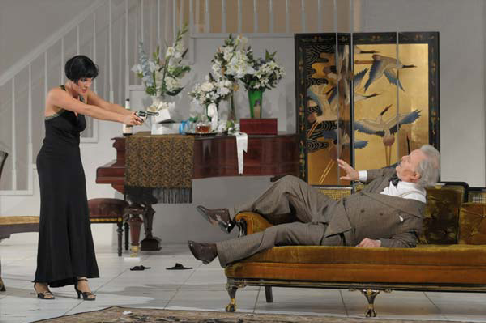 Marlis Petersen (title role) and Wolfgang Schöne (Dr. Schön) in Lyric Opera of Chicago’s new production of Lulu, directed by Paul Curran for the 2008-09 season. Photo by Dan Rest/Lyric Opera of Chicago
The many featured roles were well taken by Lyric’s outstanding young artists, with Scott Ramsay’s Painter deserving special mention for his gleaming delivery. Only Jan Buchwald seemed not quite in the same league as this stellar group of soloists, with a fairly woolly and diffuse Animal Tamer. While he sang much more clearly as the Athlete, Mr. Buchwald suggested more an East Bloc WWF act than the usual trim track star.
Stage director Paul Curran managed his skilled cast with excellent results, combining meaningful groupings and well motivated blocking with often inspired stage business. He also successfully mined all the humor in the piece which greatly heightened the catastrophic outcome. Kevin Knight’s effective set design pulled off the trick of using a white-box-as-unit-environment without parodying the dreadful cliche’s of 1980’s German opera design. This handsomely detailed space was changeably adorned with well chosen dressing, and subsequently opened up at the back to reveal a beautiful multi-leveled staircase. Mr. Knight also provided the characterful costumes.
If anything, I felt the white set was perhaps too clean, too bright, too open for the dark undercurrents of the story. But I grouse. The overall look of the design was a fine artistic achievement, especially paired with the spot-on (as it were) projections and film work contributed by John Boesche, and as meaningfully lit by David Jacques. First rate all.
In the pit, Sir Andrew Davis drew exceptional playing from this fine band, and made as cogent a case as I think possible for Berg’s opus. The occasional volume imbalances between orchestra and stage are seemingly unavoidable, given the thick brass voicings at some key junctures. The highly affecting, personalized solo instrumental work was equaled by superlative ensemble playing.
I cannot imagine a better case being made for this complex, challenging piece of musical theater. Still, after four different (good) productions to date, and many earnest “listens,” I frankly still don’t respond to the score. My limitation, I know. That I am not alone was evidenced by a trickle of audience leaving at the first intermission, augmented by a stream of departees after Act II.
At the end of the day, then, I have to say I found myself totally loving most everyone and everything about Lyric Opera’s admirable Lulu except…it.
James Sohre