Subscribe to
Opera Today

Receive articles and news via RSS feeds or email subscription.


twitter_logo[1].gif


UCP_9780226043425.gif

Recently in Reviews

Domingo Conducts Holdridge’s New Opera Dulce Rosa

Dulce Rosa, a brand new opera, had its world premiere Friday night, May 17, 2013 at the Broad Stage in Santa Monica, California. It was produced by Los Angeles Opera, but staged in the smaller theater.

Verdi’s Falstaff at Glyndebourne

Richard Jones’ 2009 production of Verdi’s Falstaff translates the action from the first Elizabethan age to the start of the second.

Gareth John, Wigmore Hall

Baritone Gareth John is rapidly accumulating a war-chest of honours. Winner of the 2013 Kathleen Ferrier Award, he recently won the Royal Academy of Music Patrons’ Award and was presented the Silver Medal by the Worshipful Company of Musicians.

La bohème at ENO

This second revival of Jonathan Miller’s La bohème was the first time I had caught the production.

Rolando Villazón: Verdi (International Opera Stars Series 2013)

It’s Verdi’s bicentenary year and Rolando Villazón has two new CDs to plug — titled somewhat confusingly, ‘Villazón: Verdi’ and ‘Villazón’s Verdi’, the latter a ‘personal selection’ of favourite numbers performed by stars of the past and present.

Brahms Third in San Francisco

Nicola Luisotti and the San Francisco Opera Orchestra climbed out of the War Memorial pit, braved the wind whipped bay and held spellbound an audience at Cal Performances’ Zellerbach Auditorium at UC Berkeley.

Ariane et Barbe-Bleue on Blu-Ray

Paul Dukas’ Ariane et Barbe-Bleue, first heard in 1907, once seemed important. Arturo Toscanini conducted the Met premiere in 1911 with Farrar and later arranged some of its music for a 1947 recording with his NBC Symphony.

Glyndebourne: Ariadne auf Naxos

Utterly mad but absolutely right — Richard Strauss’s Ariadne auf Naxos started the Glyndebourne 2013 season with an explosion. Strauss could hardly have made his intentions more clear. Ariadne auf Naxos is not “about” Greek myth so much as a satire on art and the way art is made.

Wozzeck at ENO

“Man is an abyss. It makes one dizzy to look into it.” So utters Georg Büchner’s Woyzeck, repeating what was also a recurring motif in the playwright’s own letters.

Mulhouse: Rare Britten Well Done

National Opera Company of the Rhine has marked this year’s Benjamin Britten celebration with a remarkably compelling, often gripping new production of the seldom-seen Owen Wingrave.

Frankfurt's Intriguing Idomeneo

Once upon a time, Frankfurt Opera had the baddest ass reputation in Germany as “the” cutting edge producer of must-see opera.

Rigoletto at Lyric Opera of Chicago

Productions of Giuseppe Verdi’s Rigoletto can serve as a vehicle for individual singers to make a strong impression and become afterward associated with specific roles in the opera.

Britten Sinfonia with Ian Bostridge

Just in case we were not aware that the evening’s programme was ‘themed’, the Britten Sinfonia designed a visual accompaniment to their musical exploration of night, sleep and dreams.

Aida, Manitoba Opera

Poor Aida! She never seems to have anything go her way.

Superlative singing: Don Carlo, Royal Opera House

Is it possible to upstage Jonas Kaufmann? Kaufmann was brilliant in this Verdi Don Carlo at the Royal Opera House, London, but the rest of the cast was so good that he was but first among equals. Don Carlo is a vehicle for stars, but this time the stars were everyone on stage and in the pit. Even the solo arias, glorious as they are, grow organically out of perfect ensemble. This was a performance that brought out the true beauty of Verdi's music.

Sarah Connolly: French Song at Wigmore Hall

The big names were absent: Duparc, D’Indy, Debussy, Ravel … and while Fauré, Chausson, Roussel and several members of Les Six put in an appearance, in less than familiar guises, this survey of French song of the early 20th century and interwar years deliberately took us on a journey through infrequently travelled terrain.

Rare restoration: Handel’s Esther 1720

Composed between 1718 and 1720, Handel’s Esther is sometimes described as the ‘first English Oratorio’, but is in fact a hybrid form, mixing elements of oratorio, masque, pastoral and opera.

The Damnation of Faust, London

Hector Berlioz's légende dramatique, La Damnation de Faust, exists somewhere between cantata and opera. Berlioz's flexible attitude to dramatic form made the piece unworkable on the stages of early 19th century Paris and his music is so vivid that you wonder whether the piece needs staging at all.

Elizabeth Connell Memorial Concert, St John's Smith Square

St. John’s Smith Square was the site of Elizabeth Connell’s final London concert, intended as a farewell to London on her moving to Australia. It was rendered ultimately final by her unexpected death.

Aida with all the Trimmings, Even a Blue Silk Elephant!

With the building of the Suez Canal, Egypt became more interesting to Western Europeans. Khedive Ismail Pasha wanted a hymn by Verdi for the opening of a new opera house in Cairo, but the composer said he did not write occasional pieces.

OPERA TODAY ARCHIVES »

Reviews

Donna Bateman (Rusalka) [Photo by Robert Workman]
04 Nov 2008

Rusalka and La tragedie de Carmen by English Touring Opera

Of their two tours per year, English Touring Opera tends to channel the majority of the budget into the Spring season, and the Autumn tour – despite a focus in recent years on some high-quality Baroque chamber works, which lend themselves well to the size of the venues around the UK which the company visits – can be rather noticeably the poor relation.

Rusalka and La tragedie de Carmen by English Touring Opera

Above: Donna Bateman (Rusalka)

All photos by Robert Workman courtesy of English Touring Opera


So Carmen and Rusalka seemed an ambitious prospect for this year's Autumn slot, without any apparent increase in resources.

One of the two, Rusalka – Dvorak's retelling of the Undine fable dealing with loss of innocence and the impossibility of survival in an alien world – reached the stage almost intact. The original orchestration is of Wagnerian proportions, and inevitably a 13-piece reduction (created for the Iford Festival by Ian Farrington) cannot create a sound-world of anything approaching the same depth, but there were few actual cuts, and the small orchestra under conductor Alex Ingram did its best to sound sumptuous and shimmering.

Director James Conway has chosen to present the opposite worlds of the water-dwellers and the humans through the medium of a real-life cultural divide – the American colonisation of Haiti in 1915. The casting reflected this, with black singers as the Water Sprite and nymphs, and white singers in the human roles. The only exception was the white Jezibaba, ostensibly a survivor of Haiti's indigenous Taino race – though I confess I wondered if this angle might have been dreamt up because ETO couldn't think of a black mezzo to cast in the role.

The general concept, though, was ingenious, successfully conveying a culture of unwitting ignorance and an irreconcilable chasm of difference between peoples, each 'side' unconsciously incapable of viewing the other as equal.

In the title role, Donna Bateman lacked legato occasionally, but her performance was full-voiced, passionate and involving, a very physical portrayal of a would-be free spirit who feels trapped and unfulfilled in her own world, but who finds that every step she takes only leads her to a new prison. As the Prince, Richard Roberts had ardour, good looks and a lyrical, evenly-produced tenor, while Fiona Kimm's Jezibaba was a tour de force.

Keel Watson was a characterful Water Sprite, his full bass caressing the melancholy falling phrases. The trio of nymphs – Angela Caesar, Abigail Kelly and Alison Crookendale – were mellifluously pleasing to the ear when singing together, with Caesar's light and attractive soprano a particular solo highlight. The Gamekeeper (Maciek O'Shea) and Turnspit (Jessica Summers) were lively and engaging in their second-act cameo, while as the Foreign Princess, Camilla Roberts was vocally powerful, full of hauteur and chillingly unpleasant in her snide insults towards Rusalka.
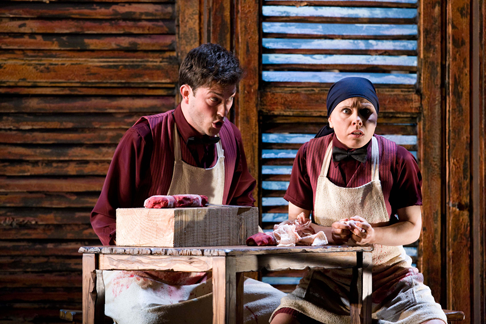
rusalka_092.pngMaciek O'Shea (Gamekeeper), Jessica Summers (Turnspit)

The staging and lighting were very simple, with minimal set and a backdrop consisting of a giant corrugated moon.
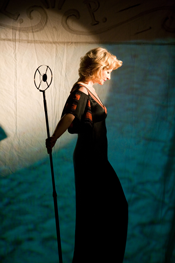
carmen_115.pngLeah Marian Jones (Carmen)
Far more adventurous, though maintaining the theme of cultural contrast, was La tragedie de Carmen, Peter Brook's short theatrical piece based on, but not a direct equivalent of, Bizet's opera. In an effort to be faithful to the spirit of Mérimée, it presents the bare bones of the story in a single act, a nightmarish sequence of flashbacks haunting the demented Don José, who at the start has Carmen's blood fresh on his hands.

Brook's version was created in 1981 and is only licensed for performance in French, which – although ETO prefers to perform as much as possible in English – director Andrew Steggall capitalises upon, staging it as a film noir. It all feels quintessentially French: the Carmen, Leah-Marian Jones, with her fair colouring and feline eyes and demeanour, comes across as a sultry French chanteuse a la Marlene Dietrich rather than a gypsy.

Marius Constant's score, freely adapted from Bizet's, makes imaginative use of orchestral colouring, using percussion to particularly evocative effect. All Carmen's own arias survive, but she sings them as introspective solo concert-pieces not addressed to anybody in particular, and Nicholas Garrett is made to croon the Toreador Song in a similarly intimate and non-operatic style. The straight 'operatic' numbers bloom like moments of unexpected beauty, and are mostly reserved for Don José (David Curry) and Micaela (Sinéad Campbell-Wallace), evoking the world of innocence from which they originate.

La tragédie is a juxtaposition of this musical beauty with raw, violent horror; in little over an hour, Don José is dragged further and further into obsession and madness, bludgeoning Carmen's gypsy husband with a bull's skull in a breathtaking piece of shadow-play. Not even Escamillo gets out of the nightmare in one piece.
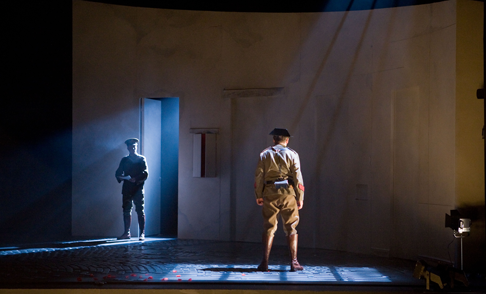
carmen_160.pngMaciek O'Shea (ZUNIGA), David Curry (Don Jose)

It is the kind of piece which would normally lend itself to performance in an off-West-End studio by a cast of theatrically-trained singing actors, and it was a luxury to hear it performed by opera singers. Moreover, it was an extremely powerful drama.

Ruth Elleson © 2008

Send to a friend

Send a link to this article to a friend with an optional message.

Friend's Email Address: (required)

Your Email Address: (required)

Message (optional):