07 Nov 2008
The Pearl Fishers at Lyric Opera of Chicago
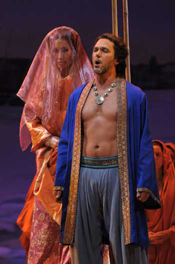
The current revival of Georges Bizet’s The Pearl Fishers at Lyric Opera of Chicago (seen 25 October) brings together an exceptionally strong cast.
English Touring Opera are delighted to announce a season of lyric monodramas to tour nationally from October to December. The season features music for solo singer and piano by Argento, Britten, Tippett and Shostakovich with a bold and inventive approach to making opera during social distancing.
This tenth of ten Live from London concerts was in fact a recorded live performance from California. It was no less enjoyable for that, and it was also uplifting to learn that this wasn’t in fact the ‘last’ LfL event that we will be able to enjoy, courtesy of VOCES8 and their fellow vocal ensembles (more below …).
Ever since Wigmore Hall announced their superb series of autumn concerts, all streamed live and available free of charge, I’d been looking forward to this song recital by Ian Bostridge and Imogen Cooper.
The Sixteen continues its exploration of Henry Purcell’s Welcome Songs for Charles II. As with Robert King’s pioneering Purcell series begun over thirty years ago for Hyperion, Harry Christophers is recording two Welcome Songs per disc.
Although Stile Antico’s programme article for their Live from London recital introduced their selection from the many treasures of the English Renaissance in the context of the theological debates and upheavals of the Tudor and Elizabethan years, their performance was more evocative of private chamber music than of public liturgy.
In February this year, Albanian soprano Ermonela Jaho made a highly lauded debut recital at Wigmore Hall - a concert which both celebrated Opera Rara’s 50th anniversary and honoured the career of the Italian soprano Rosina Storchio (1872-1945), the star of verismo who created the title roles in Leoncavallo’s La bohème and Zazà, Mascagni’s Lodoletta and Puccini’s Madama Butterfly.
Evidently, face masks don’t stifle appreciative “Bravo!”s. And, reducing audience numbers doesn’t lower the volume of such acclamations. For, the audience at Wigmore Hall gave soprano Elizabeth Llewellyn and pianist Simon Lepper a greatly deserved warm reception and hearty response following this lunchtime recital of late-Romantic song.
Collapsology. Or, perhaps we should use the French word ‘Collapsologie’ because this is a transdisciplinary idea pretty much advocated by a series of French theorists - and apparently, mostly French theorists. It in essence focuses on the imminent collapse of modern society and all its layers - a series of escalating crises on a global scale: environmental, economic, geopolitical, governmental; the list is extensive.
For this week’s Live from London vocal recital we moved from the home of VOCES8, St Anne and St Agnes in the City of London, to Kings Place, where The Sixteen - who have been associate artists at the venue for some time - presented a programme of music and words bound together by the theme of ‘reflection’.
'Such is your divine Disposation that both you excellently understand, and royally entertaine the Exercise of Musicke.’
Amongst an avalanche of new Mahler recordings appearing at the moment (Das Lied von der Erde seems to be the most favoured, with three) this 1991 Mahler Second from the 2nd Kassel MahlerFest is one of the more interesting releases.
‘And there was war in heaven: Michael and his angels fought against the dragon; and the dragon fought and his angels, And prevailed not; neither was their place found any more in heaven … that old serpent … Satan, which deceiveth the whole world: he was cast out into the earth, and his angels were cast out with him.’
If there is one myth, it seems believed by some people today, that probably needs shattering it is that post-war recordings or performances of Wagner operas were always of exceptional quality. This 1949 Hamburg Tristan und Isolde is one of those recordings - though quite who is to blame for its many problems takes quite some unearthing.
There was never any doubt that the fifth of the twelve Met Stars Live in Concert broadcasts was going to be a palpably intense and vivid event, as well as a musically stunning and theatrically enervating experience.
‘Love’ was the theme for this Live from London performance by Apollo5. Given the complexity and diversity of that human emotion, and Apollo5’s reputation for versatility and diverse repertoire, ranging from Renaissance choral music to jazz, from contemporary classical works to popular song, it was no surprise that their programme spanned 500 years and several musical styles.
The Academy of St Martin in the Fields have titled their autumn series of eight concerts - which are taking place at 5pm and 7.30pm on two Saturdays each month at their home venue in Trafalgar Square, and being filmed for streaming the following Thursday - ‘re:connect’.
The London Symphony Orchestra opened their Autumn 2020 season with a homage to Oliver Knussen, who died at the age of 66 in July 2018. The programme traced a national musical lineage through the twentieth century, from Britten to Knussen, on to Mark-Anthony Turnage, and entwining the LSO and Rattle too.
With the Live from London digital vocal festival entering the second half of the series, the festival’s host, VOCES8, returned to their home at St Annes and St Agnes in the City of London to present a sequence of ‘Choral Dances’ - vocal music inspired by dance, embracing diverse genres from the Renaissance madrigal to swing jazz.
Just a few unison string wriggles from the opening of Mozart’s overture to Le nozze di Figaro are enough to make any opera-lover perch on the edge of their seat, in excited anticipation of the drama in music to come, so there could be no other curtain-raiser for this Gala Concert at the Royal Opera House, the latest instalment from ‘their House’ to ‘our houses’.
"Before the ending of the day, creator of all things, we pray that, with your accustomed mercy, you may watch over us."
The current revival of Georges Bizet’s The Pearl Fishers at Lyric Opera of Chicago (seen 25 October) brings together an exceptionally strong cast.
Each of the four principals in this production demonstrates a strong sense of character portrayal and interpersonal emotional involvement in both singing and acting. The talents of this cast are essential to the success of the music and drama, since the solo and duet pieces are interwoven by Bizet to highlight individuals interacting with each other or with the chorus throughout the opera. The work is set in ancient Ceylon with Lyric Opera’s staging showing a mixture of images from Eastern religions. The virgin priestess Leïla, who pays a ceremonial visit of several days to the region of the pearl fishers, is sung by soprano Nicole Cabell. The long-standing friendship of two members of this community will be tested again during the course of the action. As the friends with a variable past, marked by loyalty as well as jealousy, Nadir and Zurga are sung, respectively, by tenor Eric Cutler and baritone Nathan Gunn. Finally, the spiritual leader of this society, identified as the high priest of Brahma, is sung by the bass baritone Christian Van Horn. The Lyric Opera Orchestra is conducted by John Mauceri.
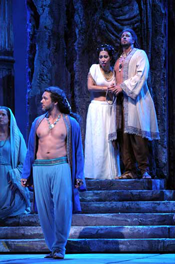 Zurga (baritone Nathan Gunn) is furious to discover the priestess Leïla (soprano Nicole Cabell) violating her sacred vows with his friend Nadir (tenor Eric Cutler). Act II, The Pearl Fishers. [Photo by Dan Rest/Lyric Opera of Chicago]
From the start of the first act, the tensions that will mark a constant shift between peaceful friendship and rivalry in love are established already in the opening music and staging. A scrim covering the stage during the overture suggests a placid tropical setting whereas the initial music, as emphasized skillfully under Mauceri’s direction, contains a multi-layered projection of forthcoming oppositions. As the assembled fishers are reminded by Zurga, they are obligated to choose a new leader. Nathan Gunn, in the role of Zurga, urges the reveling dancers with his supple and convincing vocal lines, just as he accepts their decision to make him their king with a lyrical expression of dignity. Immediately after this choice is settled, the figure of Nadir reappears following a long absence from the fishermen in search of adventure “des savanes et des forêts” (“in savannas and forests”). The role of Nadir is ideally suited to the musical sensibilities of Eric Cutler. From the first notes of his entrance, Cutler’s voice soared in Nadir’s emotional scene of recognition: the challenging upper range of the part was sung consistently on pitch and without a hint of strain. More importantly, the voice communicated at once an exciting narrative of a wandering and curious spirit. Once Nadir is welcomed back into the society of pearl fishers, he finds himself alone with his former friend. As they reminisce on the priestess whom they had both seen years before in a temple at Candi, the emotions of rival attraction vs. renunciation for the sake of friendship are poured into the justly famous duet for tenor and baritone. In both declamation and poetic singing the voices of Cutler and Gunn melded yet remained distinct in exquisite lyrical effect. As Cutler pronounced “Voyez” (“Look”), one sensed that he truly could see the priestess still in his mind’s eye. Gunn’s evocation “O vision, o rêve” (“Oh vision, oh dream”) was equally effective as memory through song. After concluding the duet with the mutual assurance of sacred friendship, the announcement of a vessel landing at shore introduces the remaining two principal figures. In a ceremonial procession the unnamed virgin, whose identity must be concealed by a veil, is led into the community under the protection of Nourabad the high priest. Her duties and the promise she must swear are detailed by Zurga as newly chosen leader. Here the impressive effect of Gunn’s seamless lyrical line was paired with the rapt attention of the assembled chorus of fishers. Leïla the veiled priestess recognizes Nadir; by the same token, Nadir is reminded of his past love, when he hears now the voice of the veiled woman assenting to the conditions of chaste anonymity. The priestess is led into the temple by Nourabad, the community disperses, and Zurga leaves his friend to conclude the day in solitary reflection. The second most familiar number of the opera occurs at this point in the score. Nadir has been greatly moved by the reminder of a voice so similar to that of his beloved Leïla. He recalls the vision of the woman from the past in his “Je crois entendre encore” (“I believe I still hear”), an aria in which Cutler demonstrates not only scrupulous legato and attention to text but also high notes imbued with feeling and sung with a remarkable piano effect. His intonation of the line “O souvenir charmante” (“Oh charming souvenir”) remains in one’s memory long afterward. As Nadir falls asleep, Nourabad returns with the priestess and gives instruction for her continued prayers on an exposed rock. In the concluding scene of the first act, Leïla begins her prayer to the god, “O Dieu Brahma,” and continues, urged on by the alternating voice of the chorus, with her lines “Esprits de l’air” (“Spirits of the air”) and “Dans le ciel sans voile” (“In the cloudless sky”). In the role of the priestess Nicole Cabell sings with beauty of tone and flexibility, her range secure in all the scales and coloratura required at this point of the score. One senses her creation of a character with voice, since she remains stationary at first during her prayer. As Nadir awakens and hears again the once familiar voice, he moves toward the base of the rock. Leïla reveals her identity by lifting momentarily the veil: the mutual recognition — and Nadir’s fervent request — prompts Leïla to continue her song. Here Cabell’s performance excels in varying and decorating the repeated lines, her effortless coloratura including several skillfully executed trills. Before the final chords of the orchestra in the act the listener senses, in this performance, that both characters have been able to use their voices to sing of and to communicate their feelings for the other, yet they must still maintain distance because of oaths sworn by each to Zurga.
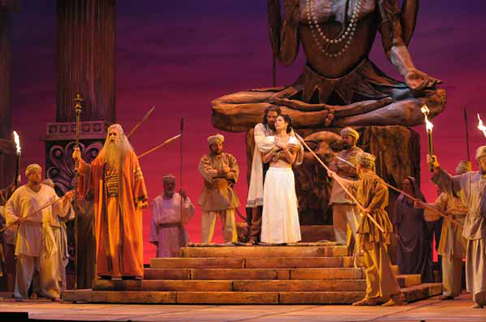 The high priest Nourabad (bass-baritone Christian Van Horn, left) prepares for the execution of Nadir (Eric Cutler) and Leïla (Nicole Cabell) in Act III of The Pearl Fishers. [Photo by Dan Rest/Lyric Opera of Chicago]
In the second, shorter act of The Pearl Fishers the anticipation and tension established already from the first act develops into both reunion and crisis for the lovers. The priest Nourabad leads Leïla to her shelter for nightly rest. Christian Van Horn sings imposingly and is able to inject a truly credible spirit of authority into his rich and flexible bass baritone. He warns Leïla to remain faithful to her vow and to eschew the temptation of earthly love. When she is alone, Leïla senses that Nadir must be in the immediate area, and she begins her cavatina “Comme autrefois” (“As in the past”). In this piece Cabell exhibits ravishing lyrical control as she combines memories of the past with hints of an imminent reunion. Her song is answered from outside the temple by Nadir so that music serves fittingly as their reintroduction to physical contact. Once they embrace, their duet is a confession of love and loyalty as well as a realization of the conflicts that will follow on their renewed bond. Both Cabell and Cutler give full expression to the complexity of emotion and commitment awaiting them. As a storm begins at the shore, Nourabad enters and sees that a man has defiled the temple by his presence. He sends for guards who capture the fleeing Nadir. Upon Leïla’s surrender in the temple, the fishers return and demand that both lovers be killed. This final scene introduces the dramatic conflicts of the following act once Zurga enters and attempts to mediate. He counsels leniency, which the crowd is prepared to accept until the identity of the priestess is revealed. Zurga’s mood shifts rapidly to rage as he sees that Nadir and Leïla have broken their separate oaths sworn to him.
The final act of the opera is neatly divided into two scenes. At the opening Zurga remains alone in his tent, where he is torn by guilt. Now that his fury has subsided, he regrets that Nadir, his cherished friend, must die at sunrise. In this scene Nathan Gunn sings the aria “Nadir, ami de mon jeune âge” (“Nadir, friend of my youth”) as a dramatically wrenching showpiece. Although the aria is not as interesting musically as other parts of Bizet’s score, Gunn performs it as a telling moment for the character of Zurga. Leïla now enters the tent to ask that he pardon Nadir, yet the rage of Zurga returns when he realizes that she still loves his rival. The exchange here between Cabell and Gunn becomes one of the dramatic highlights of the performance. She leaves the text prepared to die and deposits with a guard a necklace that she has worn since her youth. Zurga recognizes the necklace as one that he had given to a child who had saved his life by hiding him years before. In the final scene Nadir is surrounded by fishers, who prepare for the execution. Leïla is brought in to join him in death, as both sing of their happiness in remaining together. When Zurga declares that fire has broken out in the camp of the fishers, the latter rush off to save their families. Zurga announces to Nadir and Leïla that he himself has started the blaze: he frees the lovers and urges them to escape, returning the generosity that he had experienced from Leïla long before. Although he will surely pay in sacrifice for this act, Zurga has redeemed his friendship.
This production of The Pearl Fishers by Lyric Opera is a revival of the original design and staging from the 1997-98 season. Both sets and costumes have been redesigned under the direction of Scott Marr. This production argues convincingly for more frequent revivals of Bizet’s early opera, with the cast and direction of these performances serving as a model for future productions as well.
Salvatore Calomino