Recently in Reviews
English Touring Opera are delighted to announce a season of lyric monodramas to tour nationally from October to December. The season features music for solo singer and piano by Argento, Britten, Tippett and Shostakovich with a bold and inventive approach to making opera during social distancing.
This tenth of ten Live from London concerts was in fact a recorded live performance from California. It was no less enjoyable for that, and it was also uplifting to learn that this wasn’t in fact the ‘last’ LfL event that we will be able to enjoy, courtesy of VOCES8 and their fellow vocal ensembles (more below …).
Ever since Wigmore Hall announced their superb series of autumn concerts, all streamed live and available free of charge, I’d been looking forward to this song recital by Ian Bostridge and Imogen Cooper.
The Sixteen continues its exploration of Henry Purcell’s Welcome Songs for Charles II. As with Robert King’s pioneering Purcell series begun over thirty years ago for Hyperion, Harry Christophers is recording two Welcome Songs per disc.
Although Stile Antico’s programme article for their Live from London recital introduced their selection from the many treasures of the English Renaissance in the context of the theological debates and upheavals of the Tudor and Elizabethan years, their performance was more evocative of private chamber music than of public liturgy.
In February this year, Albanian soprano Ermonela Jaho made a highly lauded debut recital at Wigmore Hall - a concert which both celebrated Opera Rara’s 50th anniversary and honoured the career of the Italian soprano Rosina Storchio (1872-1945), the star of verismo who created the title roles in Leoncavallo’s La bohème and Zazà, Mascagni’s Lodoletta and Puccini’s Madama Butterfly.
Evidently, face masks don’t stifle appreciative “Bravo!”s. And, reducing audience numbers doesn’t lower the volume of such acclamations. For, the audience at Wigmore Hall gave soprano Elizabeth Llewellyn and pianist Simon Lepper a greatly deserved warm reception and hearty response following this lunchtime recital of late-Romantic song.
Collapsology. Or, perhaps we should use the French word ‘Collapsologie’ because this is a transdisciplinary idea pretty much advocated by a series of French theorists - and apparently, mostly French theorists. It in essence focuses on the imminent collapse of modern society and all its layers - a series of escalating crises on a global scale: environmental, economic, geopolitical, governmental; the list is extensive.
For this week’s Live from London vocal recital we moved from the home of VOCES8, St Anne and St Agnes in the City of London, to Kings Place, where The Sixteen - who have been associate artists at the venue for some time - presented a programme of music and words bound together by the theme of ‘reflection’.
'Such is your divine Disposation that both you excellently understand, and royally entertaine the Exercise of Musicke.’
Amongst an avalanche of new Mahler recordings appearing at the moment (Das Lied von der Erde seems to be the most favoured, with three) this 1991 Mahler Second from the 2nd Kassel MahlerFest is one of the more interesting releases.
‘And there was war in heaven: Michael and his angels fought against the dragon; and the dragon fought and his angels, And prevailed not; neither was their place found any more in heaven … that old serpent … Satan, which deceiveth the whole world: he was cast out into the earth, and his angels were cast out with him.’
If there is one myth, it seems believed by some people today, that probably needs shattering it is that post-war recordings or performances of Wagner operas were always of exceptional quality. This 1949 Hamburg Tristan und Isolde is one of those recordings - though quite who is to blame for its many problems takes quite some unearthing.
There was never any doubt that the fifth of the twelve Met Stars Live in Concert broadcasts was going to be a palpably intense and vivid event, as well as a musically stunning and theatrically enervating experience.
‘Love’ was the theme for this Live from London performance by Apollo5. Given the complexity and diversity of that human emotion, and Apollo5’s reputation for versatility and diverse repertoire, ranging from Renaissance choral music to jazz, from contemporary classical works to popular song, it was no surprise that their programme spanned 500 years and several musical styles.
The Academy of St Martin in the Fields have titled their autumn series of eight concerts - which are taking place at 5pm and 7.30pm on two Saturdays each month at their home venue in Trafalgar Square, and being filmed for streaming the following Thursday - ‘re:connect’.
The London Symphony Orchestra opened their Autumn 2020 season with a homage to Oliver Knussen, who died at the age of 66 in July 2018. The programme traced a national musical lineage through the twentieth century, from Britten to Knussen, on to Mark-Anthony Turnage, and entwining the LSO and Rattle too.
With the Live from London digital vocal festival entering the second half of the series, the festival’s host, VOCES8, returned to their home at St Annes and St Agnes in the City of London to present a sequence of ‘Choral Dances’ - vocal music inspired by dance, embracing diverse genres from the Renaissance madrigal to swing jazz.
Just a few unison string wriggles from the opening of Mozart’s overture to Le nozze di Figaro are enough to make any opera-lover perch on the edge of their seat, in excited anticipation of the drama in music to come, so there could be no other curtain-raiser for this Gala Concert at the Royal Opera House, the latest instalment from ‘their House’ to ‘our houses’.
"Before the ending of the day, creator of all things, we pray that, with your accustomed mercy, you may watch over us."
Reviews
02 Nov 2008
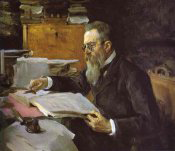
The Tsar’s Bride by OONY
What opera contains a terrific overture, a wedding sextet, two murderous magical potions, a mad scene for coloratura soprano, a magnificent a cappella aria for contralto, dozens of glorious melodies and lots of nifty choral writing?
If you read the heading of this review, you already know the answer:
Nikolai Rimsky-Korsakov’s Tsar’s Bride – one of
the most popular operas throughout Russia, but downright obscure in the West
– it has never been staged in New York (to my knowledge), despite a
huge Russian community who would eat it up and a dozen visits over the years
from three or four of Russia’s leading opera companies wasting our time
with Mlada or Macbeth or far too many Onegins.
Rimsky-Korsakov was in an Italianate mood when he composed
Tsar’s Bride, with its feast of plot complications and
consequent musical situations: licentious boyar Grisha Gryaznoi (heroic
baritone) lusts for Marfa (coloratura soprano), though she is about to wed
her truelove Lykov (romantic tenor). Grisha persuades the tsar’s
sinister German alchemist, Bomelii (character tenor), to concoct a potion
that will make Marfa fall for best man Grisha instead. Complication one:
Grisha’s jealous mistress Lyubasha (dynamite Slavic mezzo) switches the
potion with another one, intended to destroy Marfa’s good looks –
never mind how Lyubasha got the sleazy alchemist to run it up for her (think:
Tosca). Complication two: Just as Marfa drinks the potion on her
wedding day, news arrives that the tsar, Ivan the Terrible no less (sinister
offstage presence), has chosen Marfa as his bride! Too, the potion
– what was in it? – turns out to be poison that drives
her lyrically insane. At curtain’s fall, everyone is either miserable
or dead except the tsar, who remains off stage, singing (we may imagine),
“Next!” (Ivan married more wives than Henry VIII. He once
proposed to Henry’s daughter, Elizabeth.)
Bride is, thus, one of those operas (like Don Carlos or Don
Giovanni or L’Africaine) where no single character grabs
our attention all night; we are involved with the dilemmas and desires of
many, and follow them through to a general catastrophe. One reason the opera
may be rare over here may be the sheer number of great voices who are
required to sing beautiful arias and ensembles in the true, flavorful Russian
manner. Lyubasha calls for a grand low-voiced lady, with a voice from the
vaults of the earth; it has long been a signature role for Borodina, and she
graciously returned to sing it with Queler a second time. Marfa’s
father, Sobakin, is a Russian bass from the old church-trained tradition,
like Boris or Prince Igor or Prince Gremin. Marfa herself
is an all-stops-out coloratura, whose lovely final scene is one of
Rimsky’s handsomest tunes. And first and last there is the devilish
Grisha Gryaznoi, whose outward brashness conceals inner torment, selfishness,
crime and, finally, a (very Russian) orgy of guilt. Half a dozen minor roles
have major parts to sing in solos and ensembles.
The problem is that it’s hard to bring in a worthy performance (and
O.O.N.Y.’s was a very worthy performance) unless you have dozens of
great Russian singers at your disposal – but that doesn’t prevent
anyone in the West from staging Boris Godunov or even the far less
theatrically promising Khovanshchina or Prince Igor –
all three of which, by the way, might never have captured the stage at all
had it not been for Rimsky-Korsakov’s now discredited editing.
Happily, Eve Queler and her Opera Orchestra of New York threw caution to
the winds and brought this wonderful piece back to Carnegie Hall for the
first New York hearing in twenty years. Olga Borodina, new in town at that
previous performance, is now a grande dame and local favorite, but she
retains the plummy low notes that make Lyubasha appealing, her disastrous
passions touching. Borodina is one of the rare Russian singers (her husband,
Ildar Abdrazakov, is another) who has no trouble singing Italian music
idiomatically, without the voiced vowels and Slavic curlicues that make so
many Russian opera singers a little risible in western song, but back in her
native element there seem to be depths of tragic character lurking in the
rounded shadows of her singing.
Alexey Markov made an exciting impression chewing up the stage as the
narcissistic Grisha. He is a fine singing actor, with a plush, endearing
baritone – and it is necessary that this character make himself a
lovable scamp in the great narrations of the first act or his hideous
behavior for the rest of the evening will only depress you. Yeghishe
Manucharyan sang ardently and deft phrasing as Marfa’s hapless true
love, but John Easterlin nearly stole the tenor honors with a Bomelii at once
forceful and melodramatically harsh. You did not need a libretto to know
which of these men was the lover and which the villain, and Easterlin made a
villain it was a delight to hiss. Christophoros Stamboglis, as Marfa’s
understandably confused father, had a good time with one of those stirring,
from-the-depths-of-the-Russian-earth bass arias – only the last, very
lowest note eluded him. There were many excellent young singers in minor but
important roles (housekeeper, sister, mother – impossible to tell them
apart as the electric titles often broke down and there was no printed
libretto), and such poignant bits of music-making as the lovely wedding
sextet (the last happy moment before the potion is drunk and Tsar
Ivan’s messenger arrives) were revels in the bosom of vocal art.
John Yohalem