05 Dec 2008
Barcelona: Figaro la, Figaro qua
Like Seville’s peripatetic barber, Gran Teatro del Liceu's new Marriage of Figaro is rather all over the place.
English Touring Opera are delighted to announce a season of lyric monodramas to tour nationally from October to December. The season features music for solo singer and piano by Argento, Britten, Tippett and Shostakovich with a bold and inventive approach to making opera during social distancing.
This tenth of ten Live from London concerts was in fact a recorded live performance from California. It was no less enjoyable for that, and it was also uplifting to learn that this wasn’t in fact the ‘last’ LfL event that we will be able to enjoy, courtesy of VOCES8 and their fellow vocal ensembles (more below …).
Ever since Wigmore Hall announced their superb series of autumn concerts, all streamed live and available free of charge, I’d been looking forward to this song recital by Ian Bostridge and Imogen Cooper.
The Sixteen continues its exploration of Henry Purcell’s Welcome Songs for Charles II. As with Robert King’s pioneering Purcell series begun over thirty years ago for Hyperion, Harry Christophers is recording two Welcome Songs per disc.
Although Stile Antico’s programme article for their Live from London recital introduced their selection from the many treasures of the English Renaissance in the context of the theological debates and upheavals of the Tudor and Elizabethan years, their performance was more evocative of private chamber music than of public liturgy.
In February this year, Albanian soprano Ermonela Jaho made a highly lauded debut recital at Wigmore Hall - a concert which both celebrated Opera Rara’s 50th anniversary and honoured the career of the Italian soprano Rosina Storchio (1872-1945), the star of verismo who created the title roles in Leoncavallo’s La bohème and Zazà, Mascagni’s Lodoletta and Puccini’s Madama Butterfly.
Evidently, face masks don’t stifle appreciative “Bravo!”s. And, reducing audience numbers doesn’t lower the volume of such acclamations. For, the audience at Wigmore Hall gave soprano Elizabeth Llewellyn and pianist Simon Lepper a greatly deserved warm reception and hearty response following this lunchtime recital of late-Romantic song.
Collapsology. Or, perhaps we should use the French word ‘Collapsologie’ because this is a transdisciplinary idea pretty much advocated by a series of French theorists - and apparently, mostly French theorists. It in essence focuses on the imminent collapse of modern society and all its layers - a series of escalating crises on a global scale: environmental, economic, geopolitical, governmental; the list is extensive.
For this week’s Live from London vocal recital we moved from the home of VOCES8, St Anne and St Agnes in the City of London, to Kings Place, where The Sixteen - who have been associate artists at the venue for some time - presented a programme of music and words bound together by the theme of ‘reflection’.
'Such is your divine Disposation that both you excellently understand, and royally entertaine the Exercise of Musicke.’
Amongst an avalanche of new Mahler recordings appearing at the moment (Das Lied von der Erde seems to be the most favoured, with three) this 1991 Mahler Second from the 2nd Kassel MahlerFest is one of the more interesting releases.
‘And there was war in heaven: Michael and his angels fought against the dragon; and the dragon fought and his angels, And prevailed not; neither was their place found any more in heaven … that old serpent … Satan, which deceiveth the whole world: he was cast out into the earth, and his angels were cast out with him.’
If there is one myth, it seems believed by some people today, that probably needs shattering it is that post-war recordings or performances of Wagner operas were always of exceptional quality. This 1949 Hamburg Tristan und Isolde is one of those recordings - though quite who is to blame for its many problems takes quite some unearthing.
There was never any doubt that the fifth of the twelve Met Stars Live in Concert broadcasts was going to be a palpably intense and vivid event, as well as a musically stunning and theatrically enervating experience.
‘Love’ was the theme for this Live from London performance by Apollo5. Given the complexity and diversity of that human emotion, and Apollo5’s reputation for versatility and diverse repertoire, ranging from Renaissance choral music to jazz, from contemporary classical works to popular song, it was no surprise that their programme spanned 500 years and several musical styles.
The Academy of St Martin in the Fields have titled their autumn series of eight concerts - which are taking place at 5pm and 7.30pm on two Saturdays each month at their home venue in Trafalgar Square, and being filmed for streaming the following Thursday - ‘re:connect’.
The London Symphony Orchestra opened their Autumn 2020 season with a homage to Oliver Knussen, who died at the age of 66 in July 2018. The programme traced a national musical lineage through the twentieth century, from Britten to Knussen, on to Mark-Anthony Turnage, and entwining the LSO and Rattle too.
With the Live from London digital vocal festival entering the second half of the series, the festival’s host, VOCES8, returned to their home at St Annes and St Agnes in the City of London to present a sequence of ‘Choral Dances’ - vocal music inspired by dance, embracing diverse genres from the Renaissance madrigal to swing jazz.
Just a few unison string wriggles from the opening of Mozart’s overture to Le nozze di Figaro are enough to make any opera-lover perch on the edge of their seat, in excited anticipation of the drama in music to come, so there could be no other curtain-raiser for this Gala Concert at the Royal Opera House, the latest instalment from ‘their House’ to ‘our houses’.
"Before the ending of the day, creator of all things, we pray that, with your accustomed mercy, you may watch over us."
Like Seville’s peripatetic barber, Gran Teatro del Liceu's new Marriage of Figaro is rather all over the place.
Meaning, if there is something you don’t fancy, wait a minute and the artistic gears will likely shift. Not that there is not a great deal to admire.
Updated to the Thirties, Paco Azorin’s exceedingly handsome set design and Franca Squarciapino’s elegant, tailored costumes provide much visual pleasure. The floor space consists of a large square platform, turned so that the downstage corner pokes just over the lip of the stage. In both of the first two acts, handsome white walls with detailed molding vie for prominence with Mylar-mirrored windows, hung with diaphanous drapes. The sleek white, rectangular low “sofas” get re-arranged to make a bed, a faux chaise lounge, etc. But while the handsome fireplace in Act II lent a homey counterpoint to the Countess’ melancholy, the odd inclusion of several ballet barres in the Act I bedroom was just plain “curious.”
Much more Mylar was on display in Act III, and the transparent qualities of these “two-way mirrors” was exploited by the exceptional lighting design from Albert Faura. Later in Act IV’s garden, these mirror panels painted with trees glided and re-grouped fluidly to provide plenty of hiding places for the conspirators. So beautiful were these tree effects it might be worth keeping them and standing up a production of A Little Night Music.
In spite of the quite dazzling physical production, I found the time period somewhat a defeating choice for this comedy. To be sure, the idea of the upper class exploiting servants, pursuing in-house sexual peccadillo’s, and calculating political manipulation works after a fashion in any era. But at its heart there is something decidedly unappealing about spoiled rich folks whose plight seems whiny, insignificant, and un-funny compared to a World War and the Great Depression.
That it took until halfway through Act II to generate any titter of laughter is largely the doing of stage director Lluis Pasqual, who can’t seem to settle on a playing style or a concept. Is it realistic? Commedia dell’Arte? Brechtian presentational? Noel Coward sex farce? For Mr. Pasqual, the answer is “all of the above.” What it is not with enough regularity is Mozart/da Ponte, who knew a few things about comedy timing and wrote them right into the piece, by golly. I used to think Figaro was fool-proof, but then I hadn’t yet met this director.
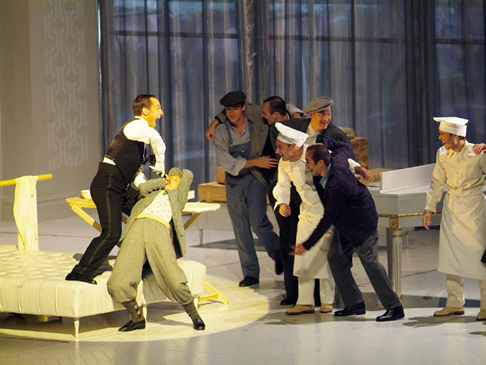 Kyle Ketelsen as Figaro (standing on the sofa) and Sophie Koch as Cherubino during “Non piu andrai”
Case in point, during a Susanna-Cherubino exchange in the first act, Figaro suddenly just walks off the platform to the darkened apron to “observe them” as an outsider. Just as abruptly, he re-joins the scene, in character. Huh? (This idea doesn’t recur.) During “Aprite un’po quegli occhi, “a silver (basket?-)ball descends on a wire, which our title character unhooks and tosses around and dribbles, albeit skillfully. Is it meant to be…a woman’s head? A planet of miniature cuckolds? A Harlem Globetrotters tryout? It was an entertaining distraction, but I am not sure it meant anything much to the story at hand.
Blocking was ill-considered in supporting the comic set-up and punch line. The Susanna-Marcellina Act I Bitch-Off was, well, just…bitched. Not a laugh to be gotten. Or even a loud smile. Stage pictures were often “all right,” but focus remained a problem throughout the night. When Susanna has her moment in the great Act III sextet of revealed parentage, she is sputtering her “sua madre’s/padre’s” completely blocked as she runs behind the other principals. Too, our director over-used a convention of dragging many solos to the furthest downstage point of the platform, changing the lighting to an isolated dramatic focus one-on-one with the audience, which almost rendered them concert arias. Ah well, happily — very happily — we had at our disposal a first rate cast.
Kyle Ketelsen is a world class Figaro, not only possessed of a healthy, burnished mellifluous bass instrument, even throughout his extensive range, but also gifted as one of the most inventive actors to be seen on an opera stage. His is a richly detailed, solidly acted, individualized impersonation. Ofelia Sala was almost his match as Susanna. Although her dramatic approach seemed more generalized, she displayed good stage savvy, game to try anything, and her well-schooled soprano had a hint more weight to it than many a Susanna. “Deh vieni” may have not had the pristine shimmer of a Kathy Battle, but it was compensated with substantially more thrust. Sidebar: why Mr. Ketelsen (as the title role) and Ms. Sala (who by far has the most stage time) are not getting the final bows is very odd. Those honors fell to…
Emma Bell, her securely sung Countess sleek and elegant of mien, really delivers the goods with sensitively controlled vocalism, meticulous phrasing, and, as needed, a generous fire in dramatic outbursts. Is it quibbling to want her to seem less self-absorbed by re-thinking some slightly-too-precious, cooing introspections? Judicious fine tuning might make the audience pity her more, if she pitied herself less. As the Count, Ludovic Tézier confirmed his growing reputation as today’s leading French baritone. He made good on that promise with a virile, buzzy tone, and solid stylistic command, although he did seem to tire slightly by opera’s end. “Contessa, perdona” was not the melting denouement it should have been, but blame for that moment can be shared with the poorly judged staging and conducting.
I quite liked Sofie Koch’s well-voiced, hard-working Cherubino with the caveat that her slightly covered tone made the lad sound a bit more mature than other, brighter voiced interpreters. A former Susanna, Marie McLaughlin has now graduated to Marcellina, singing it well without quite comfortably fitting the role’s more comic demands. Friedemann Röhlig had considerably more success with a rollicking account of Bartolo, securely sung with panache. Raúl Giménez was luxury casting as the best-sung Basilio I have experienced. Doing all that was required (if no more) as Barbarina and Antonio were Eliana Bayón and Valeriano Lanchas. The truly funny Don Curzio was exceptionally well performed by Roger Padullés.
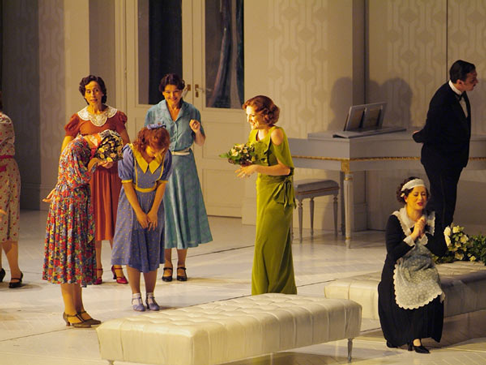 Emma Bell (center) as the Countess accepting flowers from the peasant girls and Susanna (Ofelia Sala, seated, as maid)
Last, and certainly least, the workaday conducting from Antoni Ros Marbà did little to serve this sparkling, crackling score. This usually fine orchestra sounded muted and uninspired from the git-go, with the cascading wind figures lacking incisive clarity. The horns had a bad first act but improved, while the keyboardist fat-fingered more than a few notes over the course of the recitatives. Worst, the rhythmic propulsion of the individual numbers was sometimes indefinite, resulting in a momentary disruption of coordination between stage and pit. Even at the leisurely pace of the duet “Aprite, presto, aprite,” our Susanna got ahead and there was a scary moment of Swedish until Cherubino got it back on track.
And so the evening went…sometimes too fast…sometimes too slow…sometimes slapstick…sometimes overly serious…always well sung…always nice to look at. “Figaro la, Figaro qua… “ All in all, it was a great pity that the stage director and conductor weren’t at the same high class party as the stellar cast and design team.
James Sohre