02 Dec 2008
Porgy through a glass lightly
It was, of course, coincidence. When the Chicago Lyric Opera scheduled George Gershwin’s Porgy and Bess for the current season, not even the preludes to the 2008 presidential election had begun.
English Touring Opera are delighted to announce a season of lyric monodramas to tour nationally from October to December. The season features music for solo singer and piano by Argento, Britten, Tippett and Shostakovich with a bold and inventive approach to making opera during social distancing.
This tenth of ten Live from London concerts was in fact a recorded live performance from California. It was no less enjoyable for that, and it was also uplifting to learn that this wasn’t in fact the ‘last’ LfL event that we will be able to enjoy, courtesy of VOCES8 and their fellow vocal ensembles (more below …).
Ever since Wigmore Hall announced their superb series of autumn concerts, all streamed live and available free of charge, I’d been looking forward to this song recital by Ian Bostridge and Imogen Cooper.
The Sixteen continues its exploration of Henry Purcell’s Welcome Songs for Charles II. As with Robert King’s pioneering Purcell series begun over thirty years ago for Hyperion, Harry Christophers is recording two Welcome Songs per disc.
Although Stile Antico’s programme article for their Live from London recital introduced their selection from the many treasures of the English Renaissance in the context of the theological debates and upheavals of the Tudor and Elizabethan years, their performance was more evocative of private chamber music than of public liturgy.
In February this year, Albanian soprano Ermonela Jaho made a highly lauded debut recital at Wigmore Hall - a concert which both celebrated Opera Rara’s 50th anniversary and honoured the career of the Italian soprano Rosina Storchio (1872-1945), the star of verismo who created the title roles in Leoncavallo’s La bohème and Zazà, Mascagni’s Lodoletta and Puccini’s Madama Butterfly.
Evidently, face masks don’t stifle appreciative “Bravo!”s. And, reducing audience numbers doesn’t lower the volume of such acclamations. For, the audience at Wigmore Hall gave soprano Elizabeth Llewellyn and pianist Simon Lepper a greatly deserved warm reception and hearty response following this lunchtime recital of late-Romantic song.
Collapsology. Or, perhaps we should use the French word ‘Collapsologie’ because this is a transdisciplinary idea pretty much advocated by a series of French theorists - and apparently, mostly French theorists. It in essence focuses on the imminent collapse of modern society and all its layers - a series of escalating crises on a global scale: environmental, economic, geopolitical, governmental; the list is extensive.
For this week’s Live from London vocal recital we moved from the home of VOCES8, St Anne and St Agnes in the City of London, to Kings Place, where The Sixteen - who have been associate artists at the venue for some time - presented a programme of music and words bound together by the theme of ‘reflection’.
'Such is your divine Disposation that both you excellently understand, and royally entertaine the Exercise of Musicke.’
Amongst an avalanche of new Mahler recordings appearing at the moment (Das Lied von der Erde seems to be the most favoured, with three) this 1991 Mahler Second from the 2nd Kassel MahlerFest is one of the more interesting releases.
‘And there was war in heaven: Michael and his angels fought against the dragon; and the dragon fought and his angels, And prevailed not; neither was their place found any more in heaven … that old serpent … Satan, which deceiveth the whole world: he was cast out into the earth, and his angels were cast out with him.’
If there is one myth, it seems believed by some people today, that probably needs shattering it is that post-war recordings or performances of Wagner operas were always of exceptional quality. This 1949 Hamburg Tristan und Isolde is one of those recordings - though quite who is to blame for its many problems takes quite some unearthing.
There was never any doubt that the fifth of the twelve Met Stars Live in Concert broadcasts was going to be a palpably intense and vivid event, as well as a musically stunning and theatrically enervating experience.
‘Love’ was the theme for this Live from London performance by Apollo5. Given the complexity and diversity of that human emotion, and Apollo5’s reputation for versatility and diverse repertoire, ranging from Renaissance choral music to jazz, from contemporary classical works to popular song, it was no surprise that their programme spanned 500 years and several musical styles.
The Academy of St Martin in the Fields have titled their autumn series of eight concerts - which are taking place at 5pm and 7.30pm on two Saturdays each month at their home venue in Trafalgar Square, and being filmed for streaming the following Thursday - ‘re:connect’.
The London Symphony Orchestra opened their Autumn 2020 season with a homage to Oliver Knussen, who died at the age of 66 in July 2018. The programme traced a national musical lineage through the twentieth century, from Britten to Knussen, on to Mark-Anthony Turnage, and entwining the LSO and Rattle too.
With the Live from London digital vocal festival entering the second half of the series, the festival’s host, VOCES8, returned to their home at St Annes and St Agnes in the City of London to present a sequence of ‘Choral Dances’ - vocal music inspired by dance, embracing diverse genres from the Renaissance madrigal to swing jazz.
Just a few unison string wriggles from the opening of Mozart’s overture to Le nozze di Figaro are enough to make any opera-lover perch on the edge of their seat, in excited anticipation of the drama in music to come, so there could be no other curtain-raiser for this Gala Concert at the Royal Opera House, the latest instalment from ‘their House’ to ‘our houses’.
"Before the ending of the day, creator of all things, we pray that, with your accustomed mercy, you may watch over us."
It was, of course, coincidence. When the Chicago Lyric Opera scheduled George Gershwin’s Porgy and Bess for the current season, not even the preludes to the 2008 presidential election had begun.
The company could not have known that “local boy” Barack Obama would be elected the first black president of the United States shortly before the premiere of its first-ever Porgy on November 18. Thus the two events obviously have nothing to do with each other; they do, however, underscore the degree to which the encounter with a well-established and well-known work of art is colored by such a coincidence.
It would be incorrect to suggest that the enthusiasm — indeed, the euphoria — with which masses of Americans reacted to Obama’s election carried over into the Lyric’s impressive Art Deco home on Wacker Drive. Yet a visitor to the city in the Porgy audience could but recall the exuberant scene across town at Grant Park on election night and ask whether Obama’s victory provides a new filter for the 1935 work.
Porgy, after all, has long been celebrated — if with occasional discomfort — as the great American opera. But does it still lay claim to that stature? To ask that question in no way overlooks the superior quality of the Lyric production that originated at Washington’s National Opera and went on to evoke acclaim in Los Angeles.
Director Francesca Zambello, who on occasion has trouble reigning in a hyper-active imagination, opted here for a straight-forward and down-to-earth approach to the opera, recreating — with the help designers Peter J. Davison and Paul Tazewell — a slice of the life of the Gullah blacks whose life — and music — composer George Gershwin and his creative team had studied closely on their visits to Charleston and its near-by islands.
The demand of the Gershwin estate that Porgy be staged with an all-black cast (except for police officers) remains in force, and the singers that the Lyric assembled documented the achievement of such vocalists in a world open to them for a mere half century. What was particularly impressive is that these are artists whose repertory extends far beyond Porgy. Baritone Gordon Hawkins, Porgy on November 21, sings Alberich in stagings of Wagner’s Ring around the world, and Lester Lynch (Crown) is a celebrated Count di Luna in Verdi’s Trovartore both here and in Europe. Morenike Fadayomi (Bess) lists Donna Elvira and Salome among signature roles, and Jonita Lattimore includes the Figaro Countess and Marguerite in Faust in her repertory. Marietta Simson (Maria), slowly becoming a senior among today’s black artists, is treasured for her work both in opera and oratorio. One could continue to list such credits of distinction for each member of the cast.
For the success of the production, much credit goes to John DeMain, who all but re-invented Porgy when he conducted the 1975 Houston Grand Opera production that staged the work complete for the first time with the sung recitative that Gershwin had intended. A stellar evening at the Lyric — beyond all doubt.
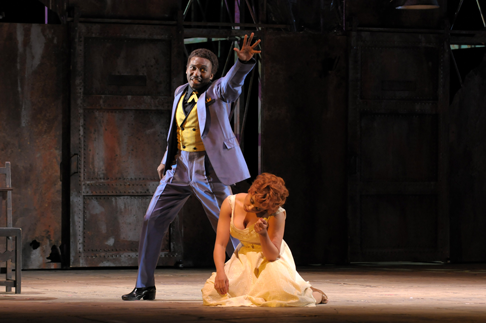 Jermaine Smith (Sportin' Life) and Morenike Fadayomi (Bess) in Porgy and Bess.
Why then did one — or at least some in the audience — feel that this production was more an impressive document than a thrilling experience of great opera? Does the election of Barack Obama as president suggest that Porgy, despite its wonderful “hit” tunes, is dated?
As mentioned above, there have always been reservations about the work. Early on, critic — and composer — Virgil Thomson wrote that “folk lore subjects recounted by an outsider are only valid as long as the folk in question is unable to speak for itself,” and Obama’s election proves definitely that that is no longer the case. Duke Ellington found that “the times are here to debunk Gershwin’s lampblack Negroisms,” and several members of the original cast later questioned whether their characters did not play into the stereotypic picture of African Americans as part of America’s huddled masses, living in poverty, taking drugs and settling disagreements with their fists.
An earlier filter on the opera was provided by the civil rights and black power movements that dominated the American scene after the 1950s. Upon a revival of the Porgy play in the ‘60s, for example, social critic and African American educator Harold Cruse called it “the most incongruous, contradictory cultural symbol ever created in the Western World.” And it evoked resistance among black artists.
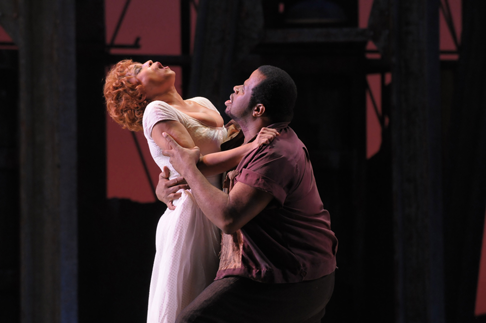 Morenike Fadayomi (Bess) tries to resist Lester Lynch's (Crown) advances in a scene from Porgy and Bess.
Harry Belafonte declined to play Porgy in the 1950s film (the role went to Sidney Poitier), and soprano Betty Allen, president of the Harlem School of the Arts, loathed the work. Grace Bumbry, Bess at the Met in 1985, later said:
I thought it beneath me; I felt I had worked far too hard, that we had come far too far to have to retrogress to 1935. My way of dealing with it was to see that it was really a piece of Americana, of American history, whether we liked it or not. Whether I sing it or not, it was still going to be there.
These are comments that come to mind on the heels of the Chicago Porgy and they have a certain valid resonance when the work is watched over Barack Obama’s shoulder. Underlying this feeling is the coincidence that the Lyric paired Porgy with Alban Berg’s Lulu at the mid-point of its 2008-2009 season.
For Lulu, an absolute among the femmes fatales of opera, was completed in fragmentary form in 1937, only two years after Porgy. Yet — and despite its roots in the hot-house fin-de-siècle sin-soaked soil of Freud’s Vienna, the work — in Paul Curran’s superlative production — is of overwhelming contemporary relevance and appeal.
This is not to suggest that Porgy and Bess should be shelved. In an erudite note in the Chicago program Naomi André sums things up:
The most disheartening part of the opera is the hopelessness of the characters’ fates. It is distressing to see the drinking, gambling, murder and sexual assault that take place. Even more devastating is that the characters we cheer for end up dead or broken by the end. And we know that Porgy — a poor crippled black man, will never make it to New York. Although the residents of Catfish Row sing about the “Heav’nly Lan’ of promise and opportunity, we know they will most likely not see it in their lifetimes.
That’s where Barack Obama enters in. One likes to think that a young black of today, already established in the drug trade, might have seen the Grant Park demonstration and thought:
“Hey, there is another way; there is hope.
I’m on my way.”
Wes Blomster