Subscribe to
Opera Today

Receive articles and news via RSS feeds or email subscription.


twitter_logo[1].gif


9780521746472.png

Recently in Reviews

James Melton: The Tenor of His Times

Those of us of a certain age have fond memories of James Melton, who entertained our parents starting in the 1930s and the rest of us in the 1940s and beyond on recordings, the radio, and films.

The Importance of Being Earnest, Covent Garden

The Importance of Being Earnest , Gerald Barry’s fifth opera, was commissioned by the Los Angeles Philharmonic Orchestra and the Barbican, and was first performed in concert, Thomas Adès conducting the London premiere.

Death in Venice by ENO

‘Beauty is the one form of spirituality that we experience through the senses.’ In Thomas Mann’s, Death in Venice, Plato’s axiom stirs the hopes of the aging, intellectually stale poet, Gustav von Aschenbach, that he may rekindle his creativity.

Adding Movie Magic to The Magic Flute

What better way for Masonic brothers, Wolfgang Amadeus Mozart and Emmanuel Shikaneder to disseminate Masonic virtues, than through the most popular musical entertainment of their age, a happy ending folktale that features a dragon, enchanting flutes and bells, mixed-up parentage, and a beautiful young princess in distress?

Madama Butterfly, Opera Holland Park

There is a sense in which it all began in London, Puccini having been seized in 1900 with the idea of an opera on this subject after watching David Belasco’s play here.

An Evening of Zarzuela and Latin American Music at Los Angeles Opera

The tenor that the audience most wanted to hear, Plácido Domingo, opened the vocal program with “Junto al puente de la peña” (Next to the rock bridge) from La Canción del Olvido (The song of Oblivion) by José Serrano. He sounded rested and his voice soared majestically over the orchestra.

Così fan tutte in San Francisco

Tucked away somewhere in the San Francisco Opera warehouse was an old John Cox production of Così fan tutte from Monte Carlo. Well, not that old by current standards at San Francisco Opera.

Rossini Maometto Secondo Garsington Opera at Wormsley

Rossini's Maometto Secondo is a major coup for Garsington Opera at Wormsley, confirming its status as the leading specialist Rossini house in Britain. Maometto Secondo is a masterpiece, yet rarely performed because it's formidably difficult to sing. It's a saga with some of the most intense music Rossini ever wrote, expressing a drama so powerful that one can understand why early audiences needed "happy endings" to water down its impact

Peter Grimes in Concert

I suppose it was inevitable that, in this Britten Centenary year, the 66th Aldeburgh Festival would open with Peter Grimes.

Die Entführung aus dem Serail, Garsington Opera at Wormsley

Die Entführung aus dem Serail at Garsington Opera at Wormsley isn’t Mozart as you’d expect but it’s true to the spirit of Mozart who loved witty, madcap japes.

Le nozze di Figaro, Glyndebourne

What a pity! On a glorious — well, by recent English standards — summer’s day, there can be few more beautiful English countryside settings than Glyndebourne, with the added bonus, as alas much of the audience appears to understand it, of an opera house attached.

Queens, Heroines and Ladykillers

Described by one critic as “cosmically gifted”, during her tragically short career, American mezzo-soprano Lorraine Hunt Lieberson amazed and delighted audiences with the spellbinding beauty of her singing and the astonishing honesty of her performances.

L’Incoronazione di Poppea from Virgin Classics

Since its first performance at the Teatro Santi Giovanni e Paolo during Venice’s 1643 Carnevale, Monteverdi’s L’Incoronazione di Poppea has been one of the most important milestones in the genesis of modern opera despite its 250 years of unmerited obscurity. 

Alzira by Chelsea Opera Group

“I wrote it almost without noticing.” So Verdi declared when reminded of his eighth — and perhaps least frequently performed, opera, Alzira. One might say that, since he composed the work, no-one else has much noticed either.

Les Contes d’Hoffmann in San Francisco

Just when you thought the protagonist was Hoffmann! Who, rather what stole the show?

La Tosca in Los Angeles

When is verismo verily veristic? Or what is a virginal girl dressed in communion white doing in the two murderous acts of the Los Angeles Opera’s current production of Tosca? And why does she sing the shepherd's song?

Saverio Mercadante: I due Figaro

Though 2013 is the bicentennial of the births of Giuseppe Verdi and Richard Wagner, the releases of Cecilia Bartoli’s recording of Bellini’s Norma on DECCA, a new studio recording of Donizetti’s Caterina Cornaro from Opera Rara, and this première recording of Saverio Mercadante’s forgotten I due Figaro, suggest that this is the start of a summer of bel canto.

Lohengrin, Welsh National Opera

Wagner’s Lohengrin is not an unfamiliar visitor to the UK thanks, in the main, to Elijah Moshinsky’s perennial production at Covent Garden.

Philip Glass: The Perfect American

Philip Glass's The Perfect American at the ENO in London is a visual treat, but the libretto is mind-numbingly anodyne.

Christian Thielemann’s Der Ring des Nibelungen

Recording Richard Wagner’s Der Ring des Nibelungen is for a record label equivalent to a climber reaching the summit of Mount Everest: it is the zenith from which a label surveys its position among its rivals and appreciates an achievement that can define its reputation for a generation. 

OPERA TODAY ARCHIVES »

Reviews

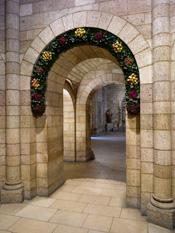
Decorated archway, The Cloisters Museum and Gardens, New York.
23 Dec 2008

The Play of Daniel — A Medieval Music Drama from Beauvais

Can we call The Play of Daniel an opera, or “music drama” (as this performance put it), when such terms did not exist, and would not exist for centuries to come when the piece was devised, around 1200, by the cathedral chapter of Beauvais?

The Play of Daniel— A Medieval Music Drama from Beauvais

Daniel: James Ruff; King Balthasar/Abacuc: Peter Walker; King Darius: José Lemos; Queen/Abacuc’s Angel: Sarah Pillow. Staged by Drew Minter. Mary Anne Ballard, music director. Presented by the Cloisters Museum concert series. Performance of December 21.

Above: Decorated archway, The Cloisters Museum and Gardens, New York.


No professional theater culture existed at the time and we do not know what conception the medieval era had of theater, though we can be pretty sure solemn dramas had a religious basis (as they do in every indigenous theater culture) and that music was involved somehow (ditto).

The Play of Daniel, however it was presented in the reign of Philip Augustus (the surviving manuscript does not apportion voices or instruments, much less stage directions), was an early landmark in the work of Noah Greenberg’s New York Pro Musica Antiqua, one of the earliest organizations to delve into early music and perform it with something like scholarly fidelity but also modern theatricality. Their Daniel had its premiere at the Cloisters in 1958, and was later filmed for television. That televised version, shown each year at Christmastime, was a joy of my childhood, when the Cloisters represented, for me, something of a dream palace. The staging, which based costume, movement, attitude, and primitive but graceful special effects on medieval illustration, was also magical – and besides, it was my first exposure to Early Music. The annual showing ended, alas, around 1969, when Channel 13 began to broadcast in color and assumed no one would want to watch a black and white film (they were so wrong!), and that film evidently survives only in a damaged kinescope – it’s not even on Youtube.

The Early Music revival has been one of the triumphs of recent times (its history is a grand book idea, if some author out there is looking for one). Today there are dozens of groups of every size touring the world with once-forgotten repertory and style, and Early Music concerts sell out from Moscow to Seattle. Once obliged to depend on academic day jobs, musicians can now make careers performing the work of once-forgotten eras. Yet the sophistication, the musicality, the wit of Greenberg’s troupe have seldom been surpassed.

Accordingly, to mark the fiftieth anniversary of that first staging, the Gotham Early Music Series (GEMS) has given four performances of Daniel as part of a series of concerts presented through the year by the Cloisters Museum in the intimate acoustic of its Fuentidueña Chapel. No less illustrious a figure than Russell Oberlin, a founder of the modern countertenor tradition and a star of the 1958 production, sat, silver-haired and regal, right in front of me, and prefaced the show with some enthusiastic words about the treat in store for us. Another great countertenor of the recent past, Drew Minter, was the stage director, and hewed to the faux-naïve medieval look, in movement, attitude, costume, image, proper to the piece.

I loved the way the chorus, singing the explanatory introduction as they marched in procession down the aisle, gravely performed simple, book-of-hours-style dances, and the nasal whine of the king’s groveling counselors, and the flashy lions set to devour Daniel who, at a touch from the Angel, began to mew and fawn to be petted instead. I have no idea how the Writing on the Wall was done in 1958, but just projecting it up there did not have the magical effect of a bodyless hand actually writing that I recall from the film. (Alex Ross, in The New Yorker, is also nostalgic for that moment. How many people did that film introduce to Early Music?) The small playing space no doubt forced many compromises on the company – in the film, of course, the entire huge building could be used, and was – I remember King Balthazar fleeing from assassins, who caught and strangled him on the terrace, and the ominous invasion of what seemed a vast Persian army, and there seemed, in my recollection, more room for dance. Today, those who attend the Cloisters’ concert series must content themselves with an hour or two imbibing atmosphere from the museum’s impressive collection of objects and architectural elements, a fine way to wind up to or down after a concert.

Perhaps the greatest departure in this revival from the original was to eliminate the brief explanatory verses by W.H. Auden (no less), recited by a monkish compère figure (Alvin Epstein back then – who is still around, and recently played King Lear downtown), which kept us abreast of the story, scene by scene, in the happy days before surtitles. Minter saw no reason for surtitles – and he was right, although Daniel’s is, in a sense, the first story about surtitles, the Writing on the Wall. But the story is simple and pretty well known (I have seen Minter himself sing the title role in Handel’s oratorio Belshazzar). But I missed the breathing space between numbers that the verses provided, and the slower pace of the singing, and there were attendees around me who studied the libretto rather than watching the clear, simple action in front of them. Like the medieval artists whose handiwork was all around us, the creators of Daniel, both the ancient and the modern ones, did everything they could to make the story and its lessons clear; a child of six would have had no trouble following the action, but some adults evidently did.

All you need, really, is a bunch of singers trained to the demands of medieval a cappella style but able as well (as church singers need not be) to move well and to act. James Ruff made a stiff Daniel, but sang with a fine vibrato-free baritone. Much more fun was had by Peter Walker as doomed King Balthazar (sic, in this version) and, later, a reluctant prophet Abacuc (Habakkuk), dragged in by his ear to foretell a messiah, by José Lemos, a splendid alto countertenor, as the triumphant Darius, by the three whiny counselors and the two prancing lions. It was no surprise to see the names of two dozen well-known early music groups mentioned in the musicians’ biographies. Psaltery, rebec, shawms – the simple orchestration contained the usual suspects, except for the intrusion, during the concluding Te Deum, of modern toned chimes. The processions of singers in and out of the chapel and off into the echoing distance made wise use of the building and added medieval atmosphere to the occasion.

I hope Daniel becomes, once more, a seasonal tradition. It will undoubtedly draw new children of all ages to this marvelous repertory, and, at 53 minutes, it’s a lot shorter than Handel’s Messiah.

John Yohalem
Send to a friend

Send a link to this article to a friend with an optional message.

Friend's Email Address: (required)

Your Email Address: (required)

Message (optional):