26 Jan 2009
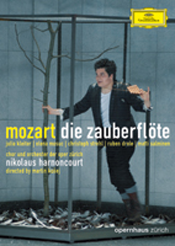
Die Zauberflöte from Opernhaus Zürich
A traditional production of Mozart and Schikaneder's singspiel Die Zauberflöte can go for charm, fantasy, and enjoyable camp. It can also turn trite and cloying.
English Touring Opera are delighted to announce a season of lyric monodramas to tour nationally from October to December. The season features music for solo singer and piano by Argento, Britten, Tippett and Shostakovich with a bold and inventive approach to making opera during social distancing.
This tenth of ten Live from London concerts was in fact a recorded live performance from California. It was no less enjoyable for that, and it was also uplifting to learn that this wasn’t in fact the ‘last’ LfL event that we will be able to enjoy, courtesy of VOCES8 and their fellow vocal ensembles (more below …).
Ever since Wigmore Hall announced their superb series of autumn concerts, all streamed live and available free of charge, I’d been looking forward to this song recital by Ian Bostridge and Imogen Cooper.
The Sixteen continues its exploration of Henry Purcell’s Welcome Songs for Charles II. As with Robert King’s pioneering Purcell series begun over thirty years ago for Hyperion, Harry Christophers is recording two Welcome Songs per disc.
Although Stile Antico’s programme article for their Live from London recital introduced their selection from the many treasures of the English Renaissance in the context of the theological debates and upheavals of the Tudor and Elizabethan years, their performance was more evocative of private chamber music than of public liturgy.
In February this year, Albanian soprano Ermonela Jaho made a highly lauded debut recital at Wigmore Hall - a concert which both celebrated Opera Rara’s 50th anniversary and honoured the career of the Italian soprano Rosina Storchio (1872-1945), the star of verismo who created the title roles in Leoncavallo’s La bohème and Zazà, Mascagni’s Lodoletta and Puccini’s Madama Butterfly.
Evidently, face masks don’t stifle appreciative “Bravo!”s. And, reducing audience numbers doesn’t lower the volume of such acclamations. For, the audience at Wigmore Hall gave soprano Elizabeth Llewellyn and pianist Simon Lepper a greatly deserved warm reception and hearty response following this lunchtime recital of late-Romantic song.
Collapsology. Or, perhaps we should use the French word ‘Collapsologie’ because this is a transdisciplinary idea pretty much advocated by a series of French theorists - and apparently, mostly French theorists. It in essence focuses on the imminent collapse of modern society and all its layers - a series of escalating crises on a global scale: environmental, economic, geopolitical, governmental; the list is extensive.
For this week’s Live from London vocal recital we moved from the home of VOCES8, St Anne and St Agnes in the City of London, to Kings Place, where The Sixteen - who have been associate artists at the venue for some time - presented a programme of music and words bound together by the theme of ‘reflection’.
'Such is your divine Disposation that both you excellently understand, and royally entertaine the Exercise of Musicke.’
Amongst an avalanche of new Mahler recordings appearing at the moment (Das Lied von der Erde seems to be the most favoured, with three) this 1991 Mahler Second from the 2nd Kassel MahlerFest is one of the more interesting releases.
‘And there was war in heaven: Michael and his angels fought against the dragon; and the dragon fought and his angels, And prevailed not; neither was their place found any more in heaven … that old serpent … Satan, which deceiveth the whole world: he was cast out into the earth, and his angels were cast out with him.’
If there is one myth, it seems believed by some people today, that probably needs shattering it is that post-war recordings or performances of Wagner operas were always of exceptional quality. This 1949 Hamburg Tristan und Isolde is one of those recordings - though quite who is to blame for its many problems takes quite some unearthing.
There was never any doubt that the fifth of the twelve Met Stars Live in Concert broadcasts was going to be a palpably intense and vivid event, as well as a musically stunning and theatrically enervating experience.
‘Love’ was the theme for this Live from London performance by Apollo5. Given the complexity and diversity of that human emotion, and Apollo5’s reputation for versatility and diverse repertoire, ranging from Renaissance choral music to jazz, from contemporary classical works to popular song, it was no surprise that their programme spanned 500 years and several musical styles.
The Academy of St Martin in the Fields have titled their autumn series of eight concerts - which are taking place at 5pm and 7.30pm on two Saturdays each month at their home venue in Trafalgar Square, and being filmed for streaming the following Thursday - ‘re:connect’.
The London Symphony Orchestra opened their Autumn 2020 season with a homage to Oliver Knussen, who died at the age of 66 in July 2018. The programme traced a national musical lineage through the twentieth century, from Britten to Knussen, on to Mark-Anthony Turnage, and entwining the LSO and Rattle too.
With the Live from London digital vocal festival entering the second half of the series, the festival’s host, VOCES8, returned to their home at St Annes and St Agnes in the City of London to present a sequence of ‘Choral Dances’ - vocal music inspired by dance, embracing diverse genres from the Renaissance madrigal to swing jazz.
Just a few unison string wriggles from the opening of Mozart’s overture to Le nozze di Figaro are enough to make any opera-lover perch on the edge of their seat, in excited anticipation of the drama in music to come, so there could be no other curtain-raiser for this Gala Concert at the Royal Opera House, the latest instalment from ‘their House’ to ‘our houses’.
"Before the ending of the day, creator of all things, we pray that, with your accustomed mercy, you may watch over us."
A traditional production of Mozart and Schikaneder's singspiel Die Zauberflöte can go for charm, fantasy, and enjoyable camp. It can also turn trite and cloying.
A strong non-traditional production should stay true to the spirit of the work, essentially a Mason-influenced entertainment, while refreshing the audience with new perspectives. Unfortunately, Martin Kušej’s 2007 staging for Zürich, with sets by Rolf Glittenberg, represents the worst excesses of so-called “regietheater” (director’s theater). The modern-dress updating and sterile sets (like the lobby of some corporate headquarters) begin to suggest fairly early in the recording that Kušej not only disrespects the work but wants the audience to dislike it as well. Only one character/performer manages to escape the cold and clinical approach of the director to connect to the audience, the irrepressible Papageno, in a star-making turn by Ruben Drole.
Of course, Kušej has pockets-full of ideas to throw around. Tamino and Pamina are a married couple, standing stock still before a white screen during the overture, and then suddenly snatched away and carried off separately as they are about to kiss. Not until the end of the opera does Kušej manage to return to this concept, with a filmed sequence of the couple in a Mercedes, possibly driving off to a honeymoon, when they realize they are submerged in water and have to fight to escape. A statement about the confinement of conventional marriage? Perhaps. But to be welcomed after their rescue by Sarastro, hardly the model for connubial bliss, makes no sense.
In between come various twists on a traditional production. Instead of one goofy looking giant snake chasing Tamino, both he and the chorus writhe on the ground, wrestling with a mass of slimy black reptiles. The gray-paneled walls slide back and forth, creating new spaces that always look the same as the previous one, with more door-slamming than in a bedroom farce. At one point the Queen of the Night enters from inside a refrigerator and leaves the same way. Papageno himself makes his first appearance inside an oversize birdcage. See? Get it? Why, you’re almost as clever as Kušej.
A decent cast gives themselves over to the director’s concept, but what that means for almost all of them is a repression of personality and individual style, which makes for dull singing. Christoph Strehl has sung many a Tamino in recent years. Heard here, his dry voice matches all too well the aridity of the concept. Julia Kleiter’s Pamina doesn’t seem to interest Kušej at all, and her scenes are flatly staged. For Monostatos, Kušej decided to go with the original libretto’s dictates of blackface, surely to make his own point about the work’s proclaimed spirituality. Rudolf Schasching is suitably grotesque in the role. The great Matti Salminen as Sarastro sends Monostatos into exile with a knee to the groin. Sarastro can be, possibly should be, a troubling character, hypocritically condemning “hypocrisy,” but the director’s underlining is not helpful. Elena Mosuc hits all the notes as the Queen of the Night, but she is never especially scary or intimidating. More imposing is the physique of the Speaker, Gabriel Bermúdez, whom Kušej presents shirtless, at a basin washing his underarms. For some reason your reviewer suspects Kušej spent a lot of time at rehearsal here, along with an extended scene of Tamino and Papageno in their underwear.
So lively and energetic is the Papageno of Ruben Drole that he seems to have popped in from another production. Perhaps all of Kušej’s sympathies go to the lower-classes - in one fairly interesting twist, it is a crowd of tired, filthy laborers who appear instead of wild animals in response to the flute. But Drole just seems to be an immensely appealing performer, with a charming manner and a most handsome voice. He is well-matched by the buxom Papagena of Eva Liebau.
In the pit Nikolaus Harnoncourt leads the Zürich Opera forces with his trademark enthusiasms for rhythmic angularity and string playing that decidedly stays away from smoothness or conventional tonal beauty. The result veers from fresh and invigorating to scratchy and irritating.
Deutsche Grammophon includes a 45-minute “Behind the Scenes” bonus feature, which pushes the set to two discs. This feature serves as evidence that Europe has also given itself over to TV hosts of creepy jocularity filmed by manic hand-held camera operators.
In the end, this may well be the Zauberflöte DVD for those who don’t really want a Zauberflöte DVD. Talk about precision marketing.
Chris Mullins